Thailand and Cambodia fighting at the border in 2025
Overview
The long-standing territorial dispute between Cambodia and Thailand escalated into direct armed conflict on 24 July 2025 along their shared border. Tensions surged a day earlier when a Thai soldier was seriously injured after stepping on a PMN-2 anti-personnel landmine in Thailand’s Ubon Ratchathani province, which acted as the immediate trigger for wider hostilities. On 24 July, clashes erupted across multiple border sectors. Thai media reported that Cambodian BM-21 multiple rocket launchers struck Thai residential areas, a hospital, and a gas station, prompting full-scale fighting. Both sides claimed self-defense and blamed the other for starting the conflict.
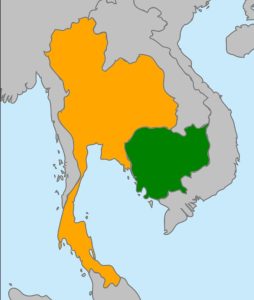
The violence displaced over 200,000 civilians in northeastern Thailand and northern Cambodia. In response, the Royal Thai Air Force (RTAF) deployed F-16 fighter jets to strike Cambodian military positions, marking its first combat operations since the Thai–Laotian Border War. The escalation drew concern from ASEAN, the United Nations, the United States, and Malaysia, all urging restraint and mediation.
Although both governments agreed to an unconditional ceasefire on 28 July 2025, tensions resurfaced in December 2025. Fighting resumed on 7 December with a brief skirmish, followed by renewed Thai ground operations and F-16 airstrikes, including near the Preah Vihear temple, and the launch of Operation Sattawat on 10 December. U.S. President Donald Trump called on both sides to uphold the Kuala Lumpur Peace Accord.
Background
The enduring sovereignty dispute between Cambodia and Thailand stems from ambiguous boundaries drawn during the 1904–1907 colonial era between the Kingdom of Siam and French Indochina. These historical inaccuracies created overlapping claims that center on the strategic highland passes of the frontier.
Following Cambodia’s 1953 independence, the Preah Vihear temple became the flashpoint of national identity. While the International Court of Justice (ICJ) awarded the temple to Cambodia in 1962, the ruling failed to clearly define the surrounding 4.6 square kilometers of scrubland. This legal “gray zone” left the adjacent cliffs and approaches in a state of military uncertainty.
Tensions escalated into lethal military clashes between 2008 and 2011, characterized by heavy artillery exchanges and patrol skirmishes. These conflicts resulted in multiple fatalities and the displacement of thousands of local villagers, highlighting the high human cost of the territorial stalemate.
Although the ICJ reaffirmed Cambodian sovereignty in 2013, the lack of a mutually agreed-upon demarcation continues to fuel instability. Analysts argue the conflict is deeply intertwined with domestic politics and nationalist sentiment, ensuring this historic site remains a volatile diplomatic flashpoint in Southeast Asia. Ultimately, the struggle reflects a broader challenge: reconciling century-old colonial maps with the modern realities of national sovereignty and strategic highland defense.
Prelude
In early 2025, the border dispute reignited at Prasat Ta Muen Thom. Tensions flared on February 13 when Thai soldiers prevented Cambodian tourists from singing their national anthem at the site. This friction escalated into a deadly exchange of fire on May 28, resulting in the death of one Cambodian soldier and the subsequent closure of border checkpoints.
In response, Cambodian Prime Minister Hun Manet sought an International Court of Justice (ICJ) ruling to prevent further military conflict. Following high-level military discussions on May 29, Thai Defense Minister Phumtham Wechayachai stated that both nations aimed to avoid escalation and considered the immediate incident resolved.
Emerald Triangle skirmish
A brief but deadly ten-minute exchange of fire broke out on May 28 in the Emerald Triangle, a sensitive frontier zone where Cambodia’s Preah Vihear province meets Thailand’s Ubon Ratchathani. The skirmish resulted in the tragic death of Cambodian Second Lieutenant Suon Roun, further straining diplomatic ties.
Both nations have traded accusations regarding who initiated the violence. Cambodian military spokesperson Mao Phalla alleged that Thai forces opened fire without provocation on soldiers positioned in an established trench. In contrast, Thai spokesperson Winthai Suvaree maintained that Thai troops were attempting to negotiate a peaceful withdrawal of Cambodian personnel when the Cambodian side fired first.
Attempts to de-escalate and continued tensions
On June 15, 2025, Thai Prime Minister Paetongtarn Shinawatra held an unscripted call with Cambodian Senate President Hun Sen. Three days later, Hun Sen unexpectedly released the recording, triggering a 4.17% drop in the Thai stock market.
The fallout intensified as the Bhumjaithai Party withdrew from the ruling coalition, plunging the cabinet into a majority-losing crisis. The leak revealed Paetongtarn labeling the Thai military—specifically Lieutenant General Boonsin Padklang—as an “opposing side.” This diplomatic breach has fundamentally destabilized Thai governance and heightened tensions between the administration and the armed forces.
Border crossing closures
By June 2025, Thai PM Paetongtarn Shinawatra transferred border authority to the Royal Thai Army (RTA). On June 21, the Chong Sai Taku crossing closed, prompting Cambodian PM Hun Manet to retaliate by shutting the Ban Chup Koki and Choam checkpoints.
On June 23, Thailand enforced stricter controls across all seven border provinces and tightened flight scrutiny to Siem Reap, citing UN reports on transnational crime. By that evening, the army shuttered all remaining crossings—including Sa Kaeo and Surin—to dismantle human trafficking and scam syndicates, allowing only limited humanitarian or essential trade.
Landmine incident
The long-standing border tension reached a breaking point in July 2025 following a series of devastating landmine incidents. On July 16, three Royal Thai Army (RTA) soldiers were injured in the Emerald Triangle by what was identified as newly laid Russian PMN-2 mines. Among the casualties, Private Thanapat Huaiwan suffered a left leg amputation. While Thailand prepared to report Cambodia to the United Nations for violating the Ottawa Treaty, Cambodian Mine Action Center representative Heng Ratana countered that Thai forces may have planted the mines themselves—an allegation the RTA dismissed as propaganda.
The crisis intensified on July 23 when a second mine blast in Ubon Ratchathani’s Nam Yuen district injured five more Thai personnel. Master Sergeant First Class Phichitchai Boonchola lost his right leg in the explosion, prompting the RTA to condemn the “inhumane act” and place border forces on combat readiness. In a swift strategic move, the military indefinitely shuttered four border checkpoints and the historic Prasat Ta Muen Thom and Prasat Ta Khwai temples.
By the evening of July 23, the conflict shifted from the frontier to the diplomatic stage. Thailand officially downgraded diplomatic ties, recalling its ambassador from Phnom Penh and expelling the Cambodian envoy from Bangkok. This dramatic severance—the first in over a decade—reflects a total collapse in regional relations as both nations prepare for potential military escalation over contested sovereignty.
July clashes
24 July
The Thailand-Cambodia border conflict shifted into a high-intensity military crisis on July 24, 2025. Early morning skirmishes erupted near Prasat Ta Muen Thom after Thai forces detected Cambodian UAVs and intercepted six armed soldiers. While Cambodia claimed self-defense against a Thai incursion, the situation rapidly spiraled.
By mid-morning, Cambodia launched BM-21 rockets into residential zones, striking a gas station in Sisaket—killing eight, including an 8-year-old—and damaging Phnom Dongrak hospital. In a major retaliation at 10:58 a.m., six Thai F-16s bombed Cambodian command posts at Chong An Ma.
In the afternoon, General Phana Khlaeoplotthuk initiated Operation Yuttha Bodin, a massive air-land offensive. Despite Thai claims of destroying two Cambodian tanks, Cambodian forces reportedly occupied Prasat Ta Khwai, the Emerald Triangle, and Ta Muen Thom.
With 5,000 civilians evacuated from Oddar Meanchey and Senate President Hun Sen commanding via video link, the day ended with closed borders and a region on the brink of total war.
25 July
On 25 July, fighting intensified as Thai forces significantly expanded air operations, deploying fighter aircraft to strike Cambodian military positions along multiple sectors of the border. The escalation led to widespread civilian displacement, damage to homes and public infrastructure, and growing humanitarian concerns in nearby border communities.
26 July
On 26 July 2025, the Royal Thai Navy stated that Cambodian forces initiated a renewed offensive near Ban Chamrak in Trat province, striking three border positions. Fighting was reported in Chanthaburi and Trat from 5:10 a.m. Thai artillery fire targeting areas inside Cambodia, including Ekphap Village, Thmar Da Commune, and Veal Veng District, reportedly wounded three civilians, prompting Cambodia to denounce the strikes as attacks on non-combatants.
In response, Thai forces launched Operation Trat Phikhat Phairi 1, claiming to have halted the advance within thirty minutes. Artillery shells also landed in Laos, causing damage, though responsibility remained disputed. Thai troops later recaptured Phu Makeua, while a senior Cambodian divisional commander was killed. Naval and air units were subsequently deployed as fighting expanded across the border.
27 July
On 27 July 2025, Cambodia accused the Royal Thai Army of continued shelling of civilian, religious, and cultural sites, including Preah Vihear, despite high-level calls involving Phumtham, Hun Manet, and U.S. President Donald Trump. Fighting intensified at Prasat Ta Khwai, Phanom Dong Rak, and Prasat Ta Muen Thom, with BM-21 rocket fire reported. Thailand returned 12 Cambodian soldiers’ remains, conducted F-16 airstrikes, destroyed a PHL-03 system, and both sides claimed control of multiple strategic sites.
First ceasefire
28 July
On 28 July 2025, ahead of ceasefire talks in Malaysia, Cambodia reported intensified Thai attacks across eight border sectors, accusing Thailand of disinformation. Clashes began around 3 a.m. in Surin, later declared a disaster area. Cambodia alleged Thai chemical weapon use, which Thailand denied; the claim was debunked as misattributed wildfire imagery. Heavy fighting continued near Prasat Ta Khwai and Chong Ahn Ma, with reports of Hun Sen’s Bodyguard Headquarters engaging in combat.
29–30 July
On 29 July 2025, the Royal Thai Army accused Cambodia of violating the ceasefire and released images of 18 captured Cambodian POWs, stating they were treated in accordance with international humanitarian law and the Geneva Conventions. Thailand later reported renewed Cambodian attacks near Chong Ahn Ma and Phu Makhuea.
On 30 July, a Cambodian commander told foreign diplomats that Thai forces abducted 20 Cambodian soldiers during post-ceasefire handshakes, alleging two deaths and one escape. Cambodia denied ceasefire violations and facilitated diplomatic visits to the An Seh border area. The Royal Thai Navy reported sporadic Cambodian fire near Preah Vihear, Phu Makhuea, and Pha Mor E Dang. Footage later showed Cambodian troops occupying Prasat Ta Khwai. Thailand revised earlier claims, stating it controlled nearby Hill 350, citing minefields and communication errors. The footage also showed Cambodian possession of PMN-2 landmines, violating the Ottawa Treaty.
1–5 August
On 1 August 2025, Thailand released two Cambodian POWs—Second Lieutenant Ang Oeung and Master Sergeant Mom Vuthy—prompting Cambodia to demand the release of all detained soldiers. One reportedly had a broken arm and the other signs of PTSD; Thailand said both were released for medical reasons and in line with the Third Geneva Convention, though reports said they were required to pledge not to fight again. On 2 August, Thailand imposed a nationwide drone ban amid spying concerns. On 3 August, Cambodia warned of a possible Thai offensive after civilian evacuations in Surin, which Thailand denied. A drone crash was later identified as Thai. On 4 August, Thailand accused Cambodia of mishandling bodies, while Cambodia alleged Thai troops violated sovereignty in An Ses. On 5 August, the RTA invited the ICRC to inspect 18 Cambodian POWs, citing transparency and humanitarian compliance.
6–27 August
Between 6 and 27 August 2025, tensions persisted despite the ceasefire. On 6 August, Acting Prime Minister Phumtham announced Thailand’s intent to seek war reparations from Cambodia outside the ICC, which Cambodia rejected, asserting self-defense. On 9 August, three Thai soldiers were injured by a landmine in Sisaket. On 10 August, Thai commander Boonsin claimed Cambodia suffered 3,000 casualties, accused it of using drones to target hospitals, and asserted Thai control over Prasat Ta Khwai. The same day, an RTN soldier died in a weapons accident.
Cambodia condemned Boonsin’s remarks on 11 August, calling them ceasefire violations. Civilians returned to Thai border areas on 12 August, though another Thai soldier was injured by a landmine. Cambodia later accused Thai paramilitary forces of ceasefire violations in Banteay Meanchey, while Thailand claimed to recover evidence of Cambodian landmine use. Thailand acknowledged using white phosphorus, stating it complied with international law.
On 20–21 August, Thailand rejected additional observers, while Cambodia demanded the release of 18 POWs. Further incidents included a Thai soldier’s death on 23 August, LRAD use during a wire dispute on 25 August, and a landmine blast on 27 August injuring three Thai soldiers. Cambodia reiterated to the UN that it had not laid new mines and remained committed to restraint.
29 August—7 September
On 29 August 2025, the Royal Thai Army declared martial law in Ban Nong Chan, Sa Kaeo, following civilian protest incidents, imposing restrictions on weapons, filming, and loudspeakers. The same day, Thailand’s Constitutional Court removed Prime Minister Paetongtarn over an unethical phone call with Hun Sen. On 2 September, Cambodia confirmed Major General Srey Duk was alive. On 4 September, an RTA eviction attempt in Banteay Meanchey led to clashes with villagers, drawing Cambodian military protection and calls to resolve disputes via GBC/JBC mechanisms. On 7 September, Hun Manet congratulated Anutin Charnvirakul on becoming Thai prime minister and expressed hopes to normalize bilateral relations.
17–27 September
On 17 September 2025, the Royal Thai Army reported that around 200 Cambodian civilian protesters removed Thai-installed barbed wire near Sa Kaeo–Banteay Meanchey, some allegedly armed with sticks and slingshots. After negotiations, Thai forces deployed riot police, tear gas, and rubber bullets, injuring some Thai soldiers. Cambodia condemned what it described as a Thai cross-border incursion into Prey Chan Village, alleging Thai border police and paratroopers injured 24–30 civilians, including monks, while Cambodian forces did not retaliate. A Malaysian-led Interim Observer Team inspected the site. Both sides accused each other of ceasefire violations.
10–14 October
On 10 October 2025, Cambodia condemned reported Thai military movements near Prey Chan village, citing violations of the ceasefire, GBC/RBC agreements, the 2000 MOU, and international law. That night, Thai forces allegedly used extremely loud speakers with disturbing sounds against residents of Prey Chan and Chouk Chey. Thailand simultaneously began mine-clearance operations at Ban Nong Chan and Ban Nong Ya Kaew, ordering 135 Cambodian households to evacuate, prompting protests. Between 10–14 October, Thai EOD units uncovered and neutralized nine landmines, including PMN-2, POMZ-2, and MN-79 types.
Diplomatic and mediation efforts
On 2 June 2025, Hun Manet announced Cambodia’s intent to submit the border dispute to the ICJ, which Thailand rejected in favor of bilateral talks. After fighting erupted, Manet appealed to the UN Security Council on 24 July, while Thailand submitted its own letter accusing Cambodia of sovereignty violations and rejecting mediation by the U.S., China, and Malaysia. Cambodia claimed Thailand withdrew from a Malaysian-brokered ceasefire. President Trump mediated calls on 26 July, followed by Malaysia-led talks. On 28 July, both sides agreed to an unconditional ceasefire in Putrajaya, attended by U.S. and Chinese envoys. China later hosted reaffirmation talks, and a 13-point GBC agreement was reached on 7 August, the same day Cambodia nominated Trump for the 2025 Nobel Peace Prize.
During the General Border Committee meeting on 10 September, Thailand and Cambodia agreed to five additional measures to improve relations:
- Removal of heavy weapons from the border area within three weeks.
- Formation of a joint committee to assist in de-mining operations.
- Curbing online scamming operations along the border.
- Management of the Ban Nong Chan area to restore normalcy within September.
- Resumption of cross-border trade in selected sections of the border.
Second ceasefire and peace deal
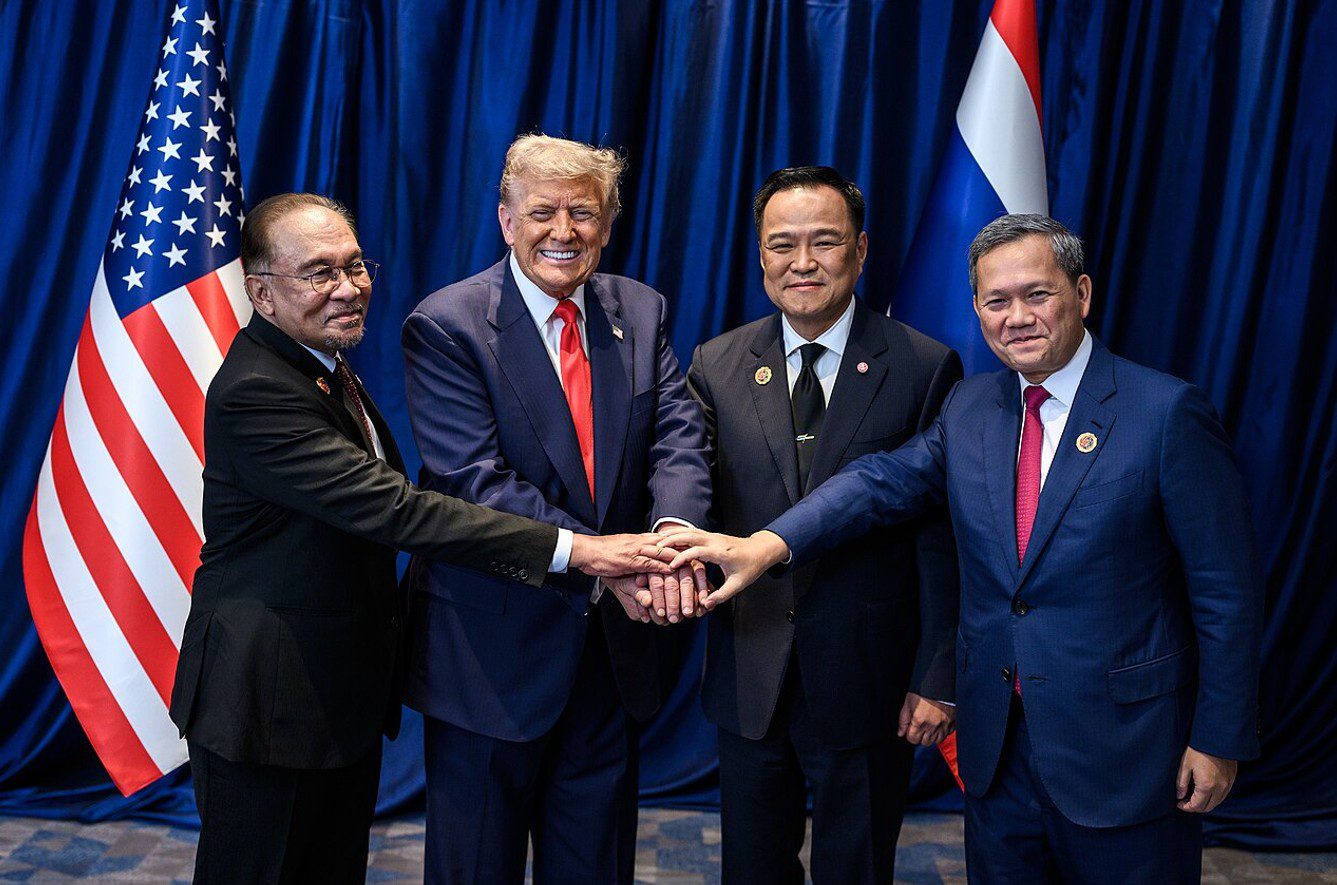
A comprehensive ceasefire, the Kuala Lumpur Peace Accord, was signed on 26 October 2025 in Kuala Lumpur at the 47th ASEAN Summit by Anutin Charnvirakul and Hun Manet, witnessed by Anwar Ibrahim and Donald Trump.
The agreement outlined a series of measures aimed at de-escalating the border conflict and restoring stability in the affected regions. Key provisions included:
- The withdrawal of heavy artillery and armored vehicles from contested border areas.
- The establishment of an interim ceasefire monitoring team composed of ASEAN observers and representatives from both nations.
- Bilateral cooperation on landmine clearance and removal of unexploded ordnance from former combat zones.
- Replacement of missing or disputed border markers with temporary markers until a permanent demarcation could be negotiated.
- The release of 18 Cambodian prisoners of war detained by Thailand during the conflict.
- Formation of a joint task force to address the cross-border proliferation of scam centres and transnational criminal activities.
Renewed conflict
Suspension of peace deal
On 10 November 2025, a suspected Cambodian landmine exploded in Sisaket, injuring two Thai soldiers; Sgt. Maj. Therdsak Samaphong lost his right foot, prompting Thailand to suspend the peace agreement. Cambodia expressed regret, blamed legacy mines, denied laying new ones, and reaffirmed compliance with the Ottawa Treaty. On 12 November, gunfire was reported; Cambodia accused the RTA of injuring civilians, killing one, and called for calm. In early December, Thailand acquired Israel’s Barak MX air defense system in a $108m deal.
December clashes
On 7 December 2025, Cambodia accused Thai troops of firing small arms, B-40 launchers, and mortars at Cambodian positions in Preah Vihear, claiming Cambodia did not return fire and requested an ASEAN investigation. Thailand countered that Cambodian forces fired first in Sisaket, injuring two Thai soldiers and using a recoilless gun, prompting Thai return fire. After clashes, Thailand ordered evacuations in four provinces.
On 8 December, fighting escalated: Thailand launched airstrikes, accused Cambodia of firing BM-21 rockets, and deployed F-16s. Civilians were injured, homes damaged, and schools and hospitals closed. Thailand issued a ceasefire ultimatum and banned drones. Cambodia denied killing a Thai soldier but said Thai attacks killed at least four civilians.
On 9 December, Thailand intensified operations, claiming major Cambodian positions destroyed. Cambodia reported seven civilians killed and 20 injured, condemned attacks on Prasat Ta Khwai and Preah Vihear, and cited ceasefire violations. Cambodia later withdrew from the 2025 SEA Games. Thailand launched Operation Sattawat, imposed martial law in Sa Kaeo, and continued air and artillery strikes into 11 December.
On 12 December, Thailand’s 2nd Army Division claimed Cambodia used FPV suicide drones, allegedly operated by foreign mercenaries. Thai PM Anutin held calls with Anwar Ibrahim and Donald Trump on a ceasefire, saying Trump urged restraint while Thailand insisted operations were defensive and demanded Cambodian withdrawal and mine clearance. On 13 December, PM Hun Manet also spoke with Anwar and Trump, reaffirming Cambodia’s commitment to the Kuala Lumpur Joint Declaration and proposing satellite verification.
Cambodia accused Thailand of continued F-16 airstrikes and naval shelling in Pursat and Koh Kong, while Thailand confirmed bombing bridges and casinos it labeled military targets. BM-21 rockets hit Thai border provinces, injuring civilians. Fighting fluctuated through 14–16 December, with BM-21 strikes killing civilians, Thai forces capturing key areas including Prasat Ta Khwai and Hill 500, and denials of Russian mercenaries.
From 17–25 December, soldiers were killed on both sides, Thailand captured Hill 350, cultural damage sparked outrage, and both sides met on 25 December to discuss a potential ceasefire.
Third ceasefire
On 27 December, Thailand and Cambodia signed a new ceasefire effective 12:00 p.m. Cambodia alleged Thai airstrikes beforehand, while Thailand reported three soldiers injured. On 29 December, Thailand accused Cambodia of deploying 250+ drones, violating the ceasefire. On 31 December, Thailand released 18 Cambodian POWs. Cambodia later claimed Thai forces erected razor wire and containers inside its territory, affecting 292 hectares and 1,300+ houses, displacing residents.
Humanitarian impact and casualties
By late July, 138,000 civilians in Thailand were evacuated, with over 200,000 displaced across both countries as attacks hit hospitals and gas stations. On 26 July, Cambodia confirmed the death of Major General Duong Samneang in an artillery strike. Five-day July clashes killed 48 people, while Nikkei Asia estimated at least 50 Cambodian combatant deaths. Thai authorities reported damage to 20 hospitals, costing 285 million baht, with Phanom Dong Rak Hospital requiring years to restore. Cambodia warned of abuse against migrant workers in Thailand. After the August ceasefire, 20,000 Cambodians returned via Ban Laem. Cambodia alleged Thai fire killed 7 civilians, including an infant, on 8–9 December. Cambodia closed the Poipet crossing from 10 October; Thailand accused detentions, while Cambodia cited safety concerns.
International reactions
U.S. President Donald Trump
The United States played a key diplomatic role in urging Thailand and Cambodia toward ceasefire and peace negotiations during the 2025 border crisis. U.S. President Donald Trump intervened at a critical moment in late July 2025 by speaking with leaders from both countries, conditioning continued U.S. economic engagement on an end to hostilities and pressing for an immediate halt to fighting, which helped bring both sides to the negotiation table. Trump’s involvement was widely credited with breaking the diplomatic deadlock and encouraging participation in talks hosted in Malaysia that led to an initial ceasefire agreement. Later, when a more durable peace was sought, the U.S. supported implementation of the Kuala Lumpur Peace Accord, with officials such as Secretary of State Marco Rubio publicly urging both governments to honor and fully implement the terms. The U.S. also signaled continued support for stability in the region through diplomatic pressure and engagement.
Primary Belligerents
-
Cambodia – Condemned Thai actions as illegal aggression; Hun Sen warned of military retaliation and declared readiness for combat.
-
Thailand – Accused Cambodia of attacking Thai positions and civilians; vowed to defend sovereignty and retaliate if violations continued.
Key ASEAN Actors
-
Malaysia – Central mediator; Prime Minister Anwar Ibrahim actively facilitated de-escalation and peace talks.
-
Indonesia – Urged peaceful resolution under ASEAN Charter; prioritized citizen safety and non-interference.
-
Singapore – Called for immediate ceasefire, diplomatic de-escalation, and civilian protection.
-
Vietnam – Advocated restraint and peaceful settlement under international law.
-
Laos – Expressed concern and urged both sides to seek peaceful solutions.
-
Philippines – Promoted dialogue; offered assistance in peace restoration.
-
Brunei – Encouraged communication and consultations to reduce tensions.
Major Global Powers
-
United States – Issued travel advisories; officially called for immediate cessation of hostilities and peaceful dialogue.
-
China – Urged dialogue; supported ASEAN mediation and emphasized colonial legacy factors.
-
Japan – Expressed deep concern; provided US$1.8 million in emergency humanitarian aid.
-
India – Monitored situation closely; issued travel advisories and urged de-escalation.
-
Russia – Called for restraint and diplomatic resolution.
Other Notable International Responses
-
Australia – Condemned shelling of civilian areas; urged de-escalation.
-
France – Called for immediate ceasefire and adherence to international law.
-
United Kingdom – Expressed concern over civilian casualties; urged restraint.
-
Canada – Voiced grave concern and called for dialogue.
-
Pakistan – Supported peace negotiations and diplomacy.
-
Saudi Arabia – Urged caution and peaceful settlement.
-
South Korea – Expressed grave concern; supported dialogue.
-
United Nations / Vatican City – Offered moral appeals, prayers, and calls for peace.
Inter-governmental organizations (short roles):
-
ASEAN – Urged an immediate halt to hostilities, strict observance of the ceasefire, and supported negotiations to de-escalate tensions.
-
European Union – Called on both sides to de-escalate and resolve the conflict through peaceful dialogue.
- United Nations – Expressed concern over the clashes and urged maximum restraint, dialogue, and a lasting, good-neighborly solution.
Read More:Martindox
