
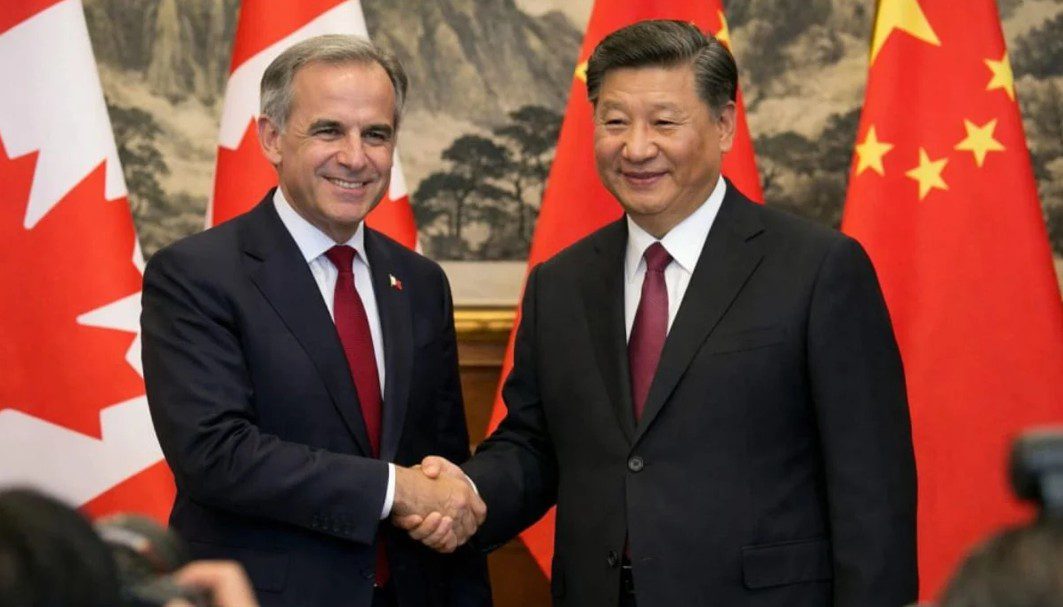
Canada & China Launch New Strategic Partnership Focused on Trade and Energy
In an increasingly divided and uncertain global environment, Canada is taking decisive steps to build a stronger, more independent, and more resilient economy. As part of this effort, Canada’s new government is acting with urgency to diversify trade relationships and attract significant new investment. As the world’s second-largest economy, China offers substantial opportunities to support this objective.
To advance a renewed Canada–China relationship, Prime Minister Mark Carney travelled to Beijing this week, marking the first visit to China by a Canadian Prime Minister since 2017. During the visit, Prime Minister Carney met with Chinese President Xi Jinping, Premier Li Qiang, and Zhao Leji, Chairman of the Standing Committee of the National People’s Congress. Following their discussions, Prime Minister Carney and President Xi issued a joint statement outlining the key pillars of a new strategic partnership between Canada and China.
A central focus of the partnership is cooperation in energy, clean technology, and climate competitiveness. As major global energy producers, Canada and China aim to expand two-way collaboration to reduce emissions and scale up investment in batteries, solar, wind, and energy storage technologies. While in Beijing, the Prime Minister met with leaders from the energy and clean technology sectors to identify and accelerate Chinese investment opportunities in Canada.
To support these objectives and strengthen Canada’s domestic manufacturing base, Canada will permit the import of up to 49,000 Chinese electric vehicles (EVs) at a most-favoured-nation tariff rate of 6.1%. This volume reflects import levels prior to recent trade frictions (2023–2024) and represents less than three percent of Canada’s new vehicle market. The government expects that within three years, the agreement will encourage significant new joint-venture investments in Canada with trusted partners, supporting job creation and reinforcing Canada’s EV supply chain. Within five years, it is anticipated that more than half of these imported vehicles will be affordable EVs priced below $35,000, expanding lower-cost options for Canadian consumers.
Agri-food and trade remain core pillars of the long-standing Canada–China relationship, with China continuing to be Canada’s second-largest export market. To strengthen this relationship, Prime Minister Carney and President Xi reached a preliminary agreement-in-principle to remove key trade barriers and reduce tariffs. By March 1, 2026, China is expected to reduce tariffs on Canadian canola seed to a combined rate of approximately 15%, down from current levels of about 85%. China represents a $4 billion market for Canadian canola producers. In addition, Canada expects that canola meal, lobsters, crabs, and peas will be exempt from relevant anti-discrimination tariffs from March 1, 2026, through at least the end of the year. Together, these measures are expected to unlock nearly $3 billion in new export opportunities for Canadian businesses and workers.
Building on this momentum, Canada has set a goal of increasing exports to China by 50% by 2030. To achieve this, both leaders discussed expanding two-way investment in clean energy and technology, agri-food, wood products, and other key sectors.
Canada and China reaffirmed their shared commitment to multilateralism and improved global governance. As part of the partnership, both countries will deepen cooperation on climate competitiveness and financial and macroeconomic stability. Canada welcomed the opportunity to support China’s 2026 APEC Presidency and expressed appreciation for China’s support of Canada’s bid to host the 2029 APEC Summit.
The two countries also agreed to pursue pragmatic cooperation on public safety and security, including enhanced law enforcement collaboration to combat narcotics trafficking, transnational and cybercrime, synthetic drugs, and money laundering.
In addition, Canada and China will explore expanded cultural exchanges and partnerships, including support for museums, digital creators, and visual artists, to strengthen people-to-people ties. Prime Minister Carney welcomed an agreement between Destination Canada and China Media Group to promote outbound tourism to Canada, particularly in preparation for the FIFA World Cup 26™. He also welcomed President Xi’s commitment to introduce visa-free travel for Canadians visiting China.
The Prime Minister’s visit to Beijing follows months of constructive and pragmatic engagement between Canada and China involving the Prime Minister, cabinet members, parliamentarians, and senior officials. Prime Minister Carney stated that he looks forward to returning to China for the 2026 APEC Leaders’ Summit.
Prime Minister Mark Carney: Canada’s Vision for a Stronger and Diversified Economy
Prime Minister Mark Carney said that in an increasingly divided and uncertain global environment, Canada is taking decisive steps to build a stronger, more independent, and more resilient economy. He emphasized that Canada’s new government is moving with urgency to diversify trade relationships and attract major new investment. According to the Prime Minister, China, as the world’s second-largest economy, presents significant opportunities to support Canada’s economic growth.
During his visit to Beijing—the first by a Canadian Prime Minister since 2017—Prime Minister Carney highlighted the importance of renewing Canada–China relations. He noted that the newly announced strategic partnership focuses on cooperation in energy, clean technology, climate competitiveness, and trade. As global energy producers, Canada and China aim to expand collaboration to reduce emissions and increase investment in batteries, solar, wind, and energy storage.
Prime Minister Carney also pointed to the decision to allow the import of up to 49,000 Chinese electric vehicles at a most-favoured-nation tariff rate of 6.1%, calling it a step toward strengthening Canada’s manufacturing base and EV supply chain. He said the agreement is expected to encourage joint-venture investments in Canada, protect and create auto-sector jobs, and expand affordable EV options for Canadian consumers.
On trade, the Prime Minister underscored the importance of agri-food exports, noting that China remains Canada’s second-largest export market. He welcomed the expected reduction in tariffs on Canadian canola and the removal of trade barriers on products such as canola meal, seafood, and peas, saying these measures could unlock nearly $3 billion in new export opportunities. Prime Minister Carney reaffirmed Canada’s goal of increasing exports to China by 50% by 2030.
President Xi Jinping: Strengthening China–Canada Cooperation and Global Engagement
Chinese President Xi Jinping said that China and Canada share common interests in promoting trade, investment, and global stability. He welcomed the renewed strategic partnership and stressed China’s commitment to expanding cooperation with Canada in clean energy, technology, agri-food, and other key sectors.
President Xi highlighted China’s intention to reduce tariffs on Canadian canola seed and remove discriminatory measures affecting other Canadian exports, describing these steps as part of efforts to strengthen bilateral trade and economic ties. He also expressed support for increasing two-way investment, particularly in clean energy, manufacturing, and sustainable development.
On global affairs, President Xi reaffirmed China’s commitment to multilateralism and improved global governance. He welcomed Canada’s engagement with China’s 2026 APEC Presidency and voiced support for Canada’s bid to host the 2029 APEC Summit. The President also emphasized cooperation on climate competitiveness, financial stability, public safety, and law enforcement to address transnational crime.
President Xi further supported expanded cultural and people-to-people exchanges, including tourism, arts, and media cooperation. He announced China’s commitment to introducing visa-free travel for Canadians visiting China, describing it as a step toward strengthening mutual understanding and long-term friendship between the two countries.


