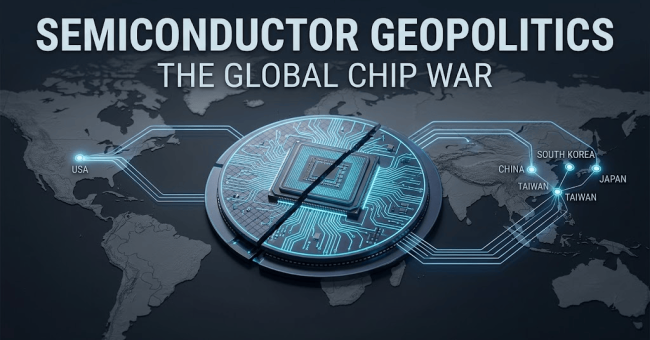
Semiconductor Geopolitics: The Global Chip War
Introduction
Semiconductors are among the most important technologies in the modern global economy. They power smartphones, computers, automobiles, telecommunications networks, data centers, artificial intelligence systems, military platforms and increasingly sophisticated industrial equipment. Because of their importance, semiconductor production is no longer simply a commercial issue. It has become a major element of geopolitics, national security and economic power.
The global semiconductor industry is highly interconnected. Chip design, manufacturing, equipment, advanced packaging and raw materials are distributed across several countries. The United States has major strengths in chip design, software and semiconductor equipment; Taiwan is a critical center for advanced contract manufacturing; South Korea is a major producer of memory chips; China is a huge semiconductor market and is investing heavily in domestic production.
This geographical concentration has created a new form of strategic competition. Governments increasingly view advanced chips as critical infrastructure and strategic technology. Export controls, industrial subsidies, investment restrictions and efforts to build domestic semiconductor capacity have therefore become important instruments of economic policy.
The result is what has increasingly been described as a global chip war—a competition over who can design, manufacture, control and secure the technologies that will shape the next generation of artificial intelligence, computing and military capabilities.
Why Semiconductors Have Become Geopolitically Important
A semiconductor is a material or device whose electrical properties can be controlled to perform computing and electronic functions. Modern integrated circuits contain billions of transistors and can perform extraordinarily complex operations.
Their strategic importance comes from several factors.
- Artificial intelligence: Advanced AI systems require powerful processors and high-bandwidth memory.
- Military technology: Modern aircraft, missiles, satellites, radar systems and communications platforms depend heavily on advanced electronics.
- Automobiles: Modern vehicles contain numerous semiconductor components for safety, navigation, automation and electric-drive systems.
- Telecommunications: 5G networks, data centers and communications infrastructure depend on semiconductor technology.
- Economic productivity: Manufacturing, financial services, logistics and digital infrastructure increasingly rely on computing power.
- National security: Countries increasingly consider access to advanced computing technology a strategic capability.
This means that controlling semiconductor technology can provide economic and strategic advantages far beyond the technology sector itself.
The Global Semiconductor Supply Chain
The semiconductor supply chain is not controlled by a single country.
Instead, it is divided among different stages and specialized economies.
The United States remains particularly important in chip architecture, design and semiconductor equipment. Companies such as NVIDIA, AMD, Qualcomm and Intel have played major roles in the development of advanced computing technologies.
Taiwan has become central to advanced semiconductor manufacturing, particularly through Taiwan Semiconductor Manufacturing Company (TSMC). TSMC pioneered the dedicated foundry model and manufactures chips designed by customers around the world. The company reported that its annual manufacturing capacity exceeded 17 million 12-inch-equivalent wafers in 2025.
South Korea has major capabilities in memory semiconductors, with Samsung Electronics and SK Hynix among the industry’s most important companies.
China, meanwhile, possesses a huge electronics manufacturing ecosystem and semiconductor market and is investing heavily in developing domestic semiconductor capabilities.
This division of labor makes the global chip industry highly productive—but also vulnerable to geopolitical disruption.
USA: Technology Power and Export Controls
The United States occupies a central position in the global semiconductor ecosystem.
American companies have significant capabilities in chip design, artificial intelligence processors, electronic design automation and semiconductor manufacturing equipment. Companies such as NVIDIA, AMD, Intel and Qualcomm have played important roles in the development of advanced computing technologies.
Washington has increasingly treated advanced semiconductors as a strategic national-security issue.
A major development was the introduction of increasingly restrictive controls on advanced semiconductor technology exports to China. The U.S. Department of Commerce stated that successive controls restricted China’s access to advanced semiconductor technologies and equipment used to manufacture advanced chips.
The logic behind these policies is broader than ordinary trade competition. Advanced computing chips can support artificial intelligence, high-performance computing and military applications. U.S. officials have therefore linked semiconductor technology with national security and technological competition.
Washington is also encouraging semiconductor manufacturing inside the United States through industrial policy and investment incentives.
This represents an important shift in economic thinking: rather than relying entirely on globally distributed production, the United States increasingly wants greater domestic and allied capacity for strategically important technologies.
China: Building Semiconductor Self-Reliance
China represents the other major side of the semiconductor competition.
China is one of the world’s largest consumers of semiconductors because of its enormous electronics, telecommunications, automotive and technology industries. However, access to some of the world’s most advanced chip manufacturing technologies and equipment has become a major strategic challenge.
U.S. export controls have attempted to restrict China’s access to certain advanced computing chips and semiconductor manufacturing technologies.
Beijing’s response has included efforts to strengthen domestic semiconductor capabilities and reduce dependence on foreign technology.
China’s semiconductor strategy is therefore closely connected to the broader concept of technological self-reliance.
The challenge is significant because producing cutting-edge semiconductors requires much more than simply having factories. It requires advanced manufacturing equipment, specialized materials, engineering expertise, software and an extensive supplier ecosystem.
This is why the semiconductor competition between Washington and Beijing is not simply about who sells more chips. It is also about who controls the technology, equipment and supply chains required to produce the next generation of chips.
The China–US Chip War
The semiconductor competition has become one of the most important dimensions of the wider China–US strategic relationship.
The competition involves several areas:
- Advanced AI processors
- Semiconductor manufacturing equipment
- Chip-design technology
- Advanced packaging
- Artificial intelligence
- Export controls
- Investment restrictions
- Domestic manufacturing incentives
- Supply-chain diversification
This creates a complicated situation for global companies.
Companies want access to China’s enormous market while also complying with restrictions imposed by the United States and other governments.
As a result, semiconductor companies increasingly have to consider geopolitical risk alongside traditional commercial considerations.
Taiwan: The Center of Advanced Chip Manufacturing
Taiwan occupies a unique position in global semiconductor geopolitics.
The island is home to TSMC, the world’s leading dedicated semiconductor foundry. TSMC’s business model focuses on manufacturing chips designed by other companies rather than primarily selling its own branded processors. The company pioneered the pure-play foundry model in 1987.
Taiwan’s importance is particularly significant in advanced manufacturing.
TSMC’s 2025 annual report states that advanced technologies—7-nanometer and beyond—accounted for 74% of its total wafer revenue, while the company manufactured products for hundreds of customers across high-performance computing, smartphones, automotive and other markets.
This gives Taiwan an unusually important position in the global technology economy.
Why Taiwan Matters
Taiwan’s semiconductor industry matters for several reasons.
Advanced manufacturing: TSMC operates at the leading edge of semiconductor manufacturing and continues to invest in advanced nodes, including 2-nanometer production.
Global customers: TSMC manufactures chips for customers serving AI, smartphones, automotive and high-performance computing markets.
Supply-chain concentration: A substantial portion of advanced semiconductor manufacturing capability is concentrated in Taiwan.
Geopolitical location: Taiwan’s political status and its relationship with mainland China make its semiconductor industry strategically sensitive.
This has created what is sometimes called the “Silicon Shield” concept—the idea that Taiwan’s importance to the global technology economy creates strong international incentives to maintain semiconductor supply-chain stability.
However, semiconductor production cannot eliminate geopolitical risks. A major disruption in the Taiwan Strait could potentially affect manufacturing, shipping, energy supplies and global technology supply chains.
South Korea: Memory Chips and Semiconductor Power
South Korea is another critical pillar of the global semiconductor industry.
Companies such as Samsung Electronics and SK Hynix are major producers of memory chips, including DRAM and high-bandwidth memory technologies that are increasingly important for artificial intelligence systems.
South Korea’s semiconductor position differs somewhat from Taiwan’s.
Taiwan is particularly important for advanced foundry manufacturing, while South Korea has enormous strength in memory semiconductors.
This distinction is becoming increasingly important as artificial intelligence drives demand for high-performance computing and advanced memory.
Recent industry developments have highlighted the importance of South Korean companies in the AI semiconductor supply chain. Samsung and SK Hynix have been major players in high-bandwidth memory, which is used alongside advanced AI processors.
South Korea’s Geopolitical Dilemma
South Korea faces a particularly complicated strategic environment.
It is a close security partner of the United States, while China remains an important economic market.
This creates a balancing challenge for Seoul.
South Korea wants to protect its technological advantages and strengthen cooperation with the United States, but it also has significant economic interests connected to China.
The country’s semiconductor industry therefore sits directly at the intersection of economic interests, technological competition and national security.
Japan: Semiconductor Materials, Equipment and Manufacturing Power
Japan remains an important player in the global semiconductor industry, even though it no longer holds the dominant position in chip manufacturing that it enjoyed during the 1980s. Today, Japan’s strategic importance lies particularly in semiconductor manufacturing equipment, high-purity materials, silicon wafers and specialized technologies essential for producing advanced chips. Japanese companies supply critical components and production technologies to semiconductor manufacturers around the world.
Japan’s Role in Semiconductor Manufacturing
Japan’s semiconductor industry is built around several specialized capabilities.
-
Semiconductor materials: Japanese companies such as Shin-Etsu Chemical, SUMCO and JSR supply important materials used in chip manufacturing, including silicon wafers and photoresists. These materials are essential for producing reliable and increasingly sophisticated semiconductors.
Semiconductors -
Manufacturing equipment: Japanese firms produce equipment used in wafer cleaning, inspection, coating and other critical manufacturing processes. This gives Japan an important position in the global semiconductor supply chain.
Semiconductors -
Specialized chips: Japan also has expertise in power semiconductors, sensors, microcontrollers and other components used in vehicles, industrial equipment and consumer electronics.
-
Advanced manufacturing ambitions: Japan is investing in next-generation chip production to strengthen domestic capabilities and reduce vulnerabilities in strategically important supply chains.
Rapidus and Japan’s Effort to Regain Chipmaking Leadership
One of Japan’s most significant semiconductor initiatives is Rapidus, a government-backed company established in 2022 to develop advanced semiconductor manufacturing capabilities.
Rapidus aims to produce 2-nanometer chips at scale, targeting production in 2027. The initiative reflects Japan’s ambition to re-establish itself as a major player in advanced chip manufacturing and strengthen its technological position in the age of artificial intelligence.
However, competing at the cutting edge is difficult. Rapidus must demonstrate reliable manufacturing performance, secure customers, develop a skilled workforce and compete with established manufacturers such as TSMC, Samsung and Intel. Its long-term success will depend on both technological execution and commercial demand.
Why Japan Matters in Semiconductor Geopolitics
Japan’s influence extends beyond the chips manufactured within its borders. Its materials and equipment are important to production networks operating across Taiwan, South Korea, the United States and other semiconductor economies.
This creates strategic leverage: a disruption in critical materials or manufacturing equipment can affect production far beyond Japan itself. Consequently, Japan’s semiconductor policy is closely connected to economic security, technological cooperation and supply-chain resilience.
Japan is also strengthening public support for its semiconductor and AI industries. Its government has outlined a framework for more than ¥10 trillion in public support over seven years through fiscal year 2030, intended to encourage substantial public and private investment in the broader semiconductor and AI ecosystem.
Japan’s Position in the Global Chip War
Unlike Taiwan, whose role is especially prominent in advanced foundry manufacturing, or South Korea, which is particularly strong in memory chips, Japan’s distinctive advantage lies in the materials, equipment and specialized technologies that make semiconductor production possible.
Japan is therefore not simply trying to manufacture more chips. It is seeking to strengthen its position across the wider semiconductor ecosystem while rebuilding advanced manufacturing capacity.
Taiwan and South Korea: Two Different Semiconductor Models
Taiwan and South Korea are both semiconductor powers, but their strengths are not identical.
| Taiwan | South Korea |
|---|---|
| Major advanced foundry power | Major memory-chip power |
| TSMC | Samsung & SK Hynix |
| Strong in contract manufacturing | Strong in DRAM and HBM |
| Critical for advanced logic chips | Critical for AI memory |
| Strong links with global chip designers | Strong links with electronics and memory markets |
Both countries, however, face similar geopolitical risks.
A recent policy analysis highlighted the vulnerability of both Taiwan and South Korea to disruptions involving energy, raw materials and geopolitical tensions because semiconductor manufacturing depends on reliable infrastructure and highly integrated supply chains.
AI and the New Semiconductor Competition
Artificial intelligence has dramatically increased the strategic importance of semiconductors.
Large AI models require enormous amounts of computing power. This has increased demand for advanced processors, high-bandwidth memory and advanced packaging.
Consequently, the semiconductor competition is increasingly becoming an AI technology competition.
Countries that control critical parts of the AI hardware supply chain can potentially gain advantages in:
- Artificial intelligence
- Cloud computing
- Autonomous systems
- Military technology
- Data centers
- Robotics
- Advanced telecommunications
This is one reason semiconductor geopolitics is becoming more important than traditional electronics competition.
The Global Chip War and Supply-Chain Security
The semiconductor industry demonstrates the vulnerabilities of globalization.
For decades, companies optimized production around efficiency, specialization and cost. This produced an extremely sophisticated global supply chain.
But geopolitical tensions have changed the calculation.
Governments now increasingly ask:
What happens if a strategically important supplier becomes unavailable?
This has encouraged countries to pursue supply-chain resilience.
The objective is not necessarily to produce every component domestically. Instead, governments are seeking diversified supply chains with trusted partners and alternative production locations.
TSMC’s expansion outside Taiwan—including manufacturing investments in the United States, Japan and Germany—is one example of how semiconductor production is becoming more geographically diversified while Taiwan remains central to the company’s manufacturing strategy.
Why the Global Chip War Matters for the World
The semiconductor competition will have consequences far beyond China, Taiwan, South Korea and the United States.
Europe is seeking greater semiconductor resilience.
Japan is rebuilding advanced chip-manufacturing capabilities, including its government-backed Rapidus initiative.
Other countries are attempting to attract semiconductor investment through subsidies, tax incentives and industrial policies.
For developing economies, the situation creates both opportunities and challenges.
Countries that can provide skilled workers, reliable electricity, water, infrastructure and investment-friendly policies may attract parts of the semiconductor supply chain.
However, competing at the most advanced manufacturing level requires enormous capital, sophisticated technology and highly specialized expertise.
The Future of Semiconductor Geopolitics
The global semiconductor industry is unlikely to return completely to the pre-geopolitical model of unrestricted globalization.
Instead, the future is likely to involve a combination of:
Globalization + diversification + strategic competition
The United States will continue seeking technological leadership and greater supply-chain resilience.
China will continue attempting to strengthen domestic semiconductor capabilities.
Taiwan will remain central to advanced chip manufacturing while expanding its international manufacturing footprint.
South Korea will remain critical to memory technologies and the rapidly expanding AI hardware ecosystem.
Japan and Europe will also seek larger roles in strategic semiconductor supply chains.
The result may be a more geographically diversified semiconductor industry—but one that is also more heavily influenced by governments and national-security considerations.
