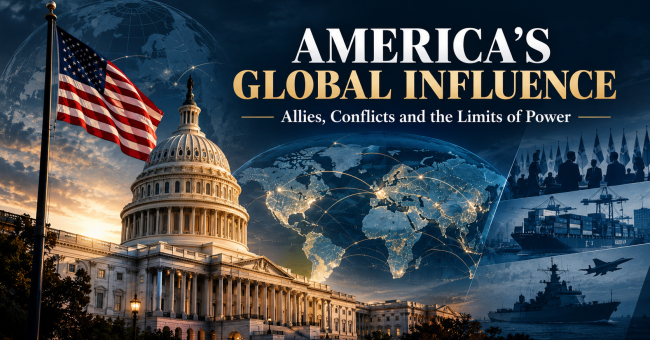
The Decline of American Power: Is US Hegemony Fading?
For decades, the United States has occupied a central position in the international system. Its economic strength, military reach, technological leadership, global financial influence and network of alliances have made it one of the most influential countries in modern history. From the aftermath of the Second World War to the end of the Cold War and the emergence of a US-led international order, Washington played a decisive role in shaping global security, trade and diplomacy.
However, the international environment is changing. Wars have exposed the limitations of military power, traditional alliances are experiencing new tensions, economic competition is intensifying, and countries that once relied heavily on Washington are increasingly seeking greater strategic flexibility. At the same time, the United States faces domestic political divisions, rising fiscal pressures and difficult choices about how to maintain its international commitments.
Several recent developments have brought these questions into sharper focus. Canada’s Prime Minister Mark Carney, Britain’s Prime Minister Keir Starmer and Spain’s Prime Minister Pedro Sánchez have pursued high-level engagement with China. The prolonged Russia–Ukraine war has raised questions about the limits of Western military and diplomatic influence. Security threats in the Middle East have highlighted the difficulty of protecting even well-armed American partners. Meanwhile, Washington’s changing approach to Russian energy exports has created questions about the consistency of its sanctions policy.
These developments do not prove that American power has collapsed. The United States remains a major economic, military and technological power. Nevertheless, they raise a fundamental question: is American hegemony fading, and is Washington finding it increasingly difficult to convert its enormous resources into reliable international influence?
Understanding this question requires examining not only America’s strengths but also the limits of its leadership, the expectations of its allies and the changing calculations of other governments.
What Does the Decline of American Power Mean?
The decline of American power does not necessarily mean the collapse of the United States or the immediate end of its superpower status. A country can remain exceptionally powerful while losing some of its ability to shape the decisions of other states.
American hegemony refers to the United States’ dominant influence over major aspects of international affairs, including security arrangements, financial systems, international institutions, technological standards and diplomatic initiatives.
There are several ways to assess whether that influence is weakening.
First, military superiority does not always produce the desired political outcome. A country may possess advanced weapons and extensive overseas bases yet struggle to secure a lasting settlement in a conflict.
Second, alliances depend on confidence as well as military capability. If partners begin to doubt the durability of American commitments, they may seek alternative economic relationships, additional defence arrangements or greater independence in foreign policy.
Third, economic influence depends on more than the size of an economy. The credibility of financial institutions, the stability of the dollar, access to markets and the willingness of other countries to follow American economic rules also matter.
Finally, international leadership requires a degree of legitimacy. When American policies appear inconsistent, unpredictable or primarily driven by short-term domestic considerations, other governments may become less willing to coordinate automatically with Washington.
The decline of hegemony, therefore, is best understood as a potential reduction in America’s relative influence—not as evidence that the country has already ceased to be a superpower.
Canada–China Relations: Why Mark Carney’s Visit Matters
Canada has long been one of the United States’ closest allies. The two countries share an extensive economic relationship, cooperate through NATO and NORAD, and maintain deeply integrated supply chains. Their geographical proximity and longstanding security partnership make Canada particularly important to American strategic interests.
Against this background, Canadian Prime Minister Mark Carney’s official visit to China was politically significant.
According to the Canadian government’s official announcement, Carney travelled to China from January 13 to 17, 2026. The leaders’ joint statement records the official visit as January 14–17, with meetings involving Chinese President Xi Jinping, Premier Li Qiang and other senior officials. The visit produced a new Canada–China strategic partnership covering energy, trade, agriculture, security-related cooperation, multilateralism and cultural exchanges. It also reflected Canada’s stated objective of diversifying its economic relationships and reducing excessive dependence on a single market.
America’s National Debt: A Growing Challenge to Global Power
The rapidly increasing national debt of the United States is another major challenge to its long-term economic strength and global leadership. According to the US Department of the Treasury’s Debt to the Penny data, America’s total national debt exceeded $40 trillion in 2026, reaching approximately $40.4 trillion by October 16, 2026. This enormous debt reflects decades of accumulated borrowing, persistent budget deficits, government spending commitments and extraordinary expenditure during periods of economic crisis.
As the debt grows, the government must devote increasing amounts of public revenue to interest payments rather than using those resources for infrastructure, research, education, defence or other national priorities. Reuters reported on October 16, 2026, that the federal budget deficit had reached nearly $2 trillion in fiscal year 2026, while annual debt-servicing costs climbed to a record $1.36 trillion. These figures raise concerns about the long-term sustainability of America’s fiscal position. High debt does not automatically mean that the United States is approaching economic collapse: the dollar’s international role, the depth of American financial markets and continued investor demand for US Treasury securities give Washington significant borrowing advantages.
Nevertheless, persistent deficits and rising interest costs can reduce the government’s flexibility to respond to future crises, finance strategic priorities and sustain international commitments. If debt continues growing faster than the economy over an extended period, the burden could become increasingly difficult to manage. In this sense, America’s national debt is not proof that its superpower status has ended, but it is an important structural vulnerability that could weaken its capacity to exercise global leadership in the decades ahead.
Was This the First Time a Canadian Prime Minister Visited China?
No. Canadian prime ministers have visited China before, and Canada–China relations have experienced periods of both cooperation and tension. The important point is that Carney’s January 2026 trip was the first visit to China by a Canadian prime minister since 2017.
The gap of approximately eight years gives the visit added significance. It took place amid changes in global trade, uncertainty about US economic policy and Canada’s interest in expanding its international options.
The visit should not be interpreted as Canada abandoning the United States or choosing China as a replacement ally. Canada remains closely connected to the American economy and defence system. Instead, the visit demonstrates that even a country deeply integrated with the United States may pursue a more diversified foreign policy when it believes its long-term economic interests require it.
For Washington, the lesson is important: longstanding alliances do not automatically prevent partners from building stronger relationships with strategic competitors.
Britain–China Relations: Keir Starmer’s Diplomatic Re-engagement
The United Kingdom is another major American ally. The two countries cooperate closely through NATO, intelligence-sharing arrangements, defence programmes and diplomatic coordination. Their relationship has historically been one of the central pillars of Western security policy.
Yet Britain also has substantial economic interests in Asia, particularly in trade, investment, financial services and advanced industries.
British Prime Minister Sir Keir Starmer visited China from January 28 to 31, 2026. The trip was the first visit by a British prime minister to China in eight years. The UK government reported that the visit secured export agreements worth billions of pounds, market-access gains and additional investment opportunities.
Why Did Britain Pursue the Visit?
The visit reflected an attempt to balance national security concerns with economic interests. British governments have had to manage concerns about Chinese state influence, technology security and human rights while also recognising China’s importance to the global economy.
Starmer’s engagement did not mean that Britain had abandoned its security relationship with Washington. Rather, it demonstrated that London wanted to maintain its American alliance while exploring areas in which cooperation with Beijing could generate economic benefits.
This balancing act illustrates a wider challenge for American leadership. If close allies increasingly believe that they must manage relations with China independently, Washington may find it more difficult to establish a unified Western approach to trade, technology and strategic competition.
The significance lies not in a single visit but in the broader pattern of allied governments pursuing their own national interests rather than automatically aligning every policy decision with American preferences.
Spain–China Relations: Pedro Sánchez’s Continued Engagement
Spain has also pursued closer diplomatic and economic engagement with China. Spanish Prime Minister Pedro Sánchez made an official visit from April 11 to 15, 2026, meeting Chinese leaders and discussing trade, investment and international cooperation.
The Spanish government described the visit as his fourth trip to China. It also announced plans to strengthen high-level political dialogue through a permanent strategic dialogue mechanism. Sánchez emphasised the importance of balanced and reciprocal economic relations between China and Europe.
Had Spain’s Prime Minister Visited China Before?
Yes. Sánchez’s 2026 visit was not an unprecedented diplomatic opening. His previous visits show that Spain had already been developing relations with China over several years. The 2026 trip was significant because it continued and deepened an existing diplomatic strategy rather than establishing relations from the beginning.
Spain’s approach illustrates the distinction between an ally’s diplomatic engagement and a formal strategic realignment. Madrid can cooperate with Washington on security matters while simultaneously pursuing trade and diplomatic opportunities with Beijing.
For the United States, the challenge is that maintaining leadership among allies requires more than asking partners to share its strategic concerns. Washington must also demonstrate that its policies support their economic interests and that its commitments remain dependable.
What Do These Visits Tell Us About American Leadership?
The visits by Canadian, British and Spanish leaders to China should not be presented as proof that America’s allies have turned against it. All three countries continue to have important relationships with the United States.
Nevertheless, the visits reveal a significant feature of contemporary international politics: allied governments increasingly want room to pursue independent economic and diplomatic priorities.
Several factors help explain this trend.
Economic Diversification
Countries may wish to reduce their exposure to sudden changes in tariffs, trade restrictions or political disagreements with Washington. Expanding commercial ties with China and other markets can provide additional options.
Strategic Autonomy
European governments and other American partners have discussed the need to develop greater capacity to act independently in areas such as defence, energy and technology. This does not necessarily require ending the US alliance, but it can reduce automatic dependence on American decisions.
Uncertainty About US Policy
Changes in American administrations can produce major shifts in tariffs, sanctions, security commitments and diplomatic priorities. Allies that view these changes as difficult to predict may try to protect their own long-term interests by diversifying partnerships.
A More Transactional Approach to Alliances
When diplomatic relationships are presented primarily through the language of payments, purchases, investment commitments or immediate concessions, partners may question whether their strategic interests will remain protected when circumstances change.
These factors do not establish that American leadership is finished. They do, however, help explain why Washington may face greater difficulty persuading allies to follow a single strategic line.
The Russia–Ukraine War: The Limits of American Influence
The Russia–Ukraine war is one of the clearest examples of the difference between military power and the ability to secure a desired political outcome.
Since Russia launched its full-scale invasion in February 2022, the United States has provided Ukraine with substantial military, financial and diplomatic support, working alongside European and other partners. Western governments have imposed extensive sanctions on Russia, restricted access to selected technologies and attempted to increase the economic costs of the invasion.
Despite these measures, the war has continued for years, with heavy human, economic and infrastructure costs.
Why Has the War Been So Difficult to End?
The conflict involves fundamental disagreements over territory, sovereignty, security guarantees and Russia’s regional objectives. Ukraine has resisted Russian occupation, while Moscow has continued to pursue its military and territorial aims. External assistance has affected the battlefield, but it has not automatically produced a political settlement.
As of October 2026, Russia controlled approximately 19% of Ukraine’s internationally recognised territory, including Crimea and areas occupied before the full-scale invasion of February 2022. Estimates based on battlefield mapping also indicate that the share captured since the 2022 invasion is smaller than the total area currently under Russian control. This figure is a measure of the scale of the territorial challenge, not proof that Ukraine’s eventual future has been decided. Front lines can change, and occupation does not confer international legal sovereignty.
Does the Prolonged War Mean America Has Failed?
Not entirely. The United States has helped Ukraine continue resisting a much larger invading power and has coordinated extensive support among Western governments. Russia has also faced substantial military, economic and diplomatic costs.
However, the continued fighting demonstrates the limits of American leverage. Washington has not been able to compel Russia to end the war on terms acceptable to Ukraine, nor has it secured a durable settlement simply through sanctions and military assistance.
The war has also exposed tensions within Western policy over the costs, duration and objectives of supporting Ukraine. European governments have had to reassess their own defence capabilities and the degree to which their security depends on sustained American support.
The central issue is not whether the United States possesses military power. It clearly does. The question is whether that power can reliably produce the political outcomes Washington seeks.
Middle East Security: Can America Protect Its Gulf Partners?
The Middle East provides another important test of American influence. Saudi Arabia, the United Arab Emirates, Bahrain, Kuwait, Qatar and Jordan have longstanding security relationships with Washington, although the nature and legal terms of those relationships differ.
The United States maintains military facilities and defence cooperation arrangements across the region. Several Gulf governments purchase advanced American weapons, host US forces or cooperate with Washington on air defence, intelligence and maritime security.
These relationships create expectations that American military capabilities can help deter attacks and protect vital infrastructure. Yet no alliance can guarantee that every missile or drone will be intercepted.
Iranian Attacks and the Limits of Regional Defence
The regional conflict that escalated in 2026 exposed serious vulnerabilities. A Reuters investigation published on October 15 reported at least 135 Iranian or Iran-aligned missile and drone attacks against 84 critical infrastructure sites across the Gulf region following the start of the US–Israeli campaign against Iran on February 28, 2026. Targets included energy infrastructure, transport facilities and other strategic sites.
These attacks demonstrated that even states equipped with sophisticated air-defence systems remain vulnerable to repeated, coordinated and relatively inexpensive aerial attacks. Protecting large territories, oil facilities, ports, airports and industrial complexes requires extensive surveillance, sufficient interceptor stocks, effective command systems and cooperation among several countries.
The attacks do not mean that the United States provided no protection or that every affected government expected Washington to intercept every incoming weapon. US and partner forces have played important defensive roles in the region. However, the damage and disruption show that American military superiority cannot eliminate all risks faced by its partners.
Saudi Arabia and the Houthis Threat
Saudi Arabia has also faced continuing security challenges from Yemen’s Houthi movement, which has developed missile and drone capabilities and previously conducted attacks against Saudi territory and critical infrastructure.
In October 2026, renewed Houthi attacks highlighted the difficulty of defending a large country with extensive energy infrastructure against asymmetric threats. The Associated Press reported that Saudi Arabia had struggled to defend against a recent wave of sophisticated drone and missile attacks, despite its substantial military arsenal.
Saudi Arabia’s defence challenges should not be reduced to a claim that Washington simply refused to protect it. The effectiveness of a security partnership depends on the specific threat, the available forces, political decisions, the rules governing military action and the partner country’s own capabilities.
Nevertheless, these developments raise an important question for US regional leadership: how much confidence can partners place in American security support when threats escalate and Washington must choose between direct intervention, limited assistance and diplomatic restraint?
Gulf Investment Deals and the Question of Security Guarantees
President Donald Trump’s May 2025 visit to Gulf countries placed substantial emphasis on investment, commercial agreements, defence cooperation and technology partnerships.
During the tour, Saudi Arabia announced a $600 billion investment commitment involving the United States, while the UAE announced major investment and commercial initiatives. The visits also produced announcements involving artificial intelligence, energy, aviation and other sectors.
The reported commitments were substantial, but they should not all be treated as cash already transferred or completed contracts. Announced investment pledges, memorandums of understanding, purchase agreements and executed transactions are different categories.
More importantly, economic agreements do not automatically establish a binding military guarantee.
Can Financial Partnerships Guarantee Security?
Gulf governments have strong incentives to maintain close relations with Washington. American defence technology, intelligence cooperation and military presence remain important to their security calculations. At the same time, these governments may seek additional diplomatic options and stronger domestic defence capabilities.
The 2026 regional attacks demonstrate that commercial partnerships and advanced weapons purchases cannot eliminate the risks of regional conflict. They also highlight a difficult reality: the United States may have extensive interests in a region without being willing or able to prevent every attack against its partners.
This distinction matters for American credibility. If partners interpret economic cooperation as a promise of unconditional military protection, a gap can emerge between their expectations and Washington’s actual commitments.
The appropriate conclusion is not that American alliances have become meaningless. Rather, their credibility depends on clearly defined commitments, effective coordination, adequate defence capacity and realistic expectations about what military power can achieve.
The United States and Russia: Sanctions, Energy and Strategic Consistency
One of the most striking tensions in recent American foreign policy concerns Russia’s energy exports.
Since the full-scale invasion of Ukraine, Washington has imposed extensive restrictions intended to increase economic pressure on Moscow. The United States has also encouraged European partners to reduce dependence on Russian energy, although European countries have followed different timelines and policies for different fuels.
The Nord Stream pipelines, which carried Russian natural gas to Germany through the Baltic Sea, became a symbol of the broader conflict over Europe’s energy dependence. Explosions damaged the pipelines in September 2022, disrupting a major route for Russian gas deliveries.
What Is Known About Nord Stream?
The destruction of Nord Stream has been the subject of criminal investigations and intense political controversy. German investigators have pursued suspects, including individuals reportedly linked to a Ukrainian operation. However, claims that the US government itself ordered or carried out the sabotage have not been established by publicly available conclusive evidence.
It would therefore be inaccurate to state as a proven fact that the United States arranged for Ukraine to blow up the pipelines. The responsible actors, the full chain of command and the wider circumstances must be distinguished from allegations and political accusations.
The broader political point remains significant: European energy policy changed dramatically after the invasion and the destruction of the pipelines, increasing pressure on governments to diversify supplies and reconsider their dependence on Russian gas.
The Russian Diesel Arrangement of October 2026
In October 2026, President Trump announced an arrangement involving Russian diesel supplies amid concerns about fuel prices and efforts to engage Moscow diplomatically. Reuters reported on October 15 that the Kremlin said Russian diesel exports had resumed following the announcement, with a tanker carrying approximately 40,000 metric tonnes of diesel reported to be travelling from Russia’s Primorsk port to Morocco.
The development drew criticism because it appeared to conflict with the broader effort to restrict Russian energy revenue. Critics argued that allowing additional Russian fuel exports could provide economic relief to Moscow while the war continued.
The administration’s approach reflected a different calculation: limited energy cooperation might increase supply, ease price pressures and create an incentive for diplomatic engagement.
Does This Contradiction Weaken American Credibility?
It can, particularly if allies believe that the rules Washington asks them to follow may be relaxed when American domestic priorities change.
European governments incurred economic and political costs as they reduced their dependence on Russian energy. If Washington subsequently permits selected Russian fuel transactions, some partners may question whether the sanctions strategy is being applied consistently.
However, the diesel arrangement does not mean that all US sanctions on Russia have disappeared. A temporary licence or targeted exemption is not the same as a comprehensive removal of restrictions. The legal scope, duration and implementation of the measure matter.
The central issue is policy consistency. If the United States seeks to use economic pressure to influence Russian behaviour, it must explain how limited energy cooperation supports that objective and what reciprocal steps it expects from Moscow.
Without a clear connection between concessions and diplomatic results, American policy risks appearing transactional and unpredictable.
The Dollar and America’s Economic Influence
American power rests not only on military capabilities but also on the international role of the US dollar and the depth of American financial markets.
The dollar remains a leading currency for international reserves, trade invoicing and global finance. US Treasury securities are widely held, American financial markets are highly liquid, and the dollar’s role gives Washington significant influence through sanctions and access to the US financial system.
These advantages are substantial and cannot be dismissed simply because other countries are exploring alternatives.
Nevertheless, the use of financial sanctions has encouraged some governments to consider ways to reduce their exposure to American financial restrictions. Certain countries have increased the use of local currencies in selected transactions, developed alternative payment channels or sought to diversify their reserves.
These developments do not demonstrate that the dollar is about to lose its dominant international role. Creating a credible alternative requires more than political declarations: it requires deep and liquid markets, confidence in institutions, convertibility, reliable legal protections and widespread acceptance.
However, the growing discussion of financial alternatives illustrates how the use of economic power can create incentives for other states to reduce their dependence on it.
For Washington, the long-term challenge is to preserve confidence in the dollar-based system while using financial influence in ways that remain effective and credible.
Domestic Political Division and the Cost of Global Leadership
A country’s international influence depends partly on its ability to sustain policy over time. Allies and adversaries both consider whether a government’s commitments will survive elections, changes of administration and domestic political disputes.
The United States has experienced deep political polarisation over immigration, trade, public spending, foreign assistance and the country’s role abroad. Disagreements over support for Ukraine, relations with NATO partners and the use of tariffs have sometimes made US policy appear less predictable.
This matters because defence cooperation, military procurement and diplomatic negotiations often operate over many years. Partners may hesitate to make long-term plans if they expect major changes in American policy after every election.
Domestic disagreement does not automatically weaken a democracy. Open debate, legislative oversight and public accountability can strengthen institutions. The concern arises when political divisions make international commitments appear unreliable or prevent governments from maintaining a coherent strategy.
American leadership therefore depends not only on the resources available to Washington but also on the credibility of its decisions across successive administrations.
Military Superiority Does Not Guarantee Political Success
The United States maintains extensive global military capabilities, advanced intelligence networks, a powerful navy and air force, and a wide network of overseas partnerships. These strengths remain central to its position in international affairs.
However, recent conflicts illustrate the difference between defeating military targets and achieving a sustainable political settlement.
In Ukraine, years of external support have not ended the war. In the Middle East, advanced defence systems have not prevented all attacks against critical infrastructure. More broadly, asymmetric warfare allows weaker actors to impose costs through drones, missiles, cyber operations, disruption of shipping and attacks on vulnerable infrastructure.
These challenges are not unique to the United States. Every major power faces limitations when confronting determined opponents in complex regional conflicts.
The lesson is that military superiority is only one component of strategic success. Political objectives must be achievable, alliances must be coordinated, and military action must be connected to a credible diplomatic and security strategy.
If a country repeatedly spends resources without achieving its stated objectives, questions about the effectiveness of its leadership become unavoidable.
Is US Hegemony Really Fading?
The evidence points to a more complicated conclusion than either the claim that America is collapsing or the argument that nothing has changed.
Several developments suggest that the exercise of American leadership has become more difficult:
- Longstanding allies are pursuing more diversified economic and diplomatic relationships.
- The prolonged Ukraine war demonstrates the limits of sanctions and external military assistance in compelling a major power to change course.
- Missile and drone attacks in the Middle East expose vulnerabilities in regional security arrangements.
- Changes in US policy toward Russian energy exports create questions about the consistency of its sanctions strategy.
- Domestic political divisions can make long-term commitments less predictable.
- Some governments are exploring ways to reduce their dependence on American financial and technological systems.
Yet the counterevidence is equally important. The United States retains enormous economic resources, advanced military capabilities, influential technology companies, deep capital markets and an extensive network of formal and informal partnerships.
Its allies continue to value American defence cooperation, and the dollar remains central to the international financial system. No single diplomatic visit, battlefield development or policy reversal can establish that American hegemony has ended.
The more defensible argument is that American power remains immense, but its ability to secure automatic alignment, deter every threat and achieve preferred political outcomes is increasingly contested.
This distinction matters. A country can remain the strongest or one of the strongest powers in the world while experiencing a relative decline in its ability to set the rules for everyone else.
Official and reliable sources
The United States is not simply losing its power; it is confronting growing limits on how that power can be used. Whether those limits develop into a sustained decline of American hegemony will depend on the choices Washington makes in the years ahead.
