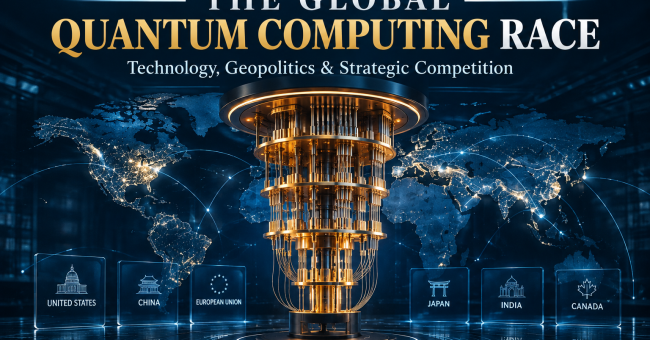
The Global Quantum Computing Race
The global technology competition is entering a new phase. Artificial intelligence, semiconductors, advanced telecommunications and space technologies have already become major instruments of economic and geopolitical power. The next major frontier is quantum computing.
Unlike conventional computers, quantum computers use qubits and exploit quantum mechanical phenomena such as superposition and entanglement. Their objective is not simply to make today’s computers faster, but to solve certain categories of problems that could remain extremely difficult for classical computers.
This has transformed quantum computing from a scientific research field into a matter of economic competitiveness, national security and geopolitical strategy.
The United States and China are currently at the centre of the global quantum computing race, while Japan, Canada, the United Kingdom, European countries, India and Singapore are developing their own capabilities. The competition is no longer only about who can build the machine with the largest number of qubits. It is increasingly about error correction, useful applications, software, talent, manufacturing ecosystems, quantum-safe cybersecurity and the ability to commercialise the technology.
What Is Quantum Computing?
Quantum computing is a new approach to computation based on the laws of quantum mechanics.
Traditional computers process information through bits, which normally represent either 0 or 1. Quantum computers use quantum bits, or qubits, which can exploit quantum states to perform certain calculations in fundamentally different ways.
Three concepts are particularly important:
Superposition
A qubit can exist in a combination of quantum states rather than behaving simply as a conventional 0 or 1.
Entanglement
Quantum systems can be linked in ways that create correlations between qubits, allowing quantum algorithms to exploit relationships that have no direct classical equivalent.
Quantum Interference
Quantum algorithms manipulate probability amplitudes so that desirable computational outcomes become more likely while unwanted outcomes are suppressed.
However, quantum computing should not be understood as a universal replacement for conventional computers. The most realistic future is likely to involve quantum processors working alongside CPUs and GPUs, creating hybrid or quantum-centric computing systems. IBM, for example, describes its future architecture around integrating quantum processors with classical high-performance computing resources.
Why Quantum Computing Has Become a Geopolitical Race
Quantum computing matters because its potential applications extend far beyond laboratories.
Economic power
Quantum computing could eventually transform areas such as:
- Drug discovery
- Financial modelling
- Materials science
- Logistics
- Energy systems
- Chemical simulation
- Advanced manufacturing
- Artificial intelligence
- Climate modelling
The countries that develop commercially useful quantum systems could gain advantages in high-value industries and technological innovation.
National security
Quantum computing also has major defence implications.
A sufficiently powerful fault-tolerant quantum computer could threaten some widely used public-key cryptographic systems. This creates an unusual strategic situation: governments must prepare for a future technology even before fully capable machines exist.
India’s NITI Aayog has specifically highlighted quantum computing’s implications for cryptography and national security, while Singapore has also emphasised the need for quantum-safe preparation.
Technological sovereignty
Quantum computing requires sophisticated hardware, cryogenic systems, control electronics, software, specialised materials and highly trained scientists.
Consequently, governments increasingly view quantum capability as part of technological sovereignty.
The United States: The Leading Commercial and Research Power
The United States is arguably the most important player in the global quantum computing race.
Its advantage comes from the combination of:
- World-class universities
- Major technology companies
- Venture capital
- Government research agencies
- Quantum startups
- Semiconductor expertise
- Cloud-computing infrastructure
- Defence research
Companies such as IBM, Google, Microsoft, Quantinuum and IonQ are pursuing different approaches to quantum hardware and software.
Google’s Willow quantum chip, announced in December 2024, demonstrated major progress in quantum error correction and performance. Google said Willow reduced errors as the system scaled and demonstrated a benchmark calculation that it reported could take a classical supercomputer an extraordinarily long time.
IBM is following another major pathway. Its current roadmap targets early examples of quantum advantage in 2026 and a large-scale fault-tolerant system, Starling, around 2029, subject to the company’s roadmap goals. IBM says Starling is planned to use 200 logical qubits and run 100 million quantum gates.
The U.S. government is also treating quantum technology as a national-security priority. In June 2026, the White House issued an executive order calling for the United States to maintain a strategic technical advantage in quantum information science and strengthen its quantum ecosystem across research, manufacturing and commercialization.
American strength therefore comes not from one company or one processor, but from a broad ecosystem linking science, capital, industry and national security.
China: America’s Principal Quantum Rival
China has emerged as the most significant strategic competitor to the United States in quantum technology.
China’s approach combines:
- State-backed research
- Major universities
- Government investment
- National laboratories
- Quantum communications
- Domestic hardware development
- Growing commercial companies
Chinese scientists have produced important results in both superconducting and photonic quantum computing.
In March 2025, Chinese researchers unveiled Zuchongzhi 3.0, a 105-qubit superconducting quantum computer prototype. The Chinese Academy of Sciences described it as a major milestone in superconducting quantum computational advantage.
China is also attempting to move beyond laboratory demonstrations.
Origin Quantum’s Origin Wukong has been used for cloud-based quantum computing and research applications. Chinese researchers and companies are increasingly focusing on industrial applications, including medical imaging, optimisation and AI-related experiments.
This makes China’s strategy particularly important: Beijing is not simply trying to demonstrate quantum supremacy; it is attempting to create a domestic quantum ecosystem capable of moving from research to manufacturing and commercial applications.
Japan: A Major Quantum Technology Power
Japan deserves a separate position in the global quantum computing race.
Japan’s strength comes from its combination of:
- Advanced electronics
- Precision manufacturing
- Materials science
- Research universities
- Large industrial corporations
- Government-supported quantum programmes
Japan’s importance is particularly significant because quantum computing depends on a broader technological ecosystem. Advanced materials, precision components, cryogenic technologies and control systems are essential for building scalable quantum computers.
Japan is therefore not simply competing on qubit counts. It is positioning itself across the industrial foundations of quantum technology.
A 2026 Bitkom survey ranked Japan third among countries respondents perceived as leading in quantum computing, behind the United States and China.
Japan’s role is strategically important for the wider Indo-Pacific technology balance because it can contribute both research capabilities and advanced industrial supply chains.
Canada: A Quantum Research and Startup Powerhouse
Canada is another major player, despite having a much smaller population than the United States or China.
The country has developed strong capabilities in:
- Quantum computing
- Quantum software
- Quantum communications
- Quantum sensing
- Quantum research
- Quantum startups
Canada launched its National Quantum Strategy in January 2023, backed by C$360 million in dedicated funding over seven years. Its strategy focuses on research, talent and commercialization, with quantum computers and software as one of its three central missions.
Canada’s government describes the country as a global quantum leader and notes that Canada has more than 100 companies working on quantum innovation.
Canada’s competitive advantage therefore lies heavily in research excellence, talent and specialised companies rather than the sheer scale of the U.S. or Chinese technology sectors.
United Kingdom: Quantum Science, Computing and Commercialisation
The United Kingdom has established itself as one of Europe’s most important quantum powers.
The British government launched its National Quantum Strategy in March 2023, establishing a ten-year vision for a quantum-enabled economy.
The strategy committed £2.5 billion of government funding for quantum research and development over ten years from 2024, with the objective of strengthening research, commercialisation, skills and industrial capabilities.
The UK also operates the National Quantum Computing Centre (NQCC), which works with government, industry and researchers to build quantum computing capabilities and investigate practical applications.
The UK therefore occupies an important position between academic research and commercial deployment.
European Union: Building a Quantum Superpower
Europe should be considered separately because quantum competition is increasingly being organised at the European level.
In July 2025, the European Commission adopted the Quantum Europe Strategy, with the objective of positioning Europe as a global quantum leader by 2030.
The strategy focuses on:
- Research and innovation
- Quantum infrastructure
- Startups and scaleups
- Supply-chain security
- Quantum skills
- Security and defence applications
The European Commission says EU and member states had invested approximately €11 billion in quantum technologies over the preceding five years.
France and Germany are also working to strengthen their quantum ecosystems. In 2025, the two countries agreed to develop a joint quantum computing ecosystem focused particularly on quantum applications and software.
Europe’s challenge is therefore not a lack of scientific capability. Its major challenge is fragmentation—turning excellent research across many countries into globally competitive companies and integrated infrastructure.
India: An Emerging Quantum Power
India is increasingly becoming an important participant in the global quantum race.
The foundation of India’s strategy is the National Quantum Mission, approved by the Union Cabinet on 19 April 2023.
The programme has an allocation of ₹6,003.65 crore for 2023–24 to 2030–31 and covers quantum computing, quantum communications, quantum sensing and metrology, and quantum materials and devices.
India’s mission aims to develop intermediate-scale quantum computers with 50–1,000 physical qubits across technologies such as superconducting and photonic systems.
By 2024–25, India had established four thematic hubs covering quantum computing, communications, sensing and materials. The Quantum Computing hub is based at the Indian Institute of Science in Bengaluru.
India’s advantage lies in its large scientific and engineering talent base, growing startup ecosystem and ability to connect quantum technologies with its broader digital economy.
Singapore: A Small Country With a Strategic Quantum Ambition
Singapore is another country worth watching.
Its strategy is not based on competing with the United States or China in scale. Instead, Singapore is attempting to become a high-value quantum research, talent and commercialisation hub.
Singapore’s National Quantum Strategy has committed approximately S$300 million toward quantum research, talent and industry collaboration.
Singapore is particularly interested in:
- Quantum computing
- Quantum communications
- Quantum-safe cybersecurity
- Quantum sensing
- Financial applications
- International research partnerships
Its strong semiconductor, financial and technology ecosystems provide a useful foundation for quantum commercialisation.
Israel: Quantum Technology as a Strategic Capability
Israel is also developing quantum capabilities as part of its broader advanced-technology and national-security ecosystem.
In 2026, Israel’s government presented plans that included the development of an Israeli quantum computer, alongside broader investment in advanced computing and AI infrastructure.
Israel’s strength is particularly relevant in:
- Cybersecurity
- Defence technology
- Advanced research
- Startups
- AI
- Quantum applications
Its quantum strategy is therefore closely connected with its wider technological-security ecosystem.
Who Is Winning the Global Quantum Computing Race?
There is no definitive ranking of countries because quantum computing has multiple dimensions.
A country can lead in one area while another leads in a different area.
For example:
| Country/Region | Major Strength |
|---|---|
| United States | Research, companies, investment, software and commercial ecosystem |
| China | State-backed R&D, hardware and strategic scale |
| Japan | Advanced industrial technology, materials and research |
| Canada | Quantum research, startups and specialised talent |
| United Kingdom | Research, software, applications and commercialisation |
| European Union | Scientific research, infrastructure and industrial ecosystem |
| India | Government mission, talent and emerging quantum ecosystem |
| Singapore | Research, quantum-safe infrastructure and commercial applications |
| Israel | Cybersecurity, defence technology and emerging quantum capabilities |
The 2026 Bitkom survey provides another useful snapshot of perceived leadership: USA 32%, China 14%, Japan 13%, Canada 7%, India 5%, with smaller shares for Europe, Germany, the UK and others. This should be interpreted as perception among surveyed companies, not as an objective measurement of quantum computing performance.
The Real Battlefield: Quantum Error Correction
One of the biggest obstacles to practical quantum computing is error.
Qubits are extremely sensitive to environmental disturbances. Maintaining quantum states and performing reliable calculations becomes increasingly difficult as systems scale.
This is why the global competition is moving beyond simple qubit counts.
The important questions are becoming:
- How reliable are the qubits?
- How long can quantum information remain coherent?
- How effectively can errors be corrected?
- How many physical qubits are needed to create useful logical qubits?
- Can quantum processors be connected?
- Can quantum computers solve commercially relevant problems?
Google’s Willow work focused heavily on quantum error correction, while IBM’s roadmap places fault-tolerant quantum computing at the centre of its longer-term development.
The country that solves error correction at scale could gain a much larger strategic advantage than the country that simply produces the largest raw qubit number.
Quantum Computing and the Cybersecurity Race
Perhaps the most immediate geopolitical concern is cybersecurity.
Modern digital systems depend heavily on public-key cryptography. A sufficiently powerful fault-tolerant quantum computer could potentially threaten some of these cryptographic systems.
This has created a second race:
The race to build quantum computers
versus
The race to protect systems against quantum computers.
Governments are therefore investing in post-quantum cryptography (PQC).
The transition cannot happen overnight. Governments, banks, defence organisations, telecom operators and technology companies need to identify vulnerable systems and migrate toward quantum-resistant standards.
Singapore, for example, has already emphasised quantum readiness and released a Quantum-Safe Handbook and Quantum Readiness Index.
Quantum Computing and Artificial Intelligence
Quantum computing and AI are increasingly being discussed together.
AI requires enormous computing resources, while quantum computing could eventually contribute to specific optimisation, simulation and machine-learning problems.
However, it would be inaccurate to claim that quantum computers will simply replace GPUs.
The more likely future is a hybrid computing ecosystem in which:
CPU + GPU + Quantum Processor + High-Performance Computing
work together.
IBM’s quantum-centric computing vision explicitly follows this model.
China is also exploring the intersection of quantum computing and AI. In 2025, Origin Quantum reported experiments involving the fine-tuning of a billion-parameter AI model on its Origin Wukong system.
Quantum Computing and Defence
Quantum technology could eventually influence national security in several areas.
Cryptography
Quantum computers could threaten some existing encryption systems.
Intelligence
Quantum sensing and computing could potentially improve certain intelligence and surveillance capabilities.
Navigation
Quantum sensors may eventually provide highly precise navigation without relying entirely on satellite positioning.
Materials and weapons research
Quantum simulation could improve understanding of complex materials and chemical processes relevant to defence.
Secure communications
Quantum communication technologies could provide new approaches to secure information exchange.
This is why quantum computing is increasingly being treated as a dual-use technology—one with both civilian and military applications.
The European Union’s Quantum Europe Strategy explicitly includes space, security and defence among its strategic areas.
The Global Quantum Supply Chain
Another important dimension is the quantum supply chain.
A quantum computer is not simply a chip.
It can require:
- Quantum processors
- Cryogenic systems
- Lasers
- Control electronics
- Specialised materials
- Photonic components
- Vacuum systems
- Quantum software
- Error-correction systems
- Classical computing infrastructure
This means the future quantum industry could develop its own strategic dependencies.
The lesson from the semiconductor industry is already clear: technological leadership depends not only on inventing a technology but also on controlling critical parts of its supply chain.
The China–US Quantum Competition
The most important geopolitical dimension of the quantum race is the emerging US–China competition.
The two countries have different strengths.
The United States benefits from:
- Major private technology companies
- Venture capital
- Leading universities
- Advanced software
- Cloud infrastructure
- Defence research
China benefits from:
- Large-scale state support
- Strategic national planning
- Rapid infrastructure development
- Strong scientific institutions
- Domestic manufacturing ambitions
- A large technology market
The competition could eventually influence global standards, technology partnerships, supply chains and cybersecurity.
The International Institute for Strategic Studies argues that quantum competition is increasingly moving from laboratory breakthroughs toward infrastructure, governance, supply chains, standards and security controls.
This is an important shift.
The future question may not simply be:
Who has the best quantum computer?
It may become:
Who controls the global quantum ecosystem?
What Does the Quantum Race Mean for the Global Economy?
The economic consequences could be substantial.
Countries that successfully commercialise quantum technologies could gain advantages in:
Pharmaceuticals
Quantum systems may eventually improve molecular simulation and drug discovery.
Finance
Quantum algorithms could contribute to optimisation, risk modelling and portfolio problems.
Energy
Quantum simulation could help researchers study materials, batteries and chemical processes.
Logistics
Complex optimisation problems could become potential targets for quantum algorithms.
Manufacturing
Quantum technologies could contribute to advanced materials and industrial optimisation.
Artificial Intelligence
Quantum-classical hybrid systems could potentially provide new computational approaches for selected AI workloads.
But these benefits remain subject to technological progress. Quantum computing is still an emerging technology, and many promised applications have not yet reached large-scale commercial maturity.
The Future of the Global Quantum Computing Race
The next phase of the competition will likely revolve around five major questions.
Can quantum computers achieve fault tolerance?
This is perhaps the biggest technical challenge.
Who will demonstrate useful quantum advantage?
The important milestone will not be a laboratory benchmark alone but solving a meaningful problem better than classical alternatives.
Who will commercialise quantum technology?
Research breakthroughs must eventually become products and services.
Who will control quantum supply chains?
Countries will increasingly seek domestic or allied access to critical components.
Who will secure the post-quantum world?
Cybersecurity preparation may become just as important as quantum computer development itself.
IBM currently targets a large-scale fault-tolerant system around 2029, while Google continues to focus on error correction and useful applications. These are company roadmaps rather than guaranteed industry timelines, but they demonstrate the direction of the competition.
Official Sources
IBM hardware and fault-tolerant computing roadmap.
Google’s Willow quantum processor and error-correction research.
U.S. quantum strategy and national-security priorities.
China’s quantum research and Zuchongzhi developments.
European Union Quantum Strategy.
