
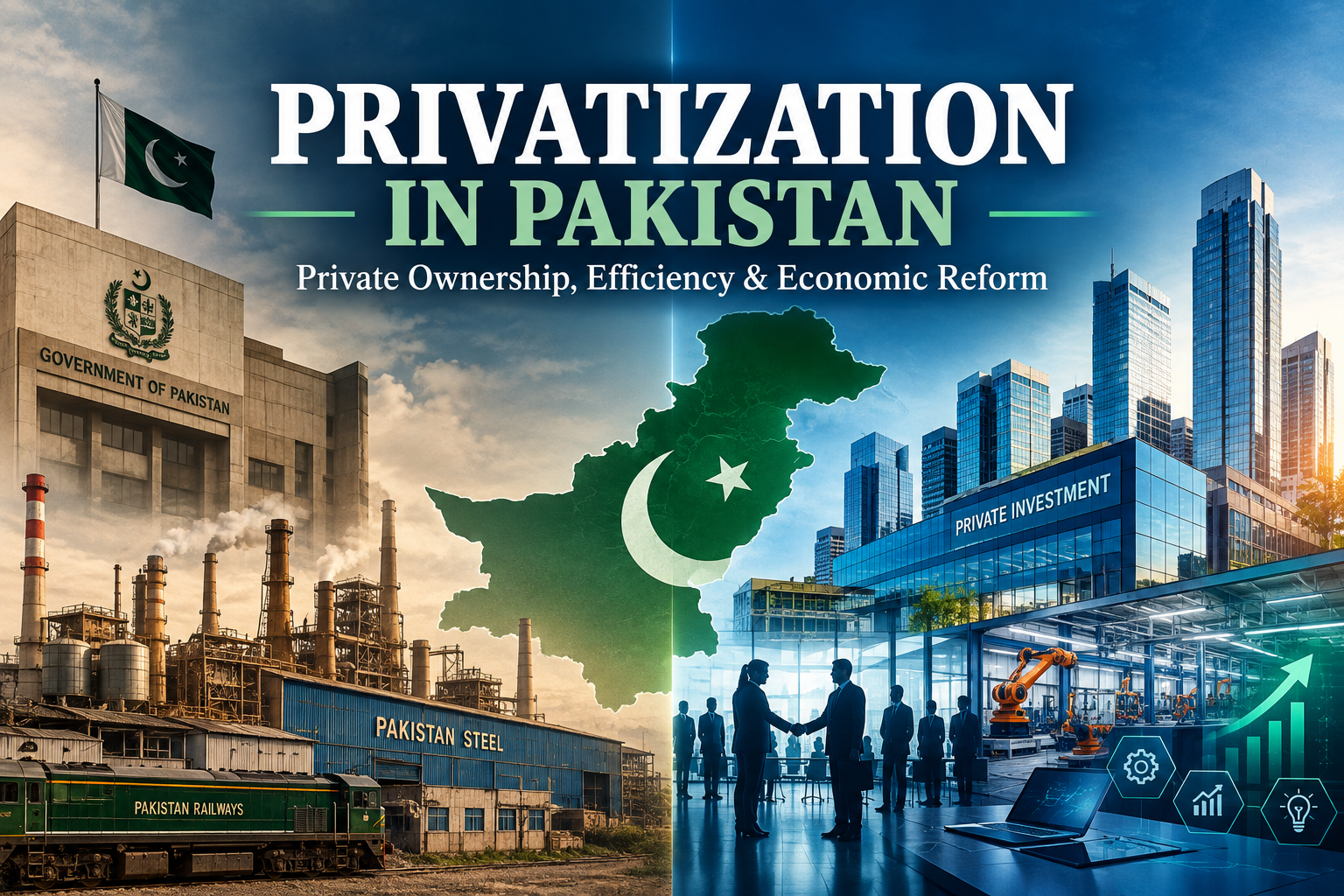
Privatization in Pakistan: Can Private Ownership Improve Efficiency?
Privatization in Pakistan has remained one of the most debated economic reform policies since the early 1990s. Supporters argue that transferring state-owned enterprises (SOEs) to private ownership can reduce government losses, improve management, attract investment, increase competition and enhance service delivery. Critics, however, believe that privatization can result in job losses, higher prices, private monopolies and the transfer of national assets to a limited group of investors.
Research Paper in PDF:
Privatization in Pakistan Can Private Ownership Improve Efficiency Research Paper in PDF
Download Power Point Presentation Slides:
Privatization-in-Pakistan-Can-Private-Ownership-Improve-Efficiency
Power Point Presentation Slides in PDF:
Privatization-in-Pakistan-Can-Private-Ownership-Improve-Efficiency presentation in PDF
The debate becomes more meaningful when Pakistan’s current privatization agenda is examined alongside the nationalization policies introduced during the government of former Prime Minister Zulfikar Ali Bhutto between 1972 and 1977. Bhutto’s government adopted nationalization to reduce the concentration of economic power, strengthen the role of the state and promote a socialist-oriented economic system. Decades later, successive governments moved in the opposite direction by promoting deregulation, liberalization and private-sector participation.
This raises an important question:
Can private ownership improve efficiency in Pakistan, or does the country need stronger governance and regulation rather than ownership transfer alone?
The answer requires an examination of Pakistan’s economic history, Bhutto’s nationalization policy, the reasons behind privatization and the conditions necessary for successful economic reform.
1. Understanding Privatization in Pakistan
Privatization is the process through which ownership, management or operational control of a government-owned enterprise is transferred to private investors. It may involve:
- Complete sale of a state-owned enterprise
- Partial sale of government shares
- Public-private partnerships
- Leasing of public assets
- Management contracts
- Concessions to private operators
- Strategic investment by private companies
In Pakistan, privatization has primarily been promoted as a way to reduce the financial burden of loss-making public enterprises and improve economic efficiency.
The official Privatization Commission of Pakistan describes privatization as part of a broader reform process involving deregulation, good governance, competition and increased private-sector participation. It also recognizes that privatization should not simply mean the transfer of public assets but should be connected with effective regulation and market competition.
The central argument is that private companies generally face stronger incentives to control costs, improve productivity, attract investment and satisfy customers. However, these benefits depend on the existence of competitive markets, capable management and effective regulatory institutions.
2. Why Did Pakistan Adopt Nationalization Under Zulfikar Ali Bhutto?
To understand the privatization debate, it is important to examine the economic environment of the early 1970s.
Following the separation of East Pakistan in December 1971, Pakistan faced serious political, economic and social challenges. Economic power was concentrated among a relatively small number of industrial and financial groups. The Pakistan Peoples Party, led by Zulfikar Ali Bhutto, presented itself as a party committed to social justice, workers’ rights and the reduction of economic inequality.
Bhutto became President of Pakistan in December 1971 and later became Prime Minister under the 1973 Constitution. His government believed that important sectors of the economy should be controlled by the state to prevent excessive concentration of wealth and to ensure that national resources served broader social objectives.
The nationalization programmed was therefore influenced by several factors:
- Concentration of industrial wealth
- Economic inequality
- Political commitments of the Pakistan Peoples Party
- Socialist economic thinking
- Desire to strengthen workers’ rights
- Distrust of powerful industrial and financial groups
- The belief that the state could guide national development
The policy was not introduced as a single decision. It developed in several stages between 1972 and 1977.
3. Timeline of Bhutto’s Nationalization Policy
3.1 First Phase: Industrial Nationalization — January 1972
The first major phase began in January 1972.
On 2 January 1972, the government announced the nationalization of major industries under the Economic Reforms framework. The policy covered approximately 32 industrial units across ten basic categories.
According to Pakistan’s official Privatization Commission, the sectors affected included:
- Iron and steel
- Basic metals
- Heavy engineering
- Heavy electrical machinery
- Motor-vehicle assembly and manufacturing
- Tractor assembly and manufacturing
- Heavy and basic chemicals
- Petrochemicals
- Cement
- Public utilities, including oil, gas and electricity
Zulfikar Ali Bhutto publicly explained the objectives of the policy in a national address on 12 January 1972. The government argued that nationalization would reduce economic concentration and support workers and national development.
The first phase was mainly focused on large-scale and strategic industries rather than every private business in the country.
3.2 Life Insurance Nationalization — March 1972
The nationalization process expanded into the financial sector in March 1972.
The Life Insurance (Nationalization) Order, 1972 was promulgated on 18 March 1972. This brought private life-insurance business under state control. The government subsequently established the State Life Insurance Corporation of Pakistan.
The official Pakistan Code records the Life Insurance (Nationalization) Order, 1972, as Ordinance No. 10 of 1972, with a promulgation date of 18 March 1972.
The government’s justification was that insurance was an important financial service and should be managed in a way that supported national savings, policyholder protection and economic planning.
3.3 Educational Institutions — September and October 1972
Nationalization also extended beyond industry and finance.
Private colleges were nationalized in September 1972, while the process was extended to schools in October 1972. The policy was intended to expand access to education and bring educational institutions under greater government supervision.
However, the policy also created concerns regarding:
- Administrative control
- Quality of education
- Institutional autonomy
- Government capacity
- Financial sustainability
- The treatment of private educational owners
The education sector demonstrated that nationalization was not limited to economic enterprises; it was also part of Bhutto’s broader vision of state-led social development.
3.4 Ghee and Vegetable-Oil Industry — August/September 1973
In 1973, nationalization was extended to the ghee and vegetable-oil industry.
The official Privatization Commission records that another 26 industrial units were nationalized in September 1973, including businesses associated with vegetable oil, life insurance, shipping and petroleum.
The government justified some of these measures on the grounds of controlling profiteering, stabilizing prices and preventing the exploitation of consumers. However, the expansion of nationalization also affected smaller entrepreneurs and private investors.
3.5 Banking Nationalization — January–March 1974
Banking nationalization was one of the most important decisions of the Bhutto government.
At the beginning of 1974, the government announced the nationalization of privately owned banks. The legal framework was subsequently formalized through the Banks (Nationalization) Act, 1974.
The Pakistan Code lists the Banks (Nationalization) Act, 1974 as Act XIX of 1974, promulgated on 4 March 1974. The National Assembly’s legislative record also identifies the Banks (Nationalization) Act on 7 March 1974, along with the Banks (Transfer of Assets and Liabilities) Act dated 1 March 1974.
The objectives of bank nationalization included:
- Expanding credit access
- Supporting agriculture and industry
- Reducing the influence of private financial groups
- Directing credit toward national development
- Improving financial inclusion
- Increasing state control over monetary resources
However, over time, political appointments, weak accountability, excessive government interference and operational inefficiencies became major concerns within the nationalized banking system.
3.6 Rice Husking and Cotton-Ginning Industries — 1976
In July 1976, the nationalization process expanded to rice husking and cotton-ginning industries. These sectors included a large number of small and medium-sized businesses.
This stage generated considerable resistance because the policy affected entrepreneurs who were not necessarily part of the large industrial groups targeted during the first phase of January 1972.
The expansion of nationalization from large strategic industries to smaller businesses weakened confidence among private-sector investors. It also increased concerns about the predictability of economic policy.
4. Was Bhutto’s Nationalization Policy Correct?
The question of whether Bhutto’s nationalization policy was correct cannot be answered through a simple “yes” or “no.” The policy had legitimate objectives, but its implementation produced serious long-term problems.
4.1 Arguments in Favor of Nationalization
A. Reduction of Economic Concentration
In the early 1970s, economic wealth and industrial ownership were concentrated among a small number of business groups. Nationalization was intended to reduce the dominance of these groups and distribute economic opportunities more broadly.
B. Protection of Workers
Bhutto’s government wanted to improve labour conditions and increase the role of workers in the economy. Nationalization was presented as a way to protect workers from exploitation and ensure better wages and benefits.
C. Strategic Control
The government believed that important sectors such as banking, energy, heavy industry and insurance were too important to be left entirely to private interests.
D. Developmental Planning
State ownership was expected to help the government direct credit, investment and industrial production toward national priorities rather than allowing investment decisions to be driven only by private profit.
E. Greater Access to Services
In theory, nationalization could help expand access to banking, education, insurance and industrial services, especially for underserved groups.
These objectives were not inherently unreasonable. Many countries have used public ownership to establish strategic industries, provide essential services and correct market failures.
5. Why Did Nationalization Create Problems?
Although the objectives of nationalization had some social and economic justification, the policy faced serious implementation weaknesses.
5.1 Political Interference
Public enterprises increasingly became vulnerable to political appointments and interference. Managers were not always selected on the basis of professional competence. Recruitment and promotion decisions could be influenced by political considerations.
5.2 Overstaffing
Many nationalized organizations experienced excessive employment. Hiring was sometimes used to provide political patronage rather than to meet operational requirements.
Overstaffing increased costs and reduced productivity. It also made later restructuring politically difficult.
5.3 Weak Corporate Governance
State-owned enterprises often lacked the same level of performance pressure faced by private firms. Since the government could provide financial support, managers had fewer incentives to control costs or improve profitability.
The official Privatization Commission identifies several problems that emerged in state-owned enterprises, including:
- Mismanagement
- Overstaffing
- Costly and inappropriate investments
- Poor service quality
- High debt
- Fiscal losses
- Increased corruption
5.4 Decline in Private Investment
Frequent and expanding nationalization created uncertainty among private investors. Businesses became concerned that successful companies could be taken over by the state or that government policy could change without adequate consultation.
The result was a decline in investor confidence and weaker incentives for long-term private investment.
5.5 Inefficient Resource Allocation
Government-owned institutions do not always allocate resources according to market demand or productivity. Political priorities may influence investment decisions, pricing and recruitment.
A research study on Pakistan’s economic development argued that Bhutto’s nationalization policy discouraged private investment and made long-term investment decisions more difficult.
5.6 Expansion Beyond Large Strategic Industries
The first phase in January 1972 focused on major industries. However, the later extension of nationalization to ghee, rice husking, cotton ginning and other smaller businesses increased resistance among private entrepreneurs.
This expansion made the policy less focused and weakened the argument that nationalization was limited to strategic sectors.
6. Was Nationalization a Major Loss for Pakistan?
It would be inaccurate to claim that nationalization alone caused all of Pakistan’s economic problems. Pakistan’s economy has also been affected by political instability, wars, energy shortages, weak tax collection, governance failures, external debt, global economic conditions and inconsistent policies.
However, the nationalization policy did create several long-term costs.
Major negative consequences included:
- Reduced private-sector confidence
- Increased bureaucratic control
- Political interference in commercial decisions
- Overstaffing and low productivity
- Fiscal pressure from loss-making enterprises
- Weak innovation
- Lower managerial accountability
- Delayed investment
- Difficulty in reversing state ownership
The policy’s greatest weakness was not necessarily the idea of state ownership itself. Rather, it was the absence of strong governance, performance monitoring and institutional accountability.
Some state-owned enterprises can perform well when they have professional management, financial discipline and clear public objectives. Therefore, the problem was not simply “public ownership”; it was often poor public-sector governance.
7. The Shift from Nationalization to Privatization
After Bhutto’s government ended in July 1977, the state gradually began reversing some nationalization measures.
The official Privatization Commission states that the Transfer of Managed Establishments Order, 1978 helped initiate a denationalization process. More than 50 small-scale enterprises, including flour mills, ginning factories and husking units, were returned to their original owners or transferred toward private management.
Further denationalization attempts took place in 1985 and 1989, although they had limited success. In 1988, the government also divested approximately 10% of its shares in Pakistan International Airlines through an initial public offering, according to the official history of privatization.
The formal institutionalization of privatization occurred on 22 January 1991, when the Privatization Commission was established as a sub-branch of the Finance Division. Later, the Privatization Commission Ordinance, 2000, was promulgated on 28 September 2000, strengthening the legal structure of the privatization programme.
This marked a major change in Pakistan’s economic philosophy:
| Nationalization Approach | Privatization Approach |
|---|---|
| State ownership | Private ownership |
| Central planning | Market-based decisions |
| Government management | Commercial management |
| Public-sector control | Private-sector participation |
| State-led investment | Private investment and competition |
However, neither approach is automatically successful. Both require good governance, transparency and accountability.
8. Can Privatization Improve Efficiency in Pakistan?
8.1 Stronger Commercial Incentives
Private owners have a direct financial interest in improving profitability and productivity. They are more likely to monitor costs, reduce waste and replace ineffective management.
8.2 Better Management
Private companies can generally make commercial decisions faster than government departments. They may have greater flexibility in:
- Recruitment
- Procurement
- Investment
- Technology adoption
- Pricing
- Marketing
- Business restructuring
8.3 Increased Investment
Private investors can bring capital, technology, management expertise and international partnerships. This is particularly important for industries requiring modernization and large-scale investment.
8.4 Better Customer Service
In competitive markets, private firms must respond to customer expectations. Poor service can lead to declining sales and loss of market share.
8.5 Reduced Government Subsidies
If a loss-making enterprise becomes financially sustainable under private ownership, the government may reduce subsidies and redirect public resources toward education, healthcare, infrastructure and social protection.
However, these benefits are not guaranteed. Privatization can fail when the process is non-transparent, competition is absent or regulators are weak.
9. Risks of Privatization in Pakistan
9.1 Private Monopolies
Selling a public monopoly to a private company without creating competition can produce a private monopoly. Such a company may increase prices and reduce service quality.
9.2 Job Losses
Private owners may reduce staff to control costs. Although this can improve efficiency, it can also create unemployment and social hardship.
9.3 Higher Consumer Prices
Private firms seek profits. In essential sectors such as electricity, transport and water, price increases can negatively affect low-income households.
9.4 Undervaluation of Public Assets
If public assets are sold below their actual value, the state and taxpayers may suffer financial losses.
9.5 Lack of Transparency
Privatization can generate allegations of corruption, political favoritism and conflict of interest if bidding and valuation processes are not open and independently monitored.
9.6 Weak Regulation
Private ownership without effective regulation may lead to exploitation, environmental damage, poor service quality and anti-competitive practices.
Therefore, privatization in Pakistan must not be treated as a simple sale of public assets. It should be part of a broader programme of institutional reform.
10. Examples from Pakistan’s Experience
10.1 Banking
Banking reforms and private-sector participation helped introduce modern technology, digital banking, new financial products and stronger competition. Nevertheless, financial inclusion, consumer protection and access to banking in rural areas remain important challenges.
10.2 Telecommunications
The telecommunications sector demonstrates how private investment and competition can improve connectivity, service variety and technological development. The sector’s progress was supported by regulatory reforms and increased competition rather than ownership transfer alone.
10.3 Energy Distribution
Pakistan’s energy sector continues to face circular debt, transmission and distribution losses, electricity theft, weak bill collection and governance problems. Private-sector participation may improve management, but it must be accompanied by strong regulation, transparent tariffs and consumer protection.
10.4 PIA Privatization: Debt Restructuring and the Test of Private Ownership
Pakistan International Airlines (PIA) is one of the most significant examples of the country’s recent privatization policy. The airline had accumulated substantial financial and operational problems, including legacy debt, government guarantees, pension obligations, political interference, overstaffing, fleet limitations and recurring losses.
To make the transaction more attractive to investors, Pakistan restructured PIA before privatization. Under the restructuring arrangement approved in April 2024, specified non-core assets, legacy liabilities and obligations were transferred to PIA Holding Company Limited, allowing the operating airline to present a relatively cleaner balance sheet. Official and parliamentary records indicate that legacy liabilities transferred out of the operating airline were in the range of Rs. 650–673 billion, although the exact figure varies according to the liabilities included in different restructuring accounts.
The privatization bidding was held on 23 December 2025, when an Arif Habib-led consortium won a 75% stake in PIA for Rs. 135 billion, surpassing the competing bid of Rs. 134 billion submitted by the Lucky Cement consortium. However, the transaction was not simply a Rs. 135 billion cash sale to the government. Under the final financial structure announced by the government in June 2026, the consortium committed a total investment of Rs. 180 billion, comprising Rs. 55 billion for the acquisition and Rs. 125 billion to be injected into PIA for its revival and transformation. Management control was formally transferred to the investor consortium on 29 June 2026, following the first financial closing.
It is still too early to declare PIA’s privatization a complete success or failure. As of June 2026, the new management had only recently taken operational control, so long-term evidence regarding profitability, fleet expansion, service quality, punctuality and financial sustainability remains limited. The transaction may improve performance if the new owners invest in aircraft, strengthen management, reduce operational inefficiencies and improve customer service. However, its success will depend on whether the promised investment is implemented, whether regulatory oversight remains effective and whether the airline can become commercially sustainable without returning to the public exchequer for financial support.
11. What Should Pakistan Do?
Pakistan should avoid both extreme state control and uncontrolled privatization. A balanced and selective approach would be more appropriate.
Policy recommendations include:
- Privatize selectively.
Not every state-owned enterprise should be sold. Strategic and essential-service institutions may require public ownership or public oversight. - Conduct independent valuations.
Public assets should be valued through transparent and internationally credible procedures. - Ensure competitive bidding.
Transactions should be open, competitive and free from political favoritism. - Strengthen regulatory institutions.
Independent regulators should prevent monopolies and protect consumers. - Improve corporate governance.
Professional boards, audited accounts, performance contracts and transparent appointments are essential. - Protect workers.
Employees affected by restructuring should receive compensation, retraining and pension protection. - Resolve debt before privatization.
Financial liabilities, legal disputes and pension obligations should be clarified before an enterprise is sold. - Use public-private partnerships where appropriate.
Full privatization is not always necessary. Management contracts, concessions and joint ventures may provide better alternatives. - Measure outcomes after privatization.
Success should be evaluated through productivity, service quality, investment, employment, consumer satisfaction and reduced fiscal losses. - Separate politics from commercial management.
Both public and private enterprises require professional management and accountability.
Conclusion
The debate over privatization in Pakistan cannot be separated from the country’s experience with nationalization under Zulfikar Ali Bhutto.
Bhutto’s first major nationalization measures began in January 1972, followed by life-insurance nationalization on 18 March 1972, further industrial nationalization in September 1973, banking nationalization under the 1974 legislation, and the expansion of state control into smaller industries by July 1976.
The policy had understandable objectives: reducing economic concentration, protecting workers, expanding state-led development and directing resources toward national priorities. However, political interference, overstaffing, weak management, declining private investment and fiscal inefficiencies undermined many of its intended benefits.
The later shift toward privatization, formally institutionalized through the establishment of the Privatization Commission on 22 January 1991, reflected the recognition that the state cannot efficiently manage every commercial activity.
Nevertheless, privatization is not automatically a solution. Private ownership can improve efficiency when it is combined with competition, professional management, transparent transactions, strong regulation and public accountability. Without these conditions, privatization may simply replace a public monopoly with a private monopoly.
Therefore, the most suitable policy for Pakistan is neither complete nationalization nor indiscriminate privatization. The country needs a selective, transparent and socially responsible reform strategy that distinguishes between strategic public services, commercially viable enterprises and persistently loss-making organizations.
Official Sources and Useful Links
- Ministry of Privatization, Government of Pakistan — Overview
Privatisation Commission Overview - Ministry of Privatisation — History and Establishment
Privatisation Commission About Us - Pakistan Code — Banks (Nationalization) Act, 1974
Pakistan Code - National Assembly of Pakistan — Acts and Legislative Record
National Assembly Acts Record - Pakistan Code — Life Insurance (Nationalisation) Order, 1972
Pakistan Code 1972 Laws - National School of Public Policy — Privatization Policy Paper
Privatization in Pakistan Policy Paper
Private ownership can improve efficiency in Pakistan, but only when ownership reform is supported by good governance, fair competition, effective regulation and protection of the public interest.


