
2026 United States of America strikes in Venezuela
In a dramatic pre-dawn raid on January 3, 2026, the United States executed Operation Absolute Resolve, a military strike on Venezuela that resulted in the capture of President Nicolás Maduro and his wife, Cilia Flores. U.S. forces suppressed air defenses across northern Venezuela before seizing the pair at their Caracas residence. Flown to New York City, both pleaded not guilty to narcoterrorism charges in a Manhattan court on January 5.
President Donald Trump justified the mission as a law-enforcement action under “inherent constitutional authority,” citing access to Venezuelan oil as a strategic motivator. The operation proved lethal, with 24 Venezuelan and 32 Cuban personnel killed.
The United Nations and legal experts condemned the raid as a violation of sovereignty. Despite the capture, the Venezuelan government persists; Vice President Delcy Rodríguez was sworn in as Acting President, denouncing the incident as a “kidnapping” while facilitating the release of political prisoners at Washington’s request.
Background
Political, Economic and International
Venezuela’s current volatility is rooted in the 2010s oil glut, which devastated its export-heavy economy. Since succeeding Hugo Chávez in 2013, Nicolás Maduro has faced intense international scrutiny for authoritarianism. A disputed 2018 re-election triggered a massive diplomatic crisis, prompting the U.S. to impose crippling sanctions under three consecutive administrations.
Tensions peaked following the 2024 presidential election. While Maduro claimed victory, international observers and the opposition provided evidence of widespread fraud. In early 2025, the U.S. formally recognized opposition leader Edmundo González as the legitimate president-elect, further isolating the Maduro regime.
Parallel to Maduro’s rise is the influence of Cilia Flores, dubbed the “First Combatant.” A former attorney for Chávez, Flores has held high-ranking roles as President of the National Assembly and Attorney General. However, her tenure was plagued by allegations of nepotism and corruption. Sanctioned by multiple nations, Flores and Maduro became primary targets for the 2026 U.S. mission, driven by both narcoterrorism charges and the strategic goal of securing Venezuela’s vast oil reserves.
Oil and Mineral Resources
Venezuela sits atop the world’s largest proven oil reserves, boasting approximately 300 billion barrels—a staggering 17% of the global total. By December 2025, the U.S. moved to capitalize on this strategic dominance by initiating a maritime blockade, intercepting tankers carrying Venezuelan crude across the Caribbean.
The “Triple Goal” Strategy
The Trump administration has framed the 2025–2026 operations as a multi-pronged mission designed to achieve three primary objectives:
-
Neutralizing the Regime: Systematically crippling the Maduro administration’s power base.
-
Disrupting Narcoterrorism: Severing established drug trafficking routes through the region.
-
Securing Energy Assets: Gaining direct access to Venezuelan oil for the U.S. Strategic Petroleum Reserve.
President Trump and advisors like Stephen Miller have justified these moves by citing the nationalization of oil assets in 1976 and 2007, alleging that Venezuela “stole” resources from American corporations.
Beyond Black Gold: Gold and Rare Earth Minerals
The interest extends beyond petroleum. Washington has turned its gaze toward Venezuela’s immense deposits of gold and rare earth minerals. While the Maduro government previously attempted to trade mineral access for diplomatic leniency, analysts now describe the current military-led approach as a return to “resource imperialism.” This shift marks a significant escalation in how the U.S. secures critical materials necessary for modern technology and national defense.
Indictment of Maduro
The United States has formally branded the administration of captured Venezuelan leader Nicolás Maduro a “narco-state,” unsealing a high-stakes federal indictment that links the regime to global terrorism. This legal escalation follows years of accusations involving electoral fraud and systemic corruption.
In a pivotal shift during early 2025, the U.S. officially designated two prominent Venezuelan criminal entities—Tren de Aragua and the Cartel of the Suns—as Foreign Terrorist Organizations (FTOs). While the White House identifies Maduro as the architect of the Cartel of the Suns, regional crime experts offer a more nuanced view, describing the “cartel” not as a traditional hierarchical gang, but as a pervasive network of military and state-sponsored corruption.
The legal strategy crystallized in July 2025 through a classified executive order authorizing the U.S. military to use force against these designated terrorist cartels. While Maduro has consistently dismissed these charges as a pretext for “regime change,” the Department of Justice maintains that the alliance between the Venezuelan state and groups like the Sinaloa Cartel and FARC constitutes a direct threat to U.S. national security.
United States Military buildup
In August 2025, the U.S. initiated a Caribbean buildup, featuring CIA tracking and Delta Force rehearsals in mock fortresses. Trump rejected a Qatari-mediated “Madurismo without Maduro” transition proposal, favoring escalation. Following oil-access promises from opposition leader María Corina Machado, a maritime blockade and tanker seizures commenced by December.
Supported by Trinidadian airport access, General Dan Caine deployed 150 aircraft after Trump’s January 2 strike announcement. Maduro’s refusal of Turkish exile and his public mockery—dancing to “No crazy war”—reportedly finalized Trump’s decision. This campaign integrated covert CIA operations with the massive January 3 assault to capture Maduro.
Strikes
At 23:46 VET on January 2, 2026, President Trump ordered the strikes, bypassing Congress for operational security while major media outlets were pre-notified. By 02:00 VET on January 3, a 150-aircraft joint force launched a 30-minute assault across northern Venezuela and Caracas. Utilizing stealth fighters, B-1B bombers, and the first operational U.S. one-way attack drones, the military neutralized power and communications.
While 160th SOAR helicopters delivered Delta Force and FBI Hostage Rescue Team members to capture Maduro, strikes hit Fort Tiuna, La Carlota, and Higuerote Airport—destroying a Buk-M2E system and warehouses. Despite taking ground fire that damaged one helicopter, U.S. forces successfully arrested Maduro. Venezuela subsequently declared a national state of emergency, condemning the “imperialist aggression” and demanding an urgent UN Security Council hearing.
Capture of Nicolás Maduro
At 05:21 VET on January 3, 2026, President Trump officially announced the successful capture and extraction of Nicolás Maduro and Cilia Flores. The high-stakes mission was executed by the U.S. Army’s Delta Force, utilizing ground-level intelligence provided by the CIA.
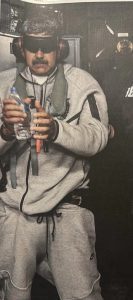
As proof of the operation’s success, Trump shared a striking image on Truth Social showing Maduro aboard the USS Iwo Jima. The former leader was seen blindfolded, wearing soundproof headphones and a gray Nike sweatsuit, while clutching a plastic water bottle. Secretary of State Marco Rubio confirmed that Maduro would face immediate federal criminal charges upon arrival on American soil.
Political Fallout and Disappearance
The capture reportedly took place at the couple’s residence within the Fort Tiuna military complex, according to PSUV leader Nahum Fernández. In the chaotic hours following the raid, Delcy Rodríguez issued an audio message on state television demanding proof that the pair were still alive. Conflicting reports placed Rodríguez in Russia at the time of the assault, though other sources argued she remained in Caracas.
The Journey to Federal Custody
The transition from Caracas to a New York jail cell happened in under 24 hours:
-
18:00 VET: The jet carrying the captives landed at Stewart Air National Guard Base in New York.
-
Manhattan Transit: Maduro was transported via helicopter to the Westside Heliport and moved by armored convoy to a DEA field office for processing.
-
Detention: He is currently being held at the Metropolitan Detention Center, awaiting a historic trial for narcoterrorism.3
Legal proceedings
Hours after their capture, U.S. Attorney General Pam Bondi announced that Nicolás Maduro and Cilia Flores were indicted in New York on narcoterrorism and weapons charges. Arraigned on 5 January 2026, Maduro claimed prisoner-of-war status. Both pleaded not guilty, and Judge Alvin Hellerstein ordered Maduro detained until a 17 March hearing.
Casualties
Venezuelan Defense Minister Vladimir Padrino López stated that U.S. combat helicopters fired rockets and missiles in urban areas, with casualties still under investigation. The New York Times reported at least 40 deaths on 3 January 2026, later revised to 80. Independent Venezuelan journalists said most fatalities were presidential guard members, with two civilians. President Trump claimed Cuban forces were involved. Cuba confirmed 32 Cuban military and intelligence personnel were killed. By 6 January, 55 military deaths were confirmed: 32 Cubans and 23 Venezuelans, with identities released. Attorney General Tarek William Saab said dozens of civilians and soldiers were killed, while Diosdado Cabello later cited 100 deaths. Independent monitors reported 42–43 Venezuelan soldiers, 32 Cubans, and two civilians killed. Acting President Delcy Rodríguez declared seven days of mourning. Civilian strikes in Catia La Mar killed one person and injured another; a Colombian civilian also died in El Hatillo. The U.S. Defense Department confirmed seven U.S. soldiers were injured but survived.
Aftermath
After Maduro’s capture, his government remained in place. Vice President Delcy Rodríguez declared Maduro Venezuela’s only president, condemned his “kidnapping,” and called for unity. On 3 January 2026, the Supreme Tribunal ordered Rodríguez to assume the presidency, and the military recognized her as acting president. She was sworn in on 5 January. The US FAA banned US flights over Venezuela, the US embassy issued a shelter-in-place order from Colombia, and parts of Caracas lost power.
President Trump said the US would oversee Venezuela’s transition, possibly deploying troops, invoking the Monroe (“Donroe”) Doctrine, and signaling US oil involvement. He criticized opposition leader María Corina Machado, while backing Rodríguez, though her statements contradicted his. Marco Rubio later clarified the US would not govern Venezuela, would maintain oil sanctions, and did not officially recognize Rodríguez. Talks began on restoring diplomatic relations.
Venezuela ordered arrests of US-attack supporters, mobilized colectivos, and detained journalists. Clashes occurred in Caracas. Trump claimed oil cooperation, which Rodríguez denied. On 8 January, the US Senate limited Trump’s war powers. Venezuela released political prisoners, prompting Trump to cancel further attacks. The US later urged its citizens to leave Venezuela due to security risks.
