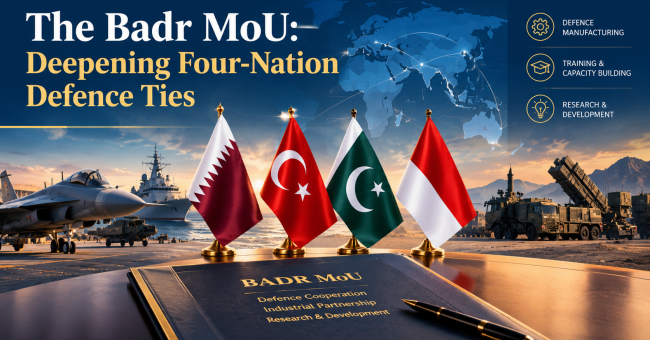
The Badr MoU: Deepening Four-Nation Defence Ties
Defence cooperation is increasingly about more than buying weapons. Countries are seeking access to military technology, local manufacturing, research and development, technical training, and reliable supply chains. These capabilities can help governments reduce dependence on external suppliers while strengthening their domestic defence industries.
On October 21, 2026, Qatar, Türkiye, Pakistan and Indonesia signed the Badr Memorandum of Understanding (MoU) in Doha. According to Qatar News Agency and Türkiye’s defence authorities, the initiative aims to promote defence manufacturing, strengthen military capabilities, and expand cooperation in technical training, research and development (R&D).
The agreement brings together four countries with different economic resources, industrial strengths and strategic priorities. Türkiye has developed a substantial defence manufacturing sector, Pakistan has experience in several military production fields, Qatar has significant investment capacity, and Indonesia offers a large domestic market and an established industrial base.
However, an important question remains: Is the Badr MoU a collective-defence alliance, similar to NATO or the Makkah Joint Defence Agreement, or is it primarily a framework for defence production and technological cooperation?
Understanding this distinction is essential to assessing what the initiative could achieve and what it does not currently promise.
What Is the Badr MoU?
The Badr MoU is a multilateral framework signed by the defence authorities of Qatar, Türkiye, Pakistan and Indonesia. Its publicly announced objectives include cooperation in defence manufacturing, enhanced military capabilities, technical defence training, and research and development.
The agreement seeks to bring together the participating countries’ capabilities to support the development of modern defence systems and strengthen their respective defence industries.
Potential areas for cooperation include:
- Joint development and production of military equipment.
- Technology sharing and industrial collaboration.
- Research into modern defence systems and technologies.
- Technical training and the development of specialised personnel.
- Cooperation on manufacturing, maintenance and supply chains.
- Opportunities to develop products for participating countries and other friendly nations.
These areas could help the four countries coordinate existing projects and explore new industrial partnerships.
Nevertheless, signing an MoU does not automatically mean that every proposed project has been approved, funded or scheduled. Actual results will depend on follow-up agreements, budgets, technology-transfer arrangements, procurement decisions and implementation.
Why Are Qatar, Türkiye, Pakistan and Indonesia Cooperating?
The four countries do not have identical military requirements or defence industries. Their potential value lies in the possibility of combining complementary resources rather than expecting each country to perform the same role.
For Türkiye, wider cooperation can create opportunities for defence exports, technology partnerships and larger production programmes. Pakistan and Indonesia can explore ways to strengthen local manufacturing and acquire technical expertise. Qatar can use its financial resources and defence requirements to support investment and procurement partnerships.
A successful arrangement could benefit participating countries by creating longer-term industrial relationships rather than relying exclusively on the purchase of finished weapons from foreign suppliers.
However, the extent of these benefits will depend on the specific projects agreed by the partners. The MoU itself should not be interpreted as proof that a fully integrated four-country defence industry already exists.
Türkiye’s Role: Defence Technology and Systems Development
Türkiye is an important industrial participant because it has developed domestic capabilities across several defence sectors, including unmanned aerial vehicles, armoured vehicles, naval platforms, missiles, electronics and other military systems.
Turkish defence companies have also established international partnerships involving exports, local production and technology development. Existing cooperation with Pakistan, Qatar and Indonesia provides a foundation on which further projects could be developed.
Türkiye’s potential contributions to the Badr framework include:
- Defence-system design and engineering.
- Systems integration and industrial expertise.
- Joint development of selected military equipment.
- Training and technical knowledge-sharing.
- Manufacturing partnerships and maintenance support.
Türkiye’s existing projects illustrate how this model can work. Turkish-Pakistani naval cooperation includes the MILGEM corvette programme, while Türkiye and Indonesia have cooperated on the development of the Kaplan MT/Harimau medium tank.
These projects demonstrate established bilateral industrial links, although they do not mean that every project is automatically part of the new Badr framework.
Türkiye is also a member of NATO. Its participation in Badr therefore demonstrates that defence-industry cooperation with additional partners can coexist with membership in an established military alliance.
Key question: Will Türkiye share technology and manufacturing responsibilities in new projects, or will cooperation mainly involve purchasing Turkish-designed equipment? The answer will depend on the individual contracts and technology-transfer provisions.
Pakistan’s Role: Manufacturing, Engineering and Military Experience
Pakistan enters the Badr framework with experience in defence manufacturing, engineering, maintenance and military procurement. Its defence sector includes organisations working on aircraft, armoured vehicles, ammunition, naval platforms, electronics and related equipment.
Pakistan Aeronautical Complex has participated in aircraft manufacturing and maintenance, including the JF-17 Thunder programme with China. Pakistan also has experience in naval construction and military equipment production through domestic defence organisations.
Potential areas of Pakistani participation include:
- Local production and assembly of selected equipment.
- Aircraft maintenance, engineering and support services.
- Naval construction and related industrial cooperation.
- Development of components and manufacturing capabilities.
- Technical training and collaboration with foreign defence companies.
Cooperation with Türkiye could help Pakistan expand selected production capabilities and improve access to engineering expertise. Partnerships with Qatar could potentially provide investment or procurement opportunities, while Indonesia could offer opportunities for wider manufacturing cooperation and market access.
However, these are potential areas of cooperation, not confirmed allocations of responsibility under the Badr MoU. Specific programmes, funding commitments and production arrangements will need to be announced separately.
For Pakistan, the practical measure of success will be whether cooperation generates local industrial capacity, skilled employment, sustainable maintenance capabilities and technology development—not simply additional equipment purchases.
Qatar’s Role: Investment, Procurement and Strategic Partnerships
Qatar has a different profile from Türkiye and Pakistan. Its potential contribution to the Badr initiative is associated with financial resources, defence procurement requirements and its ability to participate in international investment partnerships.
Qatar has previously developed defence and military relationships with Türkiye, including cooperation that extends beyond commercial transactions. Türkiye also maintains a military presence in Qatar, illustrating the depth of their existing bilateral security relationship.
Within the Badr framework, Qatar could potentially support:
- Investment in selected defence-industry projects.
- Procurement arrangements that provide demand for jointly developed systems.
- Partnerships between defence manufacturers and local institutions.
- Training and technical cooperation.
- The development of longer-term supply and maintenance relationships.
Investment can be valuable because defence manufacturing often requires substantial initial funding, specialised facilities and long-term orders. Nevertheless, the MoU’s signing does not by itself establish a particular financial contribution from Qatar or guarantee that a project will receive funding.
Qatar’s strategic interest also does not necessarily mean that it intends to replace its existing security relationships with the United States. A country can maintain established partnerships while exploring additional suppliers and industrial relationships.
Indonesia’s Role: Industrial Capacity and a Large Domestic Market
Indonesia brings a different set of opportunities. As a large Southeast Asian country, it has domestic defence requirements and an interest in developing its own industrial and technological capabilities.
Indonesia has experience in defence manufacturing through companies and institutions working on aircraft, naval systems, armoured vehicles and other equipment. It has also pursued international partnerships intended to develop local production and technical expertise.
Türkiye-Indonesia cooperation on the Kaplan MT/Harimau medium tank provides an example of their existing defence-industrial relationship.
Under the Badr framework, Indonesia could explore:
- Local manufacturing and assembly of selected military systems.
- Joint development and engineering projects.
- Technology transfer where agreed by the participating parties.
- Training for technical personnel.
- Industrial partnerships that support domestic production and maintenance.
Indonesia’s market could provide a basis for longer production runs, but market size alone does not guarantee successful manufacturing. Projects require financing, reliable suppliers, technical expertise and sufficient demand.
Indonesia also maintains defence relationships with countries beyond this four-country group. Participation in Badr should therefore be understood as an additional avenue for cooperation, not evidence that Indonesia has committed itself exclusively to a particular defence bloc.
What Does Each Country Bring to the Table?
The following comparison identifies possible contributions based on existing capabilities. These are analytical assessments, not official role assignments under the Badr MoU.
| Country | Potential contribution | Possible benefit |
|---|---|---|
| Türkiye | Defence technology, systems integration, established manufacturers and export experience | Joint development, manufacturing partnerships and wider markets |
| Pakistan | Engineering, aircraft-related production and maintenance, naval construction and other defence manufacturing | Local production, technical learning and industrial expansion |
| Qatar | Investment capacity, procurement demand and strategic partnerships | Financing opportunities and longer-term industrial projects |
| Indonesia | Domestic market, manufacturing experience and demand for local industrial development | Local production, workforce development and regional opportunities |
The countries’ capabilities are not interchangeable. Türkiye’s industrial expertise does not automatically replace Qatar’s potential financial contribution, and investment cannot substitute for engineering knowledge or production facilities.
The central challenge is to convert complementary strengths into projects that are technically practical, commercially sustainable and acceptable to all four governments.
The Makkah Pact Joint Defence
The Badr MoU and the Makkah Joint Defence Agreement are related to defence cooperation, but their stated purposes are different.
The Makkah Joint Defence Agreement was signed by Pakistan, Saudi Arabia and Türkiye on August 7, 2026. Pakistan’s Foreign Ministry stated that an armed attack against one of the three participating countries would be regarded as an attack against all, consistent with the right of individual and collective self-defence under Article 51 of the United Nations Charter.
The Badr MoU, signed in October 2026 by Qatar, Türkiye, Pakistan and Indonesia, has a publicly announced focus on defence manufacturing, military capabilities, technical training and research and development.
The distinction is important.
| Feature | Badr MoU | Makkah Joint Defence Agreement |
|---|---|---|
| Participants | Qatar, Türkiye, Pakistan and Indonesia | Saudi Arabia, Türkiye and Pakistan |
| Main stated focus | Defence production, industrial cooperation, training and R&D | Collective defence and deterrence, alongside wider defence cooperation |
| Publicly stated attack-on-one commitment | Not announced in the publicly described scope | Yes, according to Pakistan’s Foreign Ministry |
| Industrial cooperation | A central objective | Defence-industry cooperation is also included in the wider framework |
| What it means in practice | Potential joint projects, subject to implementation | A collective-defence commitment, with its practical arrangements dependent on implementation |
The Makkah agreement also has an institutional dimension. In an August 31, 2026, joint statement, the participating countries said a secretariat would be established in Saudi Arabia and that they would strengthen cooperation in defence industries, joint technology development and production.
This means the two arrangements are not necessarily competing initiatives. Industrial cooperation under Badr could complement wider security partnerships, but the two frameworks should not be treated as legally identical.
Why Are Qatar and Indonesia Not Members of the Makkah Agreement?
The Makkah Joint Defence Agreement was concluded by Saudi Arabia, Türkiye and Pakistan. Qatar and Indonesia were not among its three signatories.
There is an important distinction between a country being excluded from an agreement and a country simply not being a party to it. The publicly available statements do not establish that Qatar or Indonesia formally applied to join and were rejected, nor do they provide a definitive explanation of why the agreement was negotiated with these three participants.
The countries also have different geographical priorities and security relationships.
Saudi Arabia and Qatar are Gulf states with their own national defence priorities. Pakistan has longstanding security relations with Saudi Arabia and established military ties with Türkiye. Indonesia’s main geographical and strategic environment is Southeast Asia, where its security requirements and regional relationships differ from those of the Gulf.
These differences can influence the scope and membership of defence arrangements, but they do not establish the private motives behind any government’s decision.
Qatar and Indonesia can cooperate with Pakistan and Türkiye on defence production without becoming parties to the Makkah collective-defence commitment. Likewise, signing the Badr MoU does not automatically make either country a member of the Makkah agreement.
The key point is that membership in a defence-industrial framework is not the same as accepting a collective obligation to defend another country against an armed attack.
Is the Badr MoU Similar to NATO?
NATO is a formal political and military alliance founded by treaty. Article 5 of the North Atlantic Treaty states that an armed attack against one or more members in Europe or North America is considered an attack against them all, with each ally taking the action it deems necessary, including the possible use of armed force.
The Badr MoU has a different publicly announced purpose. Its stated areas of cooperation centre on defence manufacturing, military capabilities, technical training and research and development.
The available official description does not establish a NATO-style collective-defence guarantee, an integrated command structure or a commitment to deploy armed forces if one signatory is attacked.
This distinction matters because countries can cooperate closely in manufacturing military equipment without agreeing to fight a war together.
The Badr partners could eventually develop additional arrangements, but any future mutual-defence commitment would need to be established through a separate, clearly defined agreement or an amendment whose terms were officially confirmed.
Would an Attack on One Badr Member Mean an Attack on All Four?
Based on the publicly announced scope of the Badr MoU, there is no confirmed basis for treating an attack on one participant as an automatic armed attack on all four.
The agreement is described as a framework for defence-industrial cooperation, capability development, training and R&D. Those activities can strengthen national defence, but they do not by themselves create a mutual-defence obligation.
If a military crisis affected one of the participating countries, the other three might offer diplomatic support, intelligence cooperation, equipment, logistical assistance or other help, depending on their decisions and existing arrangements. Such assistance should not be assumed to be automatic.
Any obligation to provide military assistance would depend on the actual legal commitments agreed by the governments.
This also means the Badr MoU should not be presented as a four-country military shield comparable to NATO or as an extension of the Makkah Agreement. The available public information does not establish that status.
Does the Distance Between Türkiye, Pakistan and Indonesia Matter?
Geography matters for military operations, but it does not prevent international defence-industrial cooperation.
Türkiye and Pakistan are separated by a considerable distance from Indonesia, an archipelagic state in Southeast Asia. Moving troops, aircraft, naval vessels, ammunition and heavy equipment across these distances would require transport capacity, logistics, access arrangements and planning.
A collective-defence alliance involving distant countries would therefore face practical questions about deployment times, military access, command coordination and sustained operations.
However, the Badr MoU’s publicly stated industrial focus makes geographical distance less of a direct obstacle. Researchers can collaborate across borders, manufacturers can produce components in different countries, and equipment can be jointly designed or assembled through international supply chains.
For example, one country might contribute engineering expertise, another might manufacture components, a third might provide investment, and another might assemble or maintain the finished system. Whether any such model will be adopted under Badr remains to be seen.
The distance between the participants is therefore not proof that cooperation will fail. It is a reason to distinguish between an industrial partnership and a commitment to deploy forces jointly during a war.
What Are the Main Challenges Facing the Badr Initiative?
Despite the potential benefits, several challenges could affect the initiative.
1. Turning the MoU into funded projects
A memorandum creates a framework for cooperation, but projects need budgets, contracts, timelines and clear responsibilities. Without these, the initiative could remain largely declaratory.
2. Technology-sharing restrictions
Defence technology is often sensitive. Governments and companies may impose restrictions on intellectual property, software, components and end users. The partners will need clear agreements on what can be shared and under what conditions.
3. Different industrial capabilities
The four countries do not have the same levels of experience across all defence sectors. Effective projects will need to match technical tasks with realistic capabilities instead of assuming that every participant can manufacture every component.
4. Procurement and financial risks
Joint programmes can become expensive if requirements change, production is delayed or expected orders fail to materialise. Investment and procurement commitments will need to be commercially sustainable.
5. Compatibility between military systems
Equipment produced by different countries may use different communications, software, maintenance and logistical standards. Technical coordination will be important if jointly developed systems are expected to work together.
6. Different foreign-policy priorities
The four countries have different regional responsibilities and international partnerships. Cooperation in defence production does not mean they will automatically share the same position on every conflict or foreign-policy issue.
These challenges do not make the initiative unworkable. They show why concrete projects and transparent implementation will matter more than the signing ceremony alone.
What Could the Badr MoU Mean for Regional Security?
If implemented effectively, the Badr framework could help the four participants diversify defence suppliers, strengthen selected domestic industries and develop longer-term technology partnerships.
For Türkiye, it could expand industrial cooperation and create additional markets for defence products. Pakistan and Indonesia could seek greater local production and technical expertise. Qatar could explore investment and procurement partnerships that support a broader defence-industrial network.
The arrangement could also complement other defence relationships without replacing them. Participation in Badr does not automatically imply that Qatar, Türkiye, Pakistan or Indonesia intends to abandon existing partnerships with the United States, China or other countries.
At the same time, the agreement should not be portrayed as an established regional military alliance capable of guaranteeing the security of all four participants. That conclusion would go beyond the publicly stated terms.
Its long-term significance will depend on whether the governments establish funded programmes, share appropriate technology, develop manufacturing capacity and deliver systems that meet their military requirements.
Official and Reliable Sources
- Qatar News Agency — Badr MoU announcement
- Reuters — Four countries sign defence cooperation accord
- Pakistan Foreign Ministry — Makkah Joint Defence Agreement
- Pakistan Foreign Ministry — Makkah Agreement Joint Statement
- NATO — The North Atlantic Treaty
- Al Jazeera — How Qatar, Türkiye, Pakistan and Indonesia are deepening defence ties
