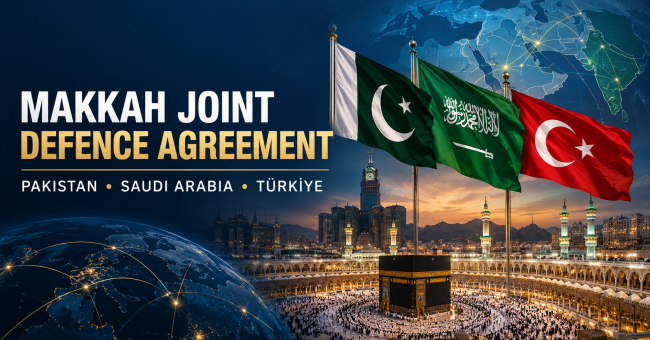
Makkah Joint Defense Agreement: Pakistan, Saudi Arabia and Türkiye
The Makkah Joint Defense Agreement signed by Pakistan, Saudi Arabia and Türkiye on 7 August 2026 represents a significant development in the security landscape of the Middle East and South Asia. The agreement was signed in Makkah Al-Mukarramah during the Makkah Al-Mukarramah Summit for Joint Defense attended by Saudi Crown Prince and Prime Minister Mohammed bin Salman, Turkish President Recep Tayyip Erdoğan and Pakistani Prime Minister Muhammad Shahbaz Sharif.
At the center of the agreement is a collective-defense principle: an armed attack against any one of the three countries is to be regarded as an attack against all three. Pakistan’s Foreign Office describes the agreement as defensive in nature and says that it is intended to strengthen collective deterrence against external aggression rather than target any particular country.
The agreement is particularly significant because it brings together three states with different geographical positions but increasingly connected strategic interests. Pakistan links South Asia with the Gulf, Saudi Arabia is a major regional power at the center of the Arab Gulf, and Türkiye possesses significant military capabilities and a growing role in Middle Eastern security.
The agreement also comes against a backdrop of continuing regional conflicts involving Gaza, Lebanon, Syria and the wider Gulf security environment. This raises a broader question: Does the Makkah framework represent a new layer of regional self-defence alongside existing U.S. security partnerships, and how might it respond to future regional crises?
What Is the Makkah Joint Defence Agreement?
The Makkah Joint Defence Agreement was signed on 7 August 2026 in Makkah, Saudi Arabia, by Pakistan, Saudi Arabia and Türkiye. The agreement seeks to strengthen defence cooperation, collective deterrence and coordination among the three countries.
The agreement states that an armed attack against one member will be regarded as an armed attack against all three. Pakistan’s Foreign Office has linked this principle to the inherent right of individual and collective self-defence recognised under Article 51 of the United Nations Charter.
The framework therefore goes beyond a conventional bilateral defence relationship. It establishes a trilateral mechanism through which Pakistan, Saudi Arabia and Türkiye can develop closer defence coordination and institutional cooperation.
However, the agreement should not automatically be interpreted as creating a NATO-style organisation. Its practical military obligations, command arrangements and mechanisms for responding to a particular attack will depend on how the framework is implemented.
Why Was the Agreement Signed?
The agreement was signed amid a rapidly changing regional security environment.
The Middle East has experienced repeated conflicts involving Israel, Hamas, Hezbollah, Iran-linked groups and other armed actors. At the same time, Gulf states face concerns involving missiles, drones, maritime security, critical infrastructure and the protection of their territory.
For Pakistan, closer cooperation with Saudi Arabia and Türkiye strengthens an already significant network of strategic relationships.
For Saudi Arabia, the agreement adds another layer of defence cooperation at a time when Riyadh is pursuing greater strategic autonomy while maintaining its longstanding relationship with the United States.
For Türkiye, the agreement provides another mechanism for expanding its security role in the wider region.
The official language of the Makkah Agreement nevertheless remains important: Pakistan says the agreement is defensive and not directed against any country.
Pakistan’s Role in the Makkah Defence Framework
Pakistan has longstanding defence ties with Saudi Arabia and Türkiye.
Its relationship with Saudi Arabia includes military training, defence cooperation and strategic coordination. Pakistan also has a deepening defence relationship with Türkiye involving military exercises, defence production and technology cooperation.
The Makkah framework brings these relationships into a trilateral structure.
Pakistan’s geographical position is particularly important. It borders the Arabian Sea and sits at the intersection of South Asian, Middle Eastern and Central Asian security dynamics.
The agreement therefore gives Pakistan a formal role in a wider regional security framework while also strengthening its bilateral relationships with Riyadh and Ankara.
Saudi Arabia’s Strategic Security Interests
Saudi Arabia has traditionally relied heavily on partnerships with the United States and Western defence suppliers.
The Kingdom hosts sophisticated air-defence and missile-defence capabilities and has extensive military cooperation with Washington. At the same time, regional conflicts have demonstrated that even states with substantial external security partnerships can face direct or indirect threats.
Saudi Arabia’s security concerns include:
- Missile and drone attacks
- Protection of critical infrastructure
- Maritime security
- Protection of population centres
- Protection of energy facilities
- Security of the Red Sea and Gulf
- Regional escalation involving Iran and armed groups
- Protection of religiously significant sites
The Makkah framework can therefore be viewed as an additional layer of regional defence cooperation rather than necessarily a replacement for Saudi Arabia’s existing U.S. security relationship.
Türkiye’s Role in the New Defence Framework
Türkiye brings substantial military capabilities and a significant defence-industrial base to the arrangement.
Turkish defence industries have developed capabilities in areas including unmanned systems, electronic warfare, naval platforms, missiles and other military technologies.
Türkiye also has its own strategic interests in Syria, Iraq, the Eastern Mediterranean and the broader Middle East.
Its participation therefore gives the Makkah framework a defence-industrial and technological dimension in addition to its political significance.
The three countries have subsequently identified defence-industry cooperation, joint technology development and joint production as areas for further cooperation.
What Does “An Attack on One Is an Attack on All” Mean?
This is the most important security principle in the agreement.
The Makkah framework provides that an armed attack against any one of the three countries will be regarded as an attack against all three. Pakistan’s Foreign Office says this is consistent with the right of individual and collective self-defence under Article 51 of the UN Charter.
However, the phrase should not automatically be interpreted as meaning that every incident would produce an identical military response.
The practical response would depend on the nature of the attack, the circumstances, consultations among the three governments and the implementation mechanisms developed under the agreement.
This distinction is important for understanding the agreement realistically.
Makkah Agreement vs. Pakistan–Saudi Strategic Mutual Defence Agreement
The 2025 Pakistan–Saudi Strategic Mutual Defence Agreement (SMDA) and the 2026 Makkah Joint Defence Agreement should not be confused.
The 2025 agreement is bilateral, involving Pakistan and Saudi Arabia. It states that aggression against either country would be considered aggression against both and seeks to strengthen bilateral defence cooperation and joint deterrence. It was signed on 17 September 2025.
The Makkah Agreement, by contrast, is trilateral, involving:
- Pakistan
- Saudi Arabia
- Türkiye
It therefore expands the defence framework from a bilateral Pakistan–Saudi arrangement into a three-country mechanism.
This distinction is essential when analysing the strategic evolution of Pakistan–Saudi defence relations.
Strategic Political and Defence Committee
The Makkah framework began developing an institutional structure soon after the agreement was signed.
On 31 August 2026, the Strategic Political and Defence Committee held its inaugural meeting in Istanbul. Foreign ministers, defence ministers and military chiefs from Pakistan, Saudi Arabia and Türkiye participated in the meeting.
The three countries agreed to further institutionalise cooperation and strengthen collective deterrence and defence.
This is significant because it suggests that the agreement is moving beyond a symbolic declaration toward a continuing institutional mechanism.
The Planned Secretariat in Saudi Arabia
The three countries have agreed to establish a Secretariat in Saudi Arabia, headed by a Secretary-General.
According to the joint statement issued after the Istanbul meeting, the Secretariat will initially be headed by a Secretary-General from Pakistan for three years.
The Secretariat could become important for:
- Coordination between the three governments
- Defence planning
- Meetings and working groups
- Implementation of decisions
- Institutional continuity
- Long-term military cooperation
Its effectiveness will ultimately depend on the authority and resources given to it by the three member states.
Defence Industry, Technology and Joint Production
One of the potentially important long-term aspects of the Makkah framework is defence-industrial cooperation.
The three countries have stated that they intend to strengthen defence capabilities through:
- Defence-industry cooperation
- Joint technology development
- Joint production
- Greater cohesion among armed forces
- Joint activities
These areas could create opportunities for technology transfer and defence-industrial partnerships among Pakistan, Saudi Arabia and Türkiye.
For Pakistan, this could complement its existing defence-production relationships with both Türkiye and Saudi Arabia.
For Saudi Arabia, it fits with its broader interest in developing domestic defence-industrial capabilities.
For Türkiye, it offers another potential market and partnership environment for its growing defence industry.
Israel and the Question of Regional Security
The regional context cannot be analysed without considering Israel’s military operations beyond Gaza.
However, it is important to distinguish documented events from the question of whether the Makkah Agreement was created specifically against Israel.
Pakistan’s official position is clear: the agreement is defensive and “not directed against any country.”
Nevertheless, Israel’s military actions in the wider region are relevant to understanding why regional states may place greater emphasis on their own security arrangements.
The September 2025 Israel Strike on Qatar
One of the most significant examples was Israel’s 9 September 2025 strike in Doha, Qatar, targeting Hamas leadership.
Reuters reported that the attack targeted Hamas leaders in Qatar, a country that hosts the major U.S. Al Udeid Air Base. The White House described the strike as unfortunate and said the United States had received only limited advance notice.
Pakistan subsequently noted that an emergency Arab-Islamic summit was convened in Doha on 15 September 2025 following the Israeli strikes on Doha.
The event raised an important regional security question:
If a Gulf state that hosts major U.S. military infrastructure can itself become the location of an Israeli strike, how should regional states think about the limits of external security guarantees?
That question is relevant to the broader strategic context of the Makkah framework.
Is the Makkah Agreement an Alliance Against Israel?
There is not enough evidence to describe the Makkah Agreement as an alliance against Israel.
The official agreement does not name Israel as an adversary. Pakistan’s Foreign Office explicitly states that the agreement is defensive and not directed against any country.
However, Israeli military operations in the region are part of the broader security environment in which the three countries are operating.
Therefore, a more accurate analytical conclusion is:
The Makkah framework may increase the collective ability of Pakistan, Saudi Arabia and Türkiye to respond to external security threats, but the agreement itself should not be characterised as an anti-Israel alliance unless its members formally adopt such a position.
This distinction makes the analysis more credible.
Is the United States Already Defending Gulf Countries?
The answer is yes, but the nature of U.S. security commitments varies by country and circumstance.
The United States has extensive defence relationships with Gulf states.
Qatar, for example, hosts Al Udeid Air Base, one of the most important U.S. military facilities in the region. Qatar is also a U.S. Major Non-NATO Ally. The U.S. Department of Defense has repeatedly described the defence relationship as important to regional security.
The United States has also cooperated directly with Gulf states against missile threats. In June 2025, U.S. and Qatari forces jointly defended Al Udeid against an Iranian ballistic-missile attack.
The United States has also developed major defence partnerships with the UAE, including cooperation in integrated air and missile defence and military interoperability.
Therefore, it would be inaccurate to say that “America does not defend the Gulf.”
The more precise question is different:
Do Gulf states believe that existing external security relationships provide sufficient protection against every possible form of regional military escalation?
That is one of the strategic questions surrounding the development of additional regional defence mechanisms.
Why Did the United States Not Prevent the Israeli Strike on Qatar?
This is a particularly important issue, but it requires careful analysis.
The United States has a very close defence relationship with Qatar, including the presence of American forces at Al Udeid. Yet the September 2025 Israeli strike occurred in Doha.
Reuters reported that the White House criticised the strike as unfortunate and said it undermined U.S. and Israeli interests, while the attack nevertheless took place.
This demonstrates a fundamental difference between:
Security partnership
and
automatic control over another country’s military decisions.
The United States can exert diplomatic, military and economic influence, but an alliance or defence partnership does not necessarily give Washington the legal or operational ability to prevent every military action by another sovereign state.
Therefore, the Doha strike is relevant to the Makkah debate not because it proves that the U.S. cannot defend Gulf states, but because it illustrates the limits and complexities of relying exclusively on external security relationships.
Israel’s Military Operations in Lebanon
Lebanon provides another example of the region’s continuing security instability.
The United Nations has repeatedly reported Israeli military activity and Israeli positions north of the Blue Line in Lebanese territory.
In March 2026, UNIFIL reported that Israeli forces maintained five positions and two buffer zones inside Lebanon and described this presence as a violation of Security Council Resolution 1701.
In March 2026, UN officials also reported Israeli airstrikes and ground activity in Lebanese territory, including Israeli forces positioned north of the Blue Line.
The UN Security Council has called on Israel to withdraw its forces north of the Blue Line, including from the five positions in Lebanese territory.
The scale of destruction in southern Lebanon has also been substantial. Amnesty International reported that more than 10,000 structures were heavily damaged or destroyed between October 2024 and January 2025, while documenting extensive damage to civilian structures and agricultural land.
Therefore, rather than claiming that Israel has occupied “thousands of square kilometres” of Lebanon, the article should focus on the documented military positions, incursions, strikes, buffer zones and continuing territorial disputes.
Israel’s Military Operations in Syria
Syria provides another important example.
In July 2025, the UN Secretary-General expressed concern over Israeli airstrikes on Syrian territory and called on Israel to refrain from violations of Syria’s independence, sovereignty and territorial integrity.
UN officials reported that Israeli strikes targeted Syrian government forces and official buildings, including the Ministry of Defence and areas near the Presidential Palace in Damascus.
Israeli military operations in Syria have therefore become another component of the wider regional security environment.
More recently, the United States has also been involved in efforts to establish deconfliction mechanisms between Israel, Türkiye and Syria, reflecting concerns about the possibility of wider escalation.
This matters for the Makkah framework because Türkiye is one of its three members and has direct strategic interests in Syria.
Implications for Middle East Security
The Makkah framework could influence Middle Eastern security in several ways.
Greater Regional Defence Coordination
The agreement provides a mechanism through which three important states can coordinate their defence policies.
Collective Deterrence
The collective-defence principle may increase the potential cost of aggression against any member.
Defence-Industrial Cooperation
Joint technology development and production could reduce reliance on external suppliers over time.
Strategic Autonomy
For Saudi Arabia and Türkiye in particular, the framework may complement existing relationships with the United States rather than necessarily replacing them.
Broader Muslim-State Security Cooperation
The framework could also become a model for further defence cooperation if other countries eventually seek closer association. However, such expansion should not be assumed unless formally agreed.
Implications for South Asian Geopolitics
The agreement also has implications beyond the Middle East.
Pakistan’s participation gives Islamabad a formal role in a regional security framework involving two major Middle Eastern and Eurasian powers.
It could strengthen:
- Pakistan–Saudi defence relations
- Pakistan–Türkiye defence cooperation
- Defence-industrial collaboration
- Strategic consultation
- Pakistan’s role in Gulf security discussions
At the same time, Pakistan must balance these relationships with its relations with Iran, China, the United States and other regional partners.
This makes the Makkah framework strategically significant for Pakistan’s broader foreign policy.
Iran, Gulf Security and Regional Diplomacy
Iran is an important part of the regional security environment, but the Makkah Agreement should not automatically be described as an anti-Iran alliance either.
Pakistan maintains diplomatic relations with Iran, while Saudi Arabia and Iran have also pursued diplomatic engagement after years of rivalry.
The agreement’s official language is defensive and does not identify Iran as an adversary.
This creates an important diplomatic balancing challenge for Pakistan.
Islamabad would potentially have to manage three objectives simultaneously:
- Maintaining its strategic relationship with Saudi Arabia
- Preserving diplomatic engagement with Iran
- Avoiding unnecessary escalation in the wider region
This balancing role could become increasingly important if regional tensions intensify.
Challenges and Limitations
Despite its strategic significance, the Makkah framework faces several challenges.
Different National Priorities
Pakistan, Saudi Arabia and Türkiye do not have identical foreign-policy interests.
Implementation
The effectiveness of the agreement will depend on concrete mechanisms for consultation, intelligence sharing, military coordination and crisis response.
U.S. Security Relationships
Saudi Arabia and Türkiye have important relationships with the United States and NATO-linked security structures. The Makkah framework will therefore operate alongside, rather than necessarily replace, existing international security arrangements.
Regional Escalation
A conflict involving one member could create pressure on the other two to respond.
Relationship with Iran
Pakistan in particular must manage the agreement without unnecessarily damaging its relationship with neighbouring Iran.
Relationship with Israel
Although the agreement is not officially directed against Israel, Israeli military operations in the region may influence how regional governments assess their future security needs.
Future of the Makkah Defence Framework
The future importance of the agreement will depend less on the signing ceremony itself and more on implementation.
The creation of a Secretariat in Saudi Arabia and the establishment of the Strategic Political and Defence Committee indicate that the three countries are attempting to build a permanent institutional mechanism.
Defence-industry cooperation and joint technology development could become particularly important if the three countries move from general commitments toward specific projects.
The framework could also develop through:
- Regular military exercises
- Intelligence cooperation
- Air and missile defence coordination
- Maritime security cooperation
- Defence technology projects
- Joint training
- Crisis-management mechanisms
- Institutionalised political consultations
The ultimate significance of the Makkah Agreement will therefore depend on how far these commitments are translated into operational cooperation.
Conclusion
The Makkah Joint Defence Agreement marks an important development in the defence relations of Pakistan, Saudi Arabia and Türkiye.
Signed in Makkah on 7 August 2026, the agreement establishes a collective-defence framework under which an armed attack against one member is regarded as an attack against all three. Pakistan’s Foreign Office describes the arrangement as defensive and says that it is not directed against any particular country.
Its significance becomes clearer when viewed against the wider regional security environment.
The Israeli strike on Doha in September 2025 demonstrated that even a Gulf state with a major U.S. military presence can face a military action by another regional power. Continuing Israeli military operations in Lebanon and Syria have also contributed to a wider environment of insecurity.
At the same time, the United States remains deeply involved in Gulf security through military bases, defence partnerships, air and missile defence cooperation and security commitments. The Makkah framework therefore should not be understood simply as an alternative to the United States.
Rather, it can be understood as an attempt by three regional powers to develop additional collective defence capacity and greater regional ownership of security.
Whether the agreement develops into a durable and effective security mechanism will depend on its implementation, the functioning of its Secretariat and committees, defence-industry cooperation, military coordination and the ability of Pakistan, Saudi Arabia and Türkiye to manage their different strategic interests.
The Makkah framework is therefore not merely about the signing of a defence agreement. Its larger significance lies in the question of whether regional states can develop stronger mechanisms for protecting their sovereignty and security while navigating an increasingly complex Middle Eastern and South Asian geopolitical environment.
Official Sources
- Pakistan Ministry of Foreign Affairs — Makkah Joint Defence Agreement
- Pakistan Ministry of Foreign Affairs — Makkah Al-Mukarramah Summit for Joint Defence
- Pakistan Ministry of Foreign Affairs — Strategic Political and Defence Committee Joint Statement
- Pakistan Ministry of Foreign Affairs — Pakistan–Saudi Strategic Mutual Defence Agreement
- United Nations / UNIFIL — Security situation in Lebanon
- United Nations — Syria and regional security statements
- U.S. Department of Defense — U.S.–Qatar defence cooperation
- U.S. Central Command — Defence of Al Udeid against missile attack
- U.S. Department of Defense — U.S.–UAE Major Defense Partnership
