Pakistan’s Geopolitical and Military Security
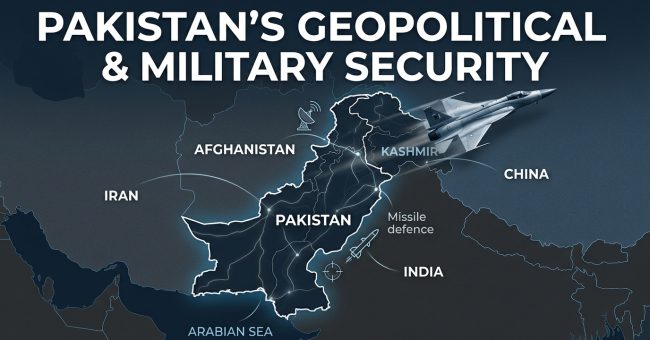
Pakistan’s geopolitical and military security is shaped by its strategic location, regional rivalries, internal security challenges, economic vulnerabilities and relationships with major global powers. Located at the intersection of South Asia, Central Asia, the Middle East and the Indian Ocean, Pakistan occupies a position of considerable strategic importance.
Research Paper in PDF:
Pakistan’s Geopolitical and Military Security Research Paper
Download Power Point Presentation Slides:
Pakistans-Geopolitical-and-Military-Security
Power Point Presentation Slides in PDF:
Pakistans-Geopolitical-and-Military-Security Presentation in PDF
Pakistan shares borders with India, Afghanistan, Iran and China and has access to the Arabian Sea. This location creates opportunities for trade, energy connectivity, regional diplomacy and strategic cooperation. However, it also exposes Pakistan to complex security challenges, including the Kashmir dispute, cross-border militancy, terrorism, maritime competition, water disputes and great-power rivalry.
The country’s security environment has become more complicated due to the activities of the Tehrik-e-Taliban Pakistan (TTP), the Balochistan Liberation Army (BLA), instability along the Afghanistan border and tensions with India. The India–Pakistan military confrontation in May 2025 demonstrated how quickly a regional crisis can escalate between two nuclear-armed states.
Pakistan’s national security is therefore not limited to military preparedness. It also depends on economic stability, diplomatic engagement, political continuity, technological development, water security, internal cohesion and effective governance.
1. Pakistan’s Geostrategic Location
Pakistan’s geographical position is one of its most important strategic assets. It connects several regions that have major political, economic and military significance.
1.1 Location Between Major Regions
Pakistan is located between:
- South Asia
- Central Asia
- The Middle East
- Western China
- The Arabian Sea
- The wider Indian Ocean region
Its eastern border with India places it close to one of the world’s most significant military rivalries. Its western borders with Afghanistan and Iran connect it to a region affected by terrorism, political instability, border disputes and regional competition.
Its northern border with China provides access to a major strategic and economic partner. China–Pakistan relations have expanded through defense cooperation, infrastructure development, trade and the China–Pakistan Economic Corridor (CPEC).
1.2 Arabian Sea and Maritime Security
Pakistan’s coastline along the Arabian Sea is important for international trade, energy imports and maritime defense. Karachi Port, Port Qasim and Gwadar Port connect Pakistan with international shipping routes.
Maritime security is essential because Pakistan depends on sea routes for:
- Oil and gas imports
- Industrial raw materials
- Export activities
- International trade
- Commercial shipping
- Strategic connectivity
Any disruption in maritime routes could affect Pakistan’s economy and energy supplies. The Pakistan Navy therefore plays an important role in coastal defense, maritime surveillance and the protection of sea-based economic activity.
1.3 Gwadar Port and CPEC
Gwadar Port and CPEC have increased Pakistan’s strategic and economic importance. CPEC is designed to improve connectivity between China and Pakistan through roads, energy projects, industrial zones and transport infrastructure.
However, CPEC also creates security responsibilities. Chinese citizens, engineers, transport routes, energy projects and industrial infrastructure require effective protection. Terrorist attacks on foreign workers or development projects can damage investor confidence and affect bilateral relations.
2. Historical Evolution of Pakistan’s Security Policy
Pakistan’s security policy has evolved in response to wars, regional conflicts, international alliances and internal instability.
2.1 Security Challenges After Independence
After independence on 14 August 1947, Pakistan faced several immediate challenges, including:
- The Kashmir dispute
- Border disagreements
- Refugee settlement
- Economic and institutional weaknesses
- Defense infrastructure limitations
- Regional uncertainty
The Kashmir dispute became a central issue in Pakistan’s foreign policy and defence planning.
2.2 Pakistan During the Cold War
During the Cold War, Pakistan developed security relations with the United States and became part of Western-led regional defence arrangements, including:
- Southeast Asia Treaty Organization (SEATO), joined in 1954
- Central Treaty Organization (CENTO), joined through the Baghdad Pact framework in 1955
Pakistan’s strategic importance increased because of its proximity to the Soviet Union, Afghanistan, China and India.
However, reliance on external alliances also created challenges because the strategic interests of Pakistan and its partners did not always remain identical.
2.3 Soviet–Afghan War
The Soviet intervention in Afghanistan began in December 1979 and significantly affected Pakistan’s security environment.
The conflict contributed to:
- Refugee inflows
- Weapons proliferation
- Growth of militant networks
- Religious extremism
- Border instability
- Drug trafficking
- Social and economic pressure
These consequences continued to affect Pakistan even after the Soviet withdrawal from Afghanistan in 1989.
2.4 Post-9/11 Security Environment
After the terrorist attacks in the United States on 11 September 2001, Pakistan became a major partner in international counterterrorism efforts. Pakistan itself experienced a significant increase in terrorism, suicide bombings, attacks on security forces and militant violence.
The country conducted several counterterrorism operations, but militancy continued to affect Khyber Pakhtunkhwa, Balochistan and other regions.
3. India–Pakistan Rivalry and the Kashmir Dispute
3.1 Indian-Administered Kashmir
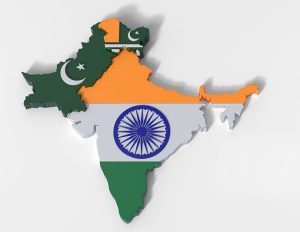
The Kashmir dispute remains the most important unresolved conflict between India and Pakistan. Pakistan commonly refers to the region as Indian-occupied Kashmir, while India uses the term Indian-administered Jammu and Kashmir and regards it as an integral part of the country.
The dispute involves:
- Territorial claims
- Political representation
- Security concerns
- Human rights allegations
- Military deployment
- Cross-border violence
- Regional stability
- Water resources
The Line of Control remains heavily militarized. Any militant attack, border incident or political development in Kashmir can increase tensions between India and Pakistan.
The United Nations Military Observer Group in India and Pakistan (UNMOGIP) was established in connection with the India–Pakistan dispute and continues to operate under its mandate.
Official source: United Nations Military Observer Group in India and Pakistan
3.2 India’s Constitutional Changes in 2019
On 5 August 2019, India announced the revocation of the special constitutional status of Jammu and Kashmir under Article 370 and reorganized the former state into the Union Territories of Jammu and Kashmir and Ladakh.
Pakistan rejected the move and argued that it altered the disputed territory’s status. India described the decision as an internal constitutional and administrative measure. The disagreement continues to affect bilateral relations.
3.3 Conventional and Nuclear Deterrence
India and Pakistan maintain significant conventional military capabilities and nuclear arsenals. Nuclear deterrence has reduced the possibility of a full-scale war, but it has not eliminated the risk of limited military confrontation.
The regional security environment is affected by:
- Missile development
- Airpower competition
- Drone technology
- Military exercises
- Cross-border militancy
- Short decision-making timelines
- Political pressure
- Misinformation
- Nuclear signaling
Nuclear weapons may discourage total war, but they do not automatically prevent limited clashes or escalation.
4. The May 2025 India–Pakistan Military Conflict
4.1 Pahalgam Terrorist Attack
On 22 April 2025, a terrorist attack took place near Pahalgam in Indian-administered Jammu and Kashmir. Twenty-six people were killed.
Indian authorities blamed Pakistan-based militant networks and alleged cross-border links. Pakistan denied involvement and called for an impartial and credible investigation. The responsibility claims and evidence became part of the subsequent diplomatic confrontation.
The attack triggered a sharp deterioration in India–Pakistan relations. India announced several diplomatic and economic measures, while Pakistan rejected the allegations and warned against military escalation.
Background source: Associated Press report on the Pahalgam attack and diplomatic consequences
4.2 Military Escalation
The military confrontation began during the night of 6–7 May 2025, when India launched strikes that it described as targeting terrorist infrastructure. Pakistan rejected India’s description and regarded the strikes as an attack on its territory.
The conflict continued from 7 May to 10 May 2025 and involved:
- Air strikes
- Missiles
- Drones
- Air-defence systems
- Military installations
- Cross-border firing
- Competing information campaigns
Pakistan announced Operation Bunyan-ul-Marsoos on 10 May 2025 in response to what it described as Indian aggression. Pakistan’s Foreign Office stated that the country acted under its claimed right of self-defense under Article 51 of the United Nations Charter.
Official source: Pakistan Foreign Office statement on the May 2025 ceasefire
4.3 Ceasefire
On 10 May 2025, India and Pakistan agreed to a ceasefire understanding. The agreement reduced the immediate risk of wider escalation, but it did not resolve the underlying disputes related to:
- Kashmir
- Cross-border militancy
- Water-sharing
- Military doctrines
- Diplomatic mistrust
- Strategic communication
The conflict was significant because it involved two nuclear-armed states and demonstrated the growing role of drones, precision weapons, air defense and information warfare in South Asian security.
4.4 Security Lessons from the 2025 Conflict
The May 2025 conflict highlighted several lessons:
- A terrorist incident can rapidly trigger a military crisis.
- Nuclear deterrence does not eliminate the possibility of limited conflict.
- Airpower and drone technology are becoming increasingly important.
- Information warfare can complicate public understanding of military events.
- Military hotlines and diplomatic communication are essential.
- Water, terrorism and territorial disputes can become interconnected security issues.
- Crisis management is necessary to prevent military exchanges from expanding.
5. Pakistan’s Military Capabilities and Airpower
5.1 Pakistan Army
The Pakistan Army is responsible for land defense, border security, counterterrorism operations and protection of strategic infrastructure.
Its major responsibilities include:
- Defense of the eastern border
- Security along the western frontier
- Counterterrorism operations
- Support during national emergencies
- Protection of sensitive infrastructure
- Strategic deterrence support
Pakistan faces a dual security environment: conventional military competition with India and internal counterterrorism challenges in the west.
5.2 Pakistan Air Force
The Pakistan Air Force (PAF) is a central component of Pakistan’s defense strategy. Its major functions include:
- Airspace protection
- Air superiority and air defense
- Ground support
- Intelligence, surveillance and reconnaissance
- Precision strike
- Airborne early warning
- Electronic warfare
- Strategic deterrence support
The PAF operates a combination of aircraft acquired through international partnerships and domestically produced platforms.
Important PAF Aircraft
The Pakistan Air Force operates or has operated aircraft such as:
- JF-17 Thunder
- J-10C
- F-16
- Mirage III
- Mirage 5
- Saab 2000 Erieye airborne early-warning aircraft
- Il-78 aerial refueling aircraft
- Various unmanned aerial systems
The JF-17 Thunder is a multi-role fighter developed jointly by Pakistan Aeronautical Complex and China’s Chengdu Aircraft Industry Group. It has become an important part of Pakistan’s efforts to develop domestic defense-production capacity.
The J-10C is a Chinese 4.5-generation multirole fighter aircraft. Pakistan formally inducted the J-10C into the Pakistan Air Force in March 2022. The aircraft provides modern radar, electronic warfare, beyond-visual-range missile and multirole capabilities.
5.3 Pakistan’s Fifth-Generation Fighter Jet Plans
Pakistan has been linked to discussions regarding the possible acquisition of China’s Shenyang J-35, a fifth-generation stealth fighter aircraft based on the FC-31 design.
However, it is important to distinguish between:
- Media reports about a possible sale
- Statements about negotiations or future cooperation
- A confirmed government-to-government procurement agreement
- Actual delivery and induction
As of the current publicly available information, reports have discussed Pakistan’s interest in or possible acquisition of the J-35, but a fully documented and publicly confirmed delivery schedule should not be presented as completed unless supported by an official contract or induction announcement.
Therefore, a careful article should state:
Pakistan has reportedly explored the acquisition of China’s J-35 fifth-generation stealth fighter, but the exact procurement agreement, delivery schedule and operational induction should be confirmed through official announcements.
This distinction is important because defense procurement reports can change before a formal contract is signed.
5.4 India’s Fighter Aircraft Generations
India operates a mixed fleet containing aircraft from different technological generations. Its major fighter platforms include:
- Rafale: Generally classified as a 4.5-generation multirole fighter
- Su-30MKI: A modernized 4++-generation or advanced 4th-generation fighter
- MiG-29UPG: Modernized 4th-generation fighter
- Mirage 2000I/TI: Modernized 4th-generation fighter
- Tejas: Generally classified as a 4th-generation light combat aircraft, with later variants incorporating improved avionics and systems
- MiG-21: Older 3rd-generation-era design, although many aircraft were upgraded before retirement
India is also developing the Advanced Medium Combat Aircraft (AMCA), intended to be a fifth-generation stealth fighter. However, development and induction are different stages; a planned aircraft should not be described as fully operational before formal induction.
Comparative Security Significance
The India–Pakistan airpower competition is influenced not only by the number of aircraft but also by:
- Radar technology
- Pilot training
- Electronic warfare
- Airborne early warning
- Beyond-visual-range missiles
- Maintenance
- Data links
- Air-defense integration
- Operational readiness
- Command and control
A simple comparison based only on aircraft generation can therefore be misleading.
6. Pakistan–Afghanistan Security Relations
6.1 Western Border Challenges
Pakistan’s western border with Afghanistan is affected by:
- Cross-border militancy
- Border-management disputes
- Refugee movements
- Smuggling
- Disagreements over the Durand Line
- Political tensions
- Militants operating from border regions
Pakistan has repeatedly expressed concern that militant groups use Afghan territory to plan or support attacks against Pakistan. Afghan authorities have rejected or disputed various Pakistani allegations.
6.2 TTP and Afghanistan
The Tehrik-e-Taliban Pakistan (TTP) is one of Pakistan’s most serious internal security threats. The group has carried out attacks against:
- Security forces
- Police
- Government institutions
- Civilians
- Religious gatherings
- Public places
- Infrastructure
The TTP seeks to challenge the Pakistani state and impose its own extremist interpretation of governance and law. Its objectives have included opposition to the Pakistani constitutional order, security institutions and state authority.
The United Nations Security Council lists the TTP under its terrorism-related sanctions framework.
Official source: United Nations Security Council: Tehrik-e-Taliban Pakistan
6.3 Major TTP Security Concerns
The TTP threat has included:
- Attacks on military and police targets
- Suicide bombings
- Assassinations
- Attacks on checkpoints
- Kidnappings
- Cross-border militant movement
- Threats to education and public institutions
According to the Pak Institute for Peace Studies (PIPS), Pakistan recorded 699 terrorist attacks in 2025, representing a 34 percent increase compared with 2024. The report identified Khyber Pakhtunkhwa and Balochistan as the principal regions affected by militant violence.
Source: PIPS Pakistan Security Report 2025
The European Union Agency for Asylum, citing conflict-monitoring sources, also reported substantial TTP activity in 2025, particularly in Khyber Pakhtunkhwa.
Source: EUAA Pakistan Country Focus: Security Situation
6.4 Pakistan’s Response to Afghanistan-Based Militancy
Pakistan’s response has included:
- Border fencing and surveillance
- Intelligence-based operations
- Diplomatic engagement with Kabul
- Demands for action against militant groups
- Military deployments
- Counterterrorism operations
- Border-crossing regulation
However, long-term stability requires more than military pressure. It also requires diplomatic communication, intelligence cooperation and a workable mechanism for preventing militant groups from using one country’s territory against the other.
7. Balochistan Liberation Army and Internal Security
7.1 What Is the BLA?
The Balochistan Liberation Army (BLA) is a separatist militant organization operating mainly in Balochistan. It opposes the Pakistani state and seeks greater autonomy or independence for Balochistan.
The BLA has targeted:
- Security forces
- Government offices
- Railway infrastructure
- Highways
- Foreign nationals
- Energy projects
- CPEC-related infrastructure
- Civilians from different ethnic backgrounds
The organization has also used suicide attackers and coordinated militant operations through its Majeed Brigade.
7.2 What Does the BLA Want?
The BLA’s stated political objective is linked to Baloch separatism. Its broader narrative includes demands associated with:
- Baloch political autonomy
- Control over natural resources
- Opposition to federal authority
- Greater political representation
- Resistance to CPEC and foreign investment projects
- Claims concerning resource distribution and local rights
The Pakistani state describes the BLA as a terrorist organization and rejects its separatist violence. At the same time, a complete analysis should recognize that Balochistan’s security crisis also involves political, economic and human-rights concerns.
7.3 Major BLA Attacks
Mach Attacks — 30 January 2024
On 30 January 2024, coordinated attacks took place in Mach, Balochistan. Militants attacked security-related locations and other sites. The fighting reportedly continued for nearly three days.
Gwadar Port Authority Colony Attack — 20 March 2024
On 20 March 2024, BLA militants attacked the Gwadar Port Authority Colony. The attack was significant because Gwadar is a central component of CPEC and Pakistan’s maritime strategy.
Balochistan Coordinated Attacks — 26–27 August 2024
On 26 and 27 August 2024, Balochistan experienced widespread violence in several districts. Attacks targeted security posts, police stations, railway infrastructure, highways and civilians.
According to reporting compiled by Dawn, at least 50 people, including security personnel, were killed in the violence. In Musakhail, militants reportedly stopped vehicles and killed passengers after checking their identity documents.
Source: Dawn timeline of BLA attacks
Quetta Railway Station Attack — 9 November 2024
On 9 November 2024, a suicide bombing at Quetta railway station killed at least 26 people, including security personnel, and injured many others. The BLA’s Majeed Brigade claimed responsibility.
Turbat Attack — 5 January 2025
On 5 January 2025, an explosive-laden vehicle struck a coach carrying Frontier Corps personnel in the Turbat area of Kech district. The attack killed several people and injured others. The BLA’s Majeed Brigade claimed responsibility.
Kalat Attack — 1 February 2025
On 1 February 2025, an attack in Kalat district resulted in the deaths of 18 soldiers, according to reports. The BLA claimed responsibility, while security forces reported killing militants during the subsequent operation.
Jaffer Express Hijacking — March 2025
On 11 March 2025, militants attacked and hijacked the Jaffer Express in Balochistan. The train was carrying hundreds of passengers travelling between Quetta and Peshawar. The attack created a major national security crisis and required a security operation to end the hostage situation.
7.4 Causes of Balochistan’s Instability
The Balochistan conflict involves several overlapping factors:
- Political alienation
- Unemployment
- Unequal development
- Disputes over natural resources
- Limited public services
- Missing-persons allegations
- Human-rights concerns
- Weak civilian institutions
- Militancy and external security concerns
A purely military response may reduce immediate violence but cannot address every underlying grievance. Long-term stability requires lawful security measures alongside political dialogue, economic development, public services, local participation and transparent resource management.
8. Pakistan–Iran Security Relations
8.1 Border Security Concerns
Pakistan and Iran share a border that is affected by:
- Cross-border militant activity
- Smuggling
- Illegal movement
- Border incidents
- Economic challenges
- Security operations
Both countries have expressed interest in improving border cooperation, but militant activity has periodically created tensions.
8.2 Pakistan’s Airstrikes Inside Iran
On 16 January 2024, Iran conducted strikes inside Pakistan, stating that it had targeted militants. Pakistan condemned the action as a violation of its sovereignty.
Two days later, on 18 January 2024, Pakistan carried out retaliatory strikes inside Iran under the codename Operation Marg Bar Sarmachar. Pakistan’s Foreign Office stated that the operation targeted militant hideouts associated with the Balochistan Liberation Army and Balochistan Liberation Front.
Pakistan also emphasized that Iran was a brotherly country and called for dialogue and cooperation to address shared security challenges.
Official source: Pakistan Foreign Office: Operation Marg Bar Sarmachar
The episode demonstrated how militant activity can create serious diplomatic and military tensions even between neighbouring states that maintain cultural and historical ties.
9. Indus Waters Treaty and Pakistan’s Water Security
9.1 Background of the Indus Waters Treaty
The Indus Waters Treaty was signed on 19 September 1960 in Karachi by India and Pakistan, with the World Bank playing a facilitating role.
The treaty allocated:
- Eastern rivers: Ravi, Beas and Sutlej, primarily for India
- Western rivers: Indus, Jhelum and Chenab, primarily for Pakistan
The agreement also established mechanisms for:
- Data exchange
- Water management
- Technical discussions
- Dispute resolution
- Neutral Expert proceedings
- Arbitration under specified conditions
The World Bank describes the treaty as an important and durable water-sharing agreement that survived wars and prolonged political tensions.
Official source: World Bank: The Indus Waters Treaty 1960
9.2 Importance of the Treaty for Pakistan
The Indus river system is essential for Pakistan’s:
- Agriculture
- Irrigation
- Food security
- Hydropower
- Drinking water
- Industrial production
- Rural employment
Pakistan’s agricultural economy depends heavily on the Indus Basin. Any significant reduction or disruption in water flows could affect food production, energy generation, employment and economic stability.
9.3 India’s Decision in 2025
Following the Pahalgam attack on 22 April 2025, India announced that it would place the Indus Waters Treaty in abeyance. Pakistan rejected the decision and argued that India could not unilaterally suspend the treaty.
The dispute made water security a more prominent part of Pakistan’s national security debate. It also demonstrated how water management can become linked to diplomacy, conflict and strategic pressure.
9.4 Water Security Challenges
Pakistan faces several water-related challenges, including:
- Water scarcity
- Climate change
- Glacier melting
- Flooding
- Inefficient irrigation
- Groundwater depletion
- Population growth
- Agricultural water wastage
- Limited storage capacity
Pakistan should use international legal and diplomatic mechanisms to protect its treaty-related interests while improving domestic water management and conservation.
10. Pakistan–Saudi Arabia Defense Cooperation
10.1 Pakistan–Saudi Strategic Mutual Defense Agreement
Pakistan and Saudi Arabia signed a bilateral Strategic Mutual Defense Agreement on 17 September 2025 in Riyadh.
The agreement established a collective-security principle under which aggression against one country would be treated as aggression against both, according to public descriptions of the pact.
The agreement reflects the longstanding defense relationship between Pakistan and Saudi Arabia, which has included:
- Military training
- Defense cooperation
- Security consultations
- Personnel exchanges
- Strategic coordination
However, the exact operational meaning of a mutual-defense commitment depends on the agreement’s implementation procedures, political decisions and military arrangements.
10.2 Makkah Joint Defense Agreement
On 7 August 2026, Pakistan, Saudi Arabia and Türkiye signed the Makkah Joint Defense Agreement during the Makkah Al-Mukarramah Summit for Joint Defense.
The agreement states that an armed attack against any one of the three states would be regarded as an attack against all three. It also seeks to expand defense cooperation and collective deterrence.
The agreement was signed by:
- Saudi Crown Prince and Prime Minister Mohammed bin Salman
- Turkish President Recep Tayyip Erdoğan
- Pakistani Prime Minister Shehbaz Sharif
The Pakistani Foreign Office described the agreement as an effort to strengthen collective security and promote regional peace and stability.
Official source: Pakistan Foreign Office: Makkah Al-Mukarramah Summit for Joint Defence
The Makkah agreement is strategically important because it connects Pakistan’s defense cooperation with two influential regional states. Its long-term impact will depend on the development of practical military coordination, intelligence cooperation, joint exercises and crisis-response mechanisms.
11. Economic Security and Military Preparedness
Military security cannot be separated from economic security. Defense modernization, military training, technological development and border protection require stable financial resources.
11.1 Economic Constraints
Pakistan’s security planning is affected by:
- Public debt
- Fiscal deficits
- Inflation
- Energy shortages
- Foreign-exchange limitations
- Dependence on imported defense technology
- Slow industrial growth
Economic weakness can limit the ability to purchase modern equipment, maintain military platforms and invest in research and development.
11.2 Economic Stability as National Security
A comprehensive security strategy should include:
- Energy security
- Food security
- Industrial development
- Export growth
- Foreign-exchange stability
- Employment
- Education
- Healthcare
- Infrastructure development
Economic stability also improves Pakistan’s diplomatic independence by reducing excessive reliance on external financial assistance.
11.3 Protection of Foreign Investment
Security is essential for attracting foreign investment. Attacks on Chinese citizens, CPEC projects, energy infrastructure and transport routes can damage investor confidence.
Pakistan must ensure the protection of:
- CPEC projects
- Ports
- Industrial zones
- Energy facilities
- Highways
- Foreign workers
- Digital infrastructure
- Mineral-development projects
12. Emerging Threats to Pakistan’s Security
12.1 Hybrid Warfare
Hybrid warfare combines military and non-military methods, including:
- Cyberattacks
- Disinformation
- Economic pressure
- Political interference
- Psychological operations
- Proxy groups
- Diplomatic pressure
Pakistan requires an integrated response involving military institutions, civilian agencies, media organizations, technology experts and diplomatic channels.
12.2 Cybersecurity
Cybersecurity threats may target:
- Government databases
- Banking systems
- Power grids
- Telecommunications
- Military communication
- Airports
- Water infrastructure
- Critical national infrastructure
Pakistan should strengthen cyber-defense institutions, digital forensics, incident-response systems and public-private cooperation.
12.3 Artificial Intelligence and Autonomous Systems
Artificial intelligence can improve:
- Intelligence analysis
- Border surveillance
- Cybersecurity
- Military logistics
- Early-warning systems
- Disaster response
- Defense research
However, AI also creates risks related to autonomous weapons, misinformation, cyberattacks and strategic miscalculation.
12.4 Drone Warfare
Drones are increasingly used for:
- Surveillance
- Border monitoring
- Intelligence gathering
- Precision strikes
- Battlefield coordination
- Infrastructure observation
The May 2025 India–Pakistan conflict demonstrated the importance of drones and counter-drone systems in modern warfare.
12.5 Climate and Water Security
Climate change can intensify Pakistan’s security challenges through:
- Floods
- Droughts
- Heatwaves
- Glacier melting
- Water scarcity
- Food insecurity
- Internal displacement
- Damage to infrastructure
Climate security should therefore be integrated into Pakistan’s defense and national-security planning.
13. Policy Recommendations
13.1 Develop a Comprehensive National Security Strategy
Pakistan should adopt a long-term strategy that integrates:
- Military defense
- Diplomacy
- Economic security
- Water security
- Cybersecurity
- Climate resilience
- Internal stability
- Technological development
13.2 Strengthen Regional Diplomacy
Pakistan should maintain diplomatic and military communication channels with India, Afghanistan and Iran.
Possible measures include:
- Military hotlines
- Border coordination
- Intelligence cooperation
- Crisis-management mechanisms
- Trade and transit discussions
- Humanitarian cooperation
13.3 Improve Border Management
Pakistan should modernize border security through:
- Surveillance technology
- Biometric systems
- Legal crossing points
- Border monitoring
- Intelligence sharing
- Better customs procedures
- Regulated cross-border trade
13.4 Counter the TTP Threat
An effective counterterrorism strategy should include:
- Intelligence-based operations
- Border security
- Counterterrorism financing measures
- Police capacity-building
- Regional diplomacy
- Deradicalization programs
- Protection of civilians
- International cooperation
13.5 Address BLA-Related Violence
Pakistan should combine security operations with measures addressing political and economic grievances in Balochistan.
These measures may include:
- Improved public services
- Greater local participation
- Transparent resource distribution
- Employment opportunities
- Stronger provincial institutions
- Investigation of human-rights allegations
- Peaceful political participation
- Protection of civilians and infrastructure
13.6 Strengthen Water Diplomacy
Pakistan should:
- Defend its treaty rights through diplomatic and legal channels
- Improve water data and technical expertise
- Engage international institutions
- Modernize irrigation systems
- Reduce water wastage
- Improve storage and conservation
- Promote climate-resilient agriculture
13.7 Invest in Defense Technology
Pakistan should prioritize:
- Artificial intelligence
- Cybersecurity
- Electronic warfare
- Satellite technology
- Drone systems
- Counter-drone technology
- Air defense
- Maritime surveillance
- Indigenous defense production
13.8 Maintain Strategic Stability with India
India and Pakistan should strengthen crisis-management mechanisms, including:
- Military hotlines
- Advance notification of exercises
- Avoidance of inflammatory rhetoric
- Nuclear-risk reduction measures
- Protection of civilians
- Investigation of border incidents
- Dialogue on water and security issues
Conclusion
Pakistan’s geopolitical and military security is shaped by its strategic geography, regional rivalries, internal militancy, economic vulnerabilities and global power competition. Its location provides access to major regions and trade routes, but it also exposes the country to challenges involving India, Afghanistan, Iran, China and the wider Indian Ocean.
The Kashmir dispute remains a central issue in Pakistan–India relations. The May 2025 military conflict, which escalated from the night of 6–7 May and continued until the ceasefire on 10 May 2025, demonstrated the dangers of military escalation between two nuclear-armed states. It also highlighted the importance of airpower, drones, missile defense, information warfare and diplomatic communication.
The TTP and BLA represent major internal security threats, although their ideologies and objectives differ. The TTP seeks to challenge the Pakistani state through militant Islamist violence, while the BLA is associated with separatist militancy in Balochistan. Countering these groups requires intelligence-based security operations, border management, political engagement, economic development and public trust.
The Indus Waters Treaty, signed on 19 September 1960, is another important component of Pakistan’s national security because the Indus Basin supports agriculture, food production, hydropower and rural livelihoods. Water diplomacy must be combined with domestic water conservation and climate adaptation.
Pakistan’s defence capabilities, strategic partnerships with China, Saudi Arabia and Türkiye, and cooperation with other states provide important security opportunities. The Pakistan–Saudi Strategic Mutual Defense Agreement of 17 September 2025 and the Makkah Joint Defence Agreement of 7 August 2026 reflect the expansion of Pakistan’s regional defense relationships.
Ultimately, military strength alone cannot guarantee sustainable security. Pakistan’s long-term stability requires economic resilience, political continuity, effective diplomacy, technological modernization, strong civilian institutions, regional cooperation and internal cohesion.
Official Sources for the Article
- Pakistan Ministry of Foreign AffairsPakistan–Afghanistan Relations: Security Challenges, Border Tensions & Future Prospects
Ministry of Foreign Affairs, Pakistan - Pakistan Foreign Office — May 2025 India–Pakistan Ceasefire Statement
Recent Developments and Ceasefire Between India and Pakistan - Pakistan Foreign Office — Makkah Joint Defence Agreement
Makkah Al-Mukarramah Summit for Joint Defence - World Bank — Indus Waters Treaty
The Indus Waters Treaty 1960 and the World Bank - United Nations — UNMOGIP
United Nations Military Observer Group in India and Pakistan - United Nations Security Council — TTP Listing
Tehrik-e-Taliban Pakistan Sanctions Listing - Pak Institute for Peace Studies — Pakistan Security Report
PIPS Pakistan Security Reports
