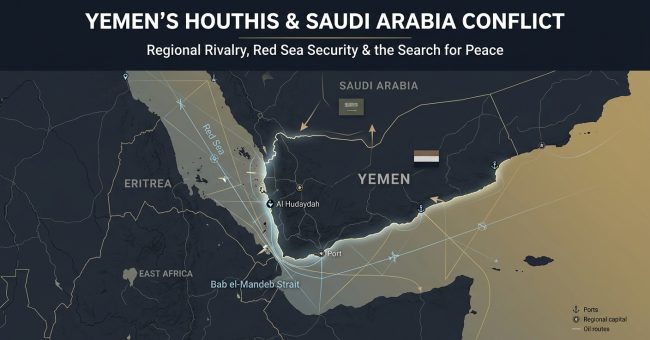
Yemen’s Houthis and Saudi Arabia Conflict
The Yemen conflict is one of the most complicated political, military and humanitarian crises in the Middle East. Although it is often described as a confrontation between Yemen’s Houthi movement and Saudi Arabia, the conflict is much broader. It involves Yemen’s internal political divisions, regional rivalry, competing armed groups, economic instability, maritime security and the wider strategic competition between Saudi Arabia and Iran.
The Houthi movement, officially known as Ansar Allah, emerged in northern Yemen and gradually developed from a local religious and political movement into a powerful armed organization. The Houthis captured Yemen’s capital, Sana’a, in September 2014, forcing the country into a deeper political and military crisis.
Saudi Arabia launched a military intervention in Yemen on 26 March 2015, leading a coalition that sought to support Yemen’s internationally recognized government and prevent the Houthis from taking control of the entire country. The intervention transformed Yemen’s internal conflict into a major regional war.
The Yemen conflict has caused extensive destruction, displacement, food insecurity, economic collapse and the weakening of public institutions. It has also affected regional stability because Yemen is located near the Bab el-Mandeb Strait, one of the world’s most important maritime trade routes.
The conflict has experienced periods of de-escalation, particularly following the United Nations-brokered truce that began in April 2022. However, the truce did not resolve the fundamental political, military and economic disputes. As of 2026, international efforts continue to focus on preventing renewed escalation and creating a comprehensive Yemeni-led peace process.
Who Are the Houthis?
The Houthis are a Yemen-based political and armed movement that emerged from the northern Saada region. They are also known as Ansar Allah, meaning “Supporters of God.”
The movement developed among communities associated with Zaydi Islam, a branch of Shia Islam historically influential in northern Yemen. However, the Yemen conflict cannot be explained only through religious differences. Political exclusion, economic grievances, weak governance and opposition to foreign influence have also played major roles.
The movement’s early leadership was associated with the Houthi family, particularly Hussein Badreddin al-Houthi, who became a prominent figure during the movement’s early development.
The Houthis have opposed:
- The policies of the central Yemeni government
- Perceived political and economic marginalization
- Foreign military influence
- American and Israeli regional policies
- Saudi influence in Yemen
- Political arrangements that they believe exclude their movement
Over time, the Houthis developed military structures, administrative institutions and alliances with local tribes and former political actors. Their rise significantly changed the political balance inside Yemen.
Historical Background of the Yemen Conflict
Yemen Before the 2011 Uprising
Yemen had experienced political instability and economic difficulties for decades. North and South Yemen unified on 22 May 1990, but unification did not eliminate regional and political tensions.
The country continued to face:
- Poverty and unemployment
- Weak state institutions
- Corruption
- Tribal competition
- Unequal regional development
- Southern separatist demands
- Disputes over natural resources
- Limited public services
These conditions weakened national cohesion and created opportunities for armed groups to challenge the central government.
The 2011 Arab Spring Uprising
In 2011, protests spread across Yemen as part of the wider Arab Spring movement. Demonstrators opposed the long rule of President Ali Abdullah Saleh, who had governed North Yemen and later the unified country for several decades.
A Gulf Cooperation Council-supported transition agreement led to Saleh transferring power to his deputy, Abd-Rabbu Mansour Hadi, in 2012.
The transition was intended to create a new political order. A National Dialogue Conference was organized to discuss the future structure of the Yemeni state. However, the process faced serious difficulties, including disagreements over federalism, resource distribution, political representation and regional autonomy.
The transition failed to satisfy many major actors, including the Houthis, southern political movements and other armed groups. These unresolved disputes contributed directly to the escalation of the Yemen conflict.
The Houthi Takeover of Sana’a
The Houthis expanded their influence during 2014, taking advantage of political divisions, public dissatisfaction and the weakness of the transitional government.
The movement initially mobilized against fuel-price increases and government policies. Houthi forces then advanced toward Sana’a and seized control of important government institutions in September 2014.
The takeover of Sana’a was a decisive turning point in the Yemen conflict. It demonstrated that the central government could no longer maintain authority across the country.
In January 2015, President Hadi resigned under pressure. He later escaped to Aden and withdrew his resignation. As Houthi forces continued their expansion, Hadi eventually sought external assistance.
The Houthis’ advance created alarm in Saudi Arabia and other regional capitals. Riyadh viewed the movement’s growing power as a threat to its southern border and as a potential expansion of Iranian influence in the Arabian Peninsula.
Why Did Saudi Arabia Intervene in Yemen?
Saudi Arabia began its military intervention on 26 March 2015. The campaign was launched under the name Operation Decisive Storm and was conducted through a Saudi-led coalition that included several Arab countries.
Saudi Arabia stated that the intervention was intended to:
- Support Yemen’s internationally recognized government
- Prevent the Houthis from taking control of the entire country
- Protect Saudi territory from cross-border attacks
- Stop the development of a hostile armed authority near its border
- Counter Iranian influence
- Protect regional maritime and energy security
The Saudi-led coalition used air power, naval operations, intelligence capabilities and support for Yemeni partner forces. However, the campaign did not produce a quick resolution. Instead, the Yemen conflict became a prolonged war involving multiple domestic and international actors.
Saudi Arabia’s Security Concerns
Saudi Arabia shares a long land border with Yemen. Instability in northern Yemen can directly affect Saudi border communities, military installations, airports, energy facilities and transportation networks.
Saudi concerns have included:
Border attacks: Houthi forces have launched missiles, rockets and drones toward Saudi territory during different phases of the conflict.
Iranian influence: Saudi officials have repeatedly accused Iran of supporting the Houthis with weapons, training and technical assistance.
Maritime security: Yemen’s coastline overlooks the Red Sea and the Bab el-Mandeb Strait, making the country strategically important for shipping and energy transportation.
Political instability: Riyadh has sought to prevent Yemen from becoming a permanently hostile or unstable state on its southern border.
The Yemen conflict therefore represents both a domestic Yemeni crisis and a national-security concern for Saudi Arabia.
Iran’s Role in the Yemen Conflict
Iran’s relationship with the Houthis is one of the most debated dimensions of the war. Saudi Arabia, the United States and other governments have accused Iran of providing the Houthis with military equipment, training, technical expertise, intelligence and political support.
The Houthis have developed increasingly sophisticated capabilities involving:
- Ballistic missiles
- Cruise missiles
- Armed drones
- Anti-ship weapons
- Maritime surveillance
- Explosive boats
- Long-range strike systems
Analysts generally agree that Iranian assistance has contributed to the development of Houthi military capabilities. However, the Houthis are not simply an organization created by Iran. They originated in Yemen, possess their own domestic political agenda and have independent interests related to power, territory and governance.
The Council on Foreign Relations describes Iranian support as an important factor in the Houthis’ military development while also emphasizing that the movement has its own Yemeni origins and objectives.
Why Iran Supports the Houthis
Iran’s relationship with the Houthis can provide several strategic benefits:
- Pressure on Saudi Arabia’s southern border
- Influence near the Red Sea
- A regional partner with missile and drone capabilities
- A means of challenging Saudi and American influence
- Additional leverage in regional negotiations
- A strategic pressure point near international maritime routes
Nevertheless, describing the Yemen conflict only as a Saudi–Iranian proxy war would be incomplete. Yemen’s internal political divisions and local grievances remain central to the conflict.
Yemen’s Internal Political Divisions
The Yemen conflict involves several Yemeni groups whose political goals are not identical.
The Houthis
The Houthis control Sana’a and large parts of northern and western Yemen. They operate de facto governing institutions in territories under their control and seek a significant role in Yemen’s future political system.
The movement maintains military forces, administrative structures and security institutions. Its control over population centers gives it substantial political leverage.
The Internationally Recognized Government
The internationally recognized government has depended heavily on regional and international support. In April 2022, President Hadi transferred his powers to the Presidential Leadership Council, which became the principal internationally recognized governing body.
The council includes representatives from several anti-Houthi factions. However, these groups have different views regarding political authority, military command, southern autonomy and the future structure of the Yemeni state.
The Southern Transitional Council
The Southern Transitional Council, commonly known as the STC, has promoted southern independence or autonomy. It has received support from the United Arab Emirates and has interests that differ from those of the internationally recognized government.
The STC’s position reflects the unresolved “southern question”—whether southern Yemen should remain part of a unified state or pursue a separate political future.
Tribal and Local Groups
Tribes and local armed groups continue to influence Yemen’s political and security environment. Their alliances are often shaped by local security, economic interests, resources and political bargaining.
Extremist Organizations
Al-Qaeda in the Arabian Peninsula and other extremist organizations have exploited state weakness and security vacuums. Their presence has added another layer of insecurity to the Yemen conflict.
Military Capabilities of the Houthis
The Houthis have developed significant asymmetric military capabilities despite lacking the conventional air force and naval power of Saudi Arabia.
Their military tools include:
- Ballistic missiles
- Cruise missiles
- Armed drones
- Anti-ship missiles
- Naval mines
- Explosive boats
- Coastal surveillance systems
- Mobile missile launchers
- Guerrilla warfare units
- Underground command and storage facilities
Houthi Asymmetric Warfare
The Houthis have used asymmetric warfare to challenge militarily superior opponents. Their methods include:
- Launching missiles and drones from mobile platforms
- Using mountainous terrain for concealment
- Relying on decentralized units
- Conducting cross-border attacks
- Targeting military and energy infrastructure
- Threatening maritime shipping
- Using political messaging alongside military operations
Their ability to survive years of airstrikes demonstrates the limitations of relying on air power without a workable political strategy and effective local ground partners.
The United Nations Security Council has documented concerns regarding Houthi attacks, maritime threats, landmines, repression, child recruitment and restrictions affecting humanitarian operations.
Saudi Arabia’s Military Role
Saudi Arabia has possessed major advantages in conventional military capabilities, including:
- Advanced fighter aircraft
- Precision-guided weapons
- Air-defence systems
- Intelligence and surveillance
- Naval forces
- Financial resources
- International military partnerships
However, the Yemen conflict demonstrated that conventional military superiority does not necessarily guarantee a decisive political outcome.
Saudi air operations caused extensive damage to Houthi military infrastructure, but the Houthis retained their organizational structure and continued to control major population centers. The conflict also exposed the difficulty of defeating an armed movement operating within a fragmented political and geographic environment.
The war placed significant financial, military and diplomatic pressure on Saudi Arabia, while also increasing international criticism concerning civilian casualties and humanitarian consequences.
The Humanitarian Crisis in Yemen
The humanitarian consequences of the Yemen conflict have been severe. Years of fighting, economic collapse, displacement and restrictions on aid have created one of the world’s most serious humanitarian emergencies.
According to the United Nations’ 2025 country results report, more than 21 million people are projected to require humanitarian assistance in 2026. Approximately 18.3 million people face acute food insecurity, while around 2.2 million children under the age of five suffer from acute malnutrition. Only about 59 percent of health facilities are fully functional.
Food Insecurity
Yemen depends heavily on imported food. Conflict-related disruptions to ports, roads, markets and supply chains have made food more expensive and less accessible.
Food insecurity has been driven by:
- Loss of livelihoods
- Currency instability
- Rising food prices
- Disrupted imports
- Restrictions on movement
- Unpaid public-sector salaries
- Damage to agricultural infrastructure
- Reduced humanitarian funding
Displacement
Millions of Yemenis have been displaced during the conflict. Displaced families often live in overcrowded camps or informal settlements with limited access to:
- Clean water
- Food
- Sanitation
- Healthcare
- Education
- Safe housing
- Employment
Displacement has also placed pressure on communities that receive internally displaced people.
Economic Collapse
The Yemen conflict has severely damaged the national economy. Major economic consequences include:
- Destruction of infrastructure
- Decline in oil and gas revenues
- Currency depreciation
- Unemployment
- Reduced investment
- Disruption of trade
- Declining household income
- Weak public services
- Dependence on humanitarian assistance
The United Nations reports that Yemen’s economy has contracted by more than half since the beginning of the conflict, while GDP per capita has also declined significantly.
Health and Education
Hospitals, schools and water systems have suffered from direct damage, lack of funding and shortages of medical supplies. Disease outbreaks, malnutrition and limited access to healthcare have increased the vulnerability of children and other civilians.
The humanitarian crisis cannot be solved only through emergency aid. It also requires political stability, economic recovery, functioning institutions and safe access for humanitarian organizations.
Bab al-Mandab Strait and Red Sea Security
Strategic Importance of the Strait
The Bab al-Mandab Strait connects the Red Sea with the Gulf of Aden and the Indian Ocean. It is a major maritime chokepoint linking Europe, Asia, the Middle East and East Africa.
The strait is important for:
- Global commercial shipping
- Energy transportation
- International trade
- Suez Canal traffic
- Saudi economic interests
- European–Asian supply chains
- Humanitarian deliveries
- International naval operations
Any disruption in this area can increase shipping costs, insurance premiums and delivery times. Ships may be forced to take longer routes around the Cape of Good Hope.
Houthi Maritime Attacks
Since late 2023, Houthi attacks and threats against commercial shipping in the Red Sea have increased international concern. The Houthis have presented some maritime operations as responses to the Gaza war and as pressure against Israel and its supporters.
However, these attacks have also affected commercial vessels and created risks for international shipping. The maritime dimension has expanded the Yemen conflict beyond the borders of Yemen and Saudi Arabia.
The United Nations Security Council has raised concerns about attacks against commercial shipping and threats to freedom of navigation in the Red Sea.
Global Economic Consequences
Red Sea insecurity can lead to:
- Higher freight costs
- Delays in global supply chains
- Increased energy-market uncertainty
- Higher insurance premiums
- Greater naval deployments
- Additional pressure on Egypt’s Suez Canal revenues
- Increased humanitarian delivery costs
This makes the Yemen conflict relevant not only to Middle Eastern politics but also to global trade and economic security.
Major Peace Efforts and Ceasefire Initiatives
Stockholm Agreement of 2018
In December 2018, Yemeni parties reached the Stockholm Agreement under UN mediation. The agreement focused on:
- Hudaydah and nearby ports
- Prisoner exchanges
- De-escalation in Taiz
- Humanitarian access
Hudaydah is particularly important because it is a major entry point for food, fuel and humanitarian supplies. Although implementation of the agreement remained limited, it helped prevent a potentially devastating full-scale battle for the port.
Riyadh Agreement of 2019
In November 2019, Saudi Arabia helped broker the Riyadh Agreement between Yemen’s internationally recognized government and the Southern Transitional Council.
The agreement aimed to reduce conflict within the anti-Houthi camp and establish a more coordinated political and security structure. Implementation, however, faced obstacles because of competing interests among Yemeni factions.
UN-Brokered Truce of 2022
A UN-brokered truce began in April 2022. It was extended several times and formally expired in October 2022, but many of its practical effects continued for a considerable period.
The truce contributed to:
- Reduced front-line fighting
- Fewer cross-border attacks
- Increased flights from Sana’a Airport
- More fuel shipments through Hudaydah
- Improved movement in some areas
- Greater diplomatic engagement
The truce was important because it demonstrated that de-escalation was possible. However, it did not resolve major disputes over political authority, salaries, oil exports, military forces, borders and the future structure of Yemen.
Saudi–Houthi Dialogue
Saudi Arabia and Houthi representatives have engaged in direct and indirect talks, with Oman playing an important mediating role. Discussions have included:
- Border security
- Salary payments
- Airport access
- Port operations
- Oil exports
- Economic restrictions
- Prisoner exchanges
- A broader ceasefire
However, a Saudi–Houthi agreement alone would not be sufficient. Yemen’s southern factions, civil society, local communities and other political actors must also be included in a comprehensive settlement.
UN Diplomatic Engagement in 2026
In June 2026, the UN Office of the Special Envoy reported that representatives connected to Yemen’s military coordination process discussed ceasefire planning, maritime security and de-escalation in Amman. In July 2026, the UN Special Envoy also urged all sides to preserve the relative calm experienced since the 2022 truce and return to negotiations across political, military and economic tracks.
These efforts indicate that diplomacy remains active, but the peace process continues to face serious challenges.
Main Causes of the Yemen Conflict
The Yemen conflict developed through the interaction of several political, social, economic and geopolitical factors.
Political Exclusion
The post-2011 political transition failed to create a political system accepted by all major groups. The Houthis and other actors argued that their interests were not adequately represented.
Economic Hardship
Poverty, unemployment, fuel-price increases and unequal development contributed to public anger and weakened the legitimacy of the central government.
Weak State Institutions
The Yemeni government struggled to provide security, public services and effective administration. Weak institutions allowed armed groups to expand their influence.
Military Fragmentation
Yemen’s armed forces were divided by political, tribal and regional loyalties. This made it difficult to maintain a unified national security structure.
Regional Rivalry
Saudi Arabia and Iran’s regional competition intensified the conflict by providing external support to opposing actors.
Southern Separatism
Southern political movements have long criticized the political and economic arrangements created after unification in 1990. Their demands complicate efforts to preserve Yemen’s territorial unity.
Strategic Geography
Yemen’s location near the Bab el-Mandeb Strait gives the conflict importance beyond the country’s internal politics.
Ideological Mobilization
The Houthis and their opponents have used ideological, political and nationalist narratives to mobilize support. However, political and economic factors are at least as important as religious differences in explaining the conflict. The US State Department has noted that political and economic issues are generally considered more significant drivers than religion alone.
Regional and International Impact
Impact on Saudi Arabia
The Yemen conflict has created several challenges for Saudi Arabia:
- Cross-border missile and drone threats
- Military expenditure
- Pressure on border communities
- Threats to energy infrastructure
- Diplomatic difficulties
- Risks to regional economic projects
- Increased international scrutiny
Saudi Arabia has also sought to reduce regional tensions and focus on economic diversification, but instability in Yemen remains a major security concern.
Impact on Iran
The conflict has provided Iran with strategic influence near Saudi Arabia and the Red Sea. At the same time, Iran’s relationship with the Houthis has contributed to regional tensions and international pressure.
Impact on Oman
Oman has played a significant diplomatic role because of its geographic proximity to Yemen and its communication channels with different regional actors. Muscat has frequently facilitated dialogue involving the Houthis, Saudi Arabia and international representatives.
Impact on Egypt
Egypt has a major interest in Red Sea stability because disruptions to shipping can affect the Suez Canal, an important source of revenue and foreign currency.
Impact on the USA and Europe
The United States and European countries have interests in:
- Freedom of navigation
- Counterterrorism
- Regional stability
- Commercial shipping
- Energy security
- Humanitarian assistance
- Protection of international trade
However, international military involvement has also generated debate about civilian protection, arms transfers and the effectiveness of military solutions.
Challenges to a Sustainable Peace Agreement
A lasting settlement remains difficult because the Yemen conflict is not controlled by only two actors.
Lack of Trust
Years of war have created deep mistrust between the Houthis, the internationally recognized government, Saudi Arabia, southern factions and other groups.
Fragmented Political Authority
Even if Saudi Arabia and the Houthis reach an agreement, internal Yemeni disputes may continue unless other political and regional actors are included.
Disarmament and Security Arrangements
A peace agreement would need to address:
- Heavy weapons
- Missile and drone capabilities
- Military integration
- Border security
- National command structures
- Local armed groups
- Prisoner releases
- Monitoring mechanisms
Economic Disputes
Issues involving oil exports, public-sector salaries, currency management, taxation, ports and central-bank authority remain major obstacles.
Southern Question
The future status of southern Yemen remains unresolved. Southern independence or autonomy demands may conflict with efforts to preserve Yemen as a unified state.
External Interference
Regional rivalry and foreign military support can undermine Yemeni-led negotiations and encourage armed actors to continue fighting.
Humanitarian Restrictions
Restrictions on aid operations, detention of humanitarian workers and insecurity continue to limit humanitarian assistance.
Policy Recommendations
Support an Inclusive Yemeni Political Process
Negotiations should include the Houthis, the internationally recognized government, southern representatives, tribal leaders, civil society, women’s organizations, youth groups and local authorities.
A settlement involving only powerful armed actors may fail to address the needs of the wider Yemeni population.
Maintain Saudi–Iranian De-escalation
Saudi Arabia and Iran should continue diplomatic engagement and avoid using Yemen as a battlefield for broader regional competition.
Strengthen the Role of Oman and the United Nations
Oman’s communication channels and the UN’s mediation framework can help maintain dialogue among actors that do not directly communicate with one another.
Prioritize Economic Recovery
A peace process should address:
- Public-sector salaries
- Currency stabilization
- Oil-export arrangements
- Port operations
- Sana’a Airport access
- Electricity and water services
- Food imports
- Reconstruction funding
Establish Ceasefire Monitoring
Any future ceasefire should include clear monitoring and verification mechanisms covering:
- Cross-border attacks
- Missile and drone launches
- Maritime threats
- Military redeployments
- Prisoner exchanges
- Road openings
- Humanitarian access
Protect Civilians and Humanitarian Workers
All parties should comply with international humanitarian law and protect hospitals, schools, markets, water facilities and humanitarian personnel.
Develop a Reconstruction Strategy
Yemen requires long-term investment in:
- Health
- Education
- Roads
- Electricity
- Water systems
- Agriculture
- Employment
- Local governance
- Demining
- Displaced-person reintegration
Reduce Military Escalation in the Red Sea
Regional and international actors should support maritime de-escalation mechanisms to protect commercial shipping while avoiding actions that could expand the Yemen conflict into a wider regional war.
Conclusion
The Yemen conflict involving the Houthis and Saudi Arabia is not simply a bilateral military confrontation. It is the result of Yemen’s political fragmentation, weak institutions, economic hardship, regional rivalry and competing visions for the country’s future.
The Houthi movement emerged from northern Yemen and expanded significantly after capturing Sana’a in September 2014. Saudi Arabia’s military intervention began on 26 March 2015, with the stated objective of supporting Yemen’s internationally recognized government and protecting Saudi national security. However, years of military operations did not produce a comprehensive political settlement.
Iranian support has strengthened Houthi military capabilities, but the Houthis remain a Yemen-based movement with their own political and domestic objectives. The conflict has also been shaped by southern separatism, tribal interests, extremist organizations and divisions within the anti-Houthi coalition.
The humanitarian consequences have been devastating. Millions of Yemenis face food insecurity, displacement, poverty, disease and limited access to healthcare and education. The strategic location of Yemen near the Bab el-Mandeb Strait has also transformed the crisis into an international maritime-security issue.
The 2022 truce demonstrated that reduced violence is possible, while UN and regional diplomatic efforts continue to seek a broader solution. Nevertheless, a durable peace requires more than a Saudi–Houthi agreement. It must include an inclusive Yemeni political process, economic stabilization, security guarantees, humanitarian protection and regional de-escalation.
The future of Yemen will ultimately depend on whether its political actors and external partners can move away from military competition and toward a negotiated settlement that addresses the country’s political, economic and humanitarian needs.
Official and Reliable Sources
Use these sources in the WordPress article’s References or Official Sources section:
- United Nations in Yemen — Humanitarian and Development Information
United Nations in Yemen - Office of the UN Special Envoy for Yemen
UN Special Envoy for Yemen - UN Special Envoy: Military Coordination Committee Meeting, 10 June 2026
UN Military Coordination Committee Update - UN Special Envoy Statement on Recent Developments, 13 July 2026
UN Statement on Yemen De-escalation - Council on Foreign Relations — Iran’s Support of the Houthis
Iran’s Support of the Houthis: What to Know - Council on Foreign Relations — Yemen Conflict Background
Yemen’s Tragedy: War, Stalemate and Suffering - UN Security Council — Houthi-Related Information
United Nations Security Council – Houthis - House of Commons Library — Yemen Conflict Background
UK Parliament Research Briefing on Yemen - United Nations Peacemaker — Yemen Peace Agreements
UN Peacemaker – Yemen Peace Agreements
