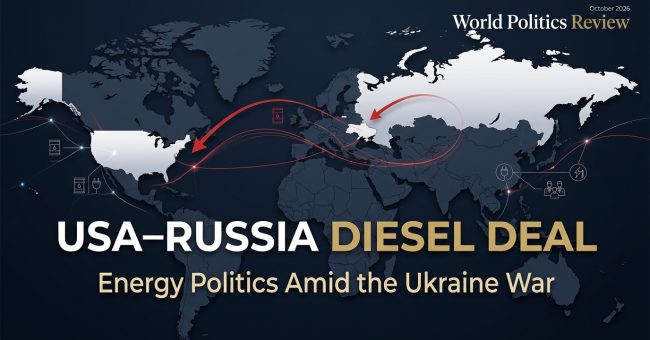
USA–Russia Diesel Deal Amid the Ukraine War
The war between Russia and Ukraine has transformed international security, disrupted energy markets, and intensified competition among major powers. Since Russia launched its full-scale invasion of Ukraine in February 2022, the United States and its allies have used economic sanctions and restrictions on Russian energy exports to increase pressure on Moscow. Energy policy has therefore become an important instrument of the wider geopolitical confrontation.
In October 2026, US President Donald Trump announced an agreement under which Russia would supply diesel fuel to the American and global markets. The announcement represented a significant development in US–Russia relations because Washington had previously restricted Russian energy imports in response to the war. The US administration presented the arrangement as an effort to ease fuel-price pressures, while critics questioned whether renewed Russian fuel sales could weaken sanctions and provide Moscow with additional revenue.
On October 15, the Kremlin said Russian diesel exports had resumed following the announcement. However, the agreement’s full commercial details, long-term effects, and implications for the war remained uncertain. The development has raised an important question: can energy cooperation between Washington and Moscow contribute to diplomatic progress, or will it undermine the international pressure intended to end Russia’s war against Ukraine?
What Is the USA–Russia Diesel Deal?
On October 9, 2026, President Donald Trump announced that Russia had agreed to supply diesel fuel to the American and global markets following a conversation with Russian President Vladimir Putin. Trump described the proposed supplies as a way to help reduce fuel prices.
According to the announcement reported by the Associated Press, the initial supply was expected to exceed 300,000 metric tonnes, followed by additional shipments in November and subsequent months. Trump also announced plans for further supplies, although the precise delivery schedule and the extent to which all proposed volumes would be fulfilled remained uncertain.
The US Treasury Department issued a temporary general licence allowing certain Russian diesel transactions, easing restrictions for eligible supplies. This regulatory step created a legal route for covered transactions, but it did not establish that every announced shipment would be delivered or that a comprehensive, long-term bilateral energy agreement had been concluded.
On October 15, the Kremlin stated that Russian diesel had begun reaching international markets. Shipping data cited by Reuters indicated that a tanker carrying approximately 40,000 metric tonnes of ultra-low-sulphur diesel had departed Russia’s Primorsk port for Morocco.
These developments suggest that the announcement was followed by actual export activity. Nevertheless, the extent of the resulting increase in supply, its effect on prices, and the final destinations of subsequent shipments require continued monitoring.
Why Did the United States Agree to Russian Diesel Supplies?
1. Pressure to Reduce Fuel Prices
Fuel prices influence transportation costs, agricultural production, manufacturing, and household expenses. Diesel is particularly important because it powers freight trucks, agricultural machinery, construction equipment, and many industrial operations.
Higher diesel prices can increase the cost of moving goods throughout the economy. These additional expenses may eventually be reflected in food prices, consumer products, and business operating costs.
The Trump administration presented the Russian diesel arrangement as part of its effort to address high fuel prices. Increasing available supplies could help ease market pressure, especially when other disruptions have reduced refining capacity or constrained international trade.
However, additional Russian supplies do not automatically guarantee lower prices. The effect depends on the volume delivered, the availability of alternative fuels, shipping costs, refinery capacity, and the broader international energy situation.
2. Domestic Political Considerations
Energy prices can become a major political issue in the United States because they affect voters, businesses, and the overall cost of living.
The diesel announcement came ahead of the November 3, 2026, US midterm elections. The administration therefore had an immediate political incentive to demonstrate that it was taking action to address fuel costs.
This timing does not, by itself, prove that domestic politics was the sole reason for the arrangement. Nevertheless, it forms an important part of the political context in which the decision was announced.
3. Diplomatic Engagement With Moscow
Energy policy can also be used as a diplomatic instrument. Washington may calculate that limited economic cooperation could encourage Moscow to engage more seriously in negotiations over Ukraine.
Reuters reported on October 12 that US representatives had presented the diesel arrangement to Ukrainian officials as part of an effort to bring Russia back to negotiations. The reported diplomatic logic was that Washington could offer a limited economic benefit while seeking reciprocal movement from Moscow.
The central uncertainty is whether this approach will produce meaningful concessions. Russia could benefit economically without changing its military objectives, while the United States could find it difficult to reverse the arrangement without creating another diplomatic dispute.
The Connection Between the Diesel Deal and the Russia–Ukraine War
The diesel arrangement cannot be understood simply as a commercial transaction. It is connected to the larger struggle over sanctions, military financing, energy security, and the future of European security.
Since Russia’s full-scale invasion of Ukraine in 2022, the United States and its partners have introduced economic measures intended to restrict Moscow’s access to international finance, technology, and energy revenue. Energy restrictions have been especially significant because petroleum exports are an important source of income for the Russian economy.
The October 2026 announcement introduced a new complication. Washington was attempting to address energy-market pressures while also maintaining pressure on Russia over its military campaign.
The arrangement could serve several purposes from the American perspective: increasing fuel availability, testing a limited form of economic engagement, and potentially creating an incentive for diplomatic negotiations.
From Ukraine’s perspective, however, the concern is that easing restrictions could provide Russia with additional commercial opportunities while the war continues.
The outcome will depend on whether the arrangement remains a limited, temporary measure or becomes part of a broader relaxation of restrictions without corresponding Russian concessions.
Russia’s Strategic and Economic Interests
Additional Opportunities for Energy Revenue
Russia is a major producer of crude oil and petroleum products. International energy exports have remained an important component of its economy, including during the period of Western sanctions.
Renewed diesel exports may offer Russian producers additional opportunities to sell fuel abroad and earn revenue. Even when exports are conducted through international markets rather than directly to American consumers, increased access to buyers can affect Russia’s commercial position.
However, the overall financial benefit should not be exaggerated. The value of any additional exports depends on actual volumes, market prices, transport and insurance costs, and the restrictions that remain in force.
Reopening Export Channels
The arrangement also demonstrates how energy trade can change when governments issue temporary licences or adjust sanctions enforcement.
For Russia, additional export opportunities could help restore some commercial flexibility. For the United States, the decision provides a potential source of fuel while creating a new negotiating issue with Moscow.
The longer-term importance of the arrangement will depend on whether the temporary authorisation expires as planned, is extended, or is replaced by a broader policy framework.
Strategic Leverage
Energy exports can provide economic benefits and diplomatic leverage. Russia may seek to demonstrate that its petroleum products remain important to international markets despite Western restrictions.
At the same time, the United States retains influence through sanctions, financial regulations, access to markets, and its relationships with European and other international partners.
Neither side can guarantee that energy cooperation will translate into progress on the central political questions surrounding Ukraine.
Ukraine’s Response and Concerns
Ukraine has opposed measures that could strengthen Russia’s ability to finance its war effort. President Volodymyr Zelensky criticised the diesel announcement, arguing that sanctions relief without meaningful de-escalation would benefit Moscow without guaranteeing peace.
Kyiv’s position reflects a broader concern: economic benefits provided to Russia while fighting continues could weaken the incentive to negotiate seriously.
Ukraine also faces a difficult strategic balance. It depends on international assistance and security cooperation while seeking to defend its territory and maintain pressure on Russian military capabilities.
The diesel arrangement has therefore introduced another point of tension between Washington and Kyiv. Even if the United States continues providing military and intelligence support, disagreements over sanctions and energy policy can complicate coordination.
On October 13, Trump said the United States was still sharing intelligence with Ukraine and working with both Kyiv and Moscow toward ending the war. His comments indicated that the diesel arrangement had not, by itself, ended American cooperation with Ukraine.
The fundamental question remains whether any economic accommodation with Russia will be accompanied by measurable steps toward ending hostilities.
The Impact on US–Russia Relations
Relations between Washington and Moscow have been shaped by the Ukraine war, sanctions, military competition, and disagreements over European security. The diesel arrangement introduces a limited area of economic cooperation into this difficult relationship.
A Possible Opening for Diplomacy
Supporters of engagement may argue that diplomacy sometimes requires carefully managed economic incentives. If a limited relaxation of restrictions helps bring Russia into substantive negotiations, the arrangement could become one element of a wider diplomatic strategy.
For such a strategy to succeed, however, commercial benefits would need to be linked to clear and verifiable expectations. These might include a sustained reduction in attacks, an agreed process for negotiations, or progress toward a credible ceasefire.
The Risk of Conflicting Signals
The arrangement also creates a potential contradiction in US policy. Washington has used economic pressure to raise the cost of Russia’s invasion, yet the diesel announcement allows certain Russian fuel transactions to proceed.
Moscow may interpret this as evidence that energy-market pressures can lead Washington to soften restrictions. Ukraine and other partners may interpret it as a weakening of the common sanctions strategy.
The diplomatic significance will therefore depend not only on fuel shipments but also on the conditions attached to the policy and the actions Russia takes in response.
Limited Trust Between the Two Governments
A commercial arrangement cannot resolve the fundamental disagreements behind the war. Territorial claims, security guarantees, military deployments, and Ukraine’s future relationship with European institutions remain major obstacles to a settlement.
The diesel deal may create an additional channel for engagement, but it cannot substitute for negotiations addressing these underlying disputes.
Implications for Global Energy Markets
The global impact of the agreement will depend on how much additional diesel reaches the market and whether the supplies represent genuinely new production or are redirected from existing customers.
Could Diesel Prices Fall?
Increased supply can place downward pressure on prices when demand remains unchanged. Yet the effect of the Russian arrangement may be limited if the additional volumes are small compared with total global consumption or if other disruptions continue.
Reuters reported on October 15 that Russian diesel exports had resumed, but the Kremlin acknowledged that the supplies alone would not be sufficient to stabilise oil markets fully.
The distinction between crude oil and diesel is also important. Crude oil must be refined into usable products, and a shortage of refinery capacity can constrain diesel availability even when crude oil is accessible.
Consequently, the price of diesel depends on refining capacity, product inventories, transport costs, demand, and the availability of competing suppliers—not simply on the volume of crude oil produced.
Effects on Businesses and Consumers
If the arrangement contributes to lower diesel prices, transport companies, farmers, construction firms, and other fuel-intensive businesses could benefit.
Lower operating costs may reduce inflationary pressure, although the extent to which savings reach consumers depends on competition and wider economic conditions.
Conversely, if the additional supplies are insufficient to change market conditions, consumers may see little immediate benefit while the diplomatic controversy continues.
Competition Among Energy Suppliers
Russian fuel entering international markets may also change trade patterns. Buyers that obtain additional supplies from Russia may reduce purchases elsewhere, encouraging other producers to adjust their prices or redirect shipments.
This means that the effect of the arrangement cannot be measured solely by the destination of Russian diesel. The wider consequences depend on how international suppliers and buyers respond.
The Sanctions Debate: Economic Relief or Strategic Mistake?
Sanctions are intended to impose economic costs on Russia and constrain its ability to sustain the war. Relaxing restrictions on selected petroleum transactions raises questions about the effectiveness and consistency of that strategy.
Supporters of the arrangement may argue that temporary flexibility is justified when fuel shortages and high prices create significant economic pressure. They may also contend that limited economic incentives can support diplomatic efforts.
Critics argue that allowing Russian petroleum products to reach international markets can generate revenue for Moscow without guaranteeing a reduction in military activity. They also warn that repeated exceptions could make sanctions less predictable and weaken confidence among allies.
The legal details matter. A temporary general licence is not the same as the permanent removal of all sanctions against Russia. Its scope, eligibility conditions, duration, and treatment of particular transactions determine what is actually permitted.
A serious assessment must therefore distinguish between the political announcement, the legal authorisation, the transactions that take place, and the consequences for Russia’s revenue.
The most important test is whether any economic benefit is matched by concrete and verifiable diplomatic progress.
The European Dimension
European governments have played a central role in supporting Ukraine and restricting Russian energy revenue. The diesel arrangement could create further debate among allies over how to balance energy security with pressure on Moscow.
European countries face their own energy challenges, and their policies are not identical. Nevertheless, changes in US sanctions policy can influence the broader international effort to limit Russia’s economic resources.
If Washington and European capitals adopt conflicting approaches, Russia could gain additional opportunities to redirect trade and exploit differences among its opponents.
On the other hand, close coordination over the terms of any temporary exemption could reduce uncertainty and help preserve a common diplomatic strategy.
The issue is therefore larger than a single fuel transaction: it concerns the ability of the United States and Europe to maintain a coherent approach toward Russia while responding to economic pressures.
Could the Diesel Deal Help End the Ukraine War?
The agreement may create an opportunity for diplomatic engagement, but there is no guarantee that it will produce peace.
Energy cooperation can help establish communication between governments and provide a limited incentive for further talks. However, durable conflict resolution requires agreement on far more difficult questions, including security guarantees, territorial disputes, military activity, and arrangements for monitoring a ceasefire.
The announcement also coincided with discussion of a possible halt to attacks on energy infrastructure. As of the reports available by October 15, the parties had not established a clearly verified, durable energy ceasefire. Reuters reported that Russia continued to export diesel after the arrangement, while questions remained about whether the wider diplomatic effort would produce reciprocal steps.
For the deal to contribute meaningfully to peace, several conditions would be important:
- Verifiable reciprocity: Economic concessions should be accompanied by observable steps toward de-escalation.
- Clear conditions: The scope and duration of sanctions relief should be transparent.
- Coordination with Ukraine: Decisions affecting Ukraine’s security should take account of Ukrainian participation in negotiations.
- International cooperation: The United States and European partners should communicate clearly about their respective policies.
- A credible diplomatic process: Any energy-related agreement should support broader negotiations rather than replace them.
Without these conditions, the arrangement could remain a temporary commercial measure with limited influence on the war.
Future Scenarios: What Happens Next?
Three broad scenarios illustrate the possible direction of the agreement.
Scenario 1: Limited Energy Cooperation
The temporary authorisation remains limited, Russian diesel reaches international buyers, and the arrangement has only a modest effect on market prices. The war continues, and diplomatic progress remains uncertain.
This scenario would mean that the deal produces a commercial outcome without fundamentally changing the geopolitical situation.
Scenario 2: Energy Cooperation Supports Negotiations
The United States uses the arrangement as part of a wider diplomatic effort, and Russia responds with verifiable steps toward de-escalation. Talks develop into a more structured process involving Ukraine and relevant international partners.
This would give the deal greater strategic significance, although a lasting settlement would still require agreement on the underlying causes of the conflict.
Scenario 3: Sanctions Disputes Deepen
The arrangement generates additional revenue for Russia but produces little diplomatic progress. Ukraine and some US lawmakers continue to oppose the policy, while disagreements between Washington and its allies become more pronounced.
In this scenario, the commercial benefits would be accompanied by greater political friction and reduced confidence in the sanctions strategy.
These are analytical possibilities, not predictions. Which direction emerges will depend on actual shipments, sanctions implementation, international fuel-market conditions, and developments on the battlefield and at the negotiating table.
Official Sources
- US Department of the Treasury — Russia-related sanctions — for official sanctions guidance and regulatory updates.
- US Energy Information Administration — for US petroleum imports, diesel consumption, fuel prices and energy-market statistics.
- International Energy Agency — for global energy-market analysis and oil-product trends.
- Reuters — Russian diesel exports resume, October 15, 2026 — for reported export developments.
- Associated Press — Trump announces Russian diesel arrangement — for the initial announcement and its political context.
- Reuters — US diplomatic objectives and the diesel deal — for reporting on the proposed connection between energy cooperation and negotiations.
