

Israel–Palestine Conflict 1948–2025: From Colonial Settlements to Ceasefire Struggles
Introduction: Why This Conflict Still Shapes Global Politics
The Israel–Palestine conflict stands as one of the most enduring, emotionally charged, and geopolitically sensitive issues of the modern world. What began as competing nationalisms in a small patch of land has evolved into a full-blown international concern involving wars, displacements, peace deals, broken ceasefires, and ideological divides across continents.
This article traces the origins of the conflict before 1948, continues through the creation of the state of Israel, major wars and peace efforts, and leads up to the latest developments in 2025.
Chapter 1: Pre-1948 – The Roots of the Conflict
Early Jewish settlements to Palestine
Jewish immigration to Palestine began intensifying in the late 19th century, primarily driven by the rise of Zionism—a nationalist and political movement founded by Theodor Herzl that advocated for the establishment of a Jewish homeland in the historic Land of Israel. This migration was also fueled by growing antisemitism in Eastern Europe, particularly in Russia and Poland, where Jews faced violent pogroms and systemic discrimination.
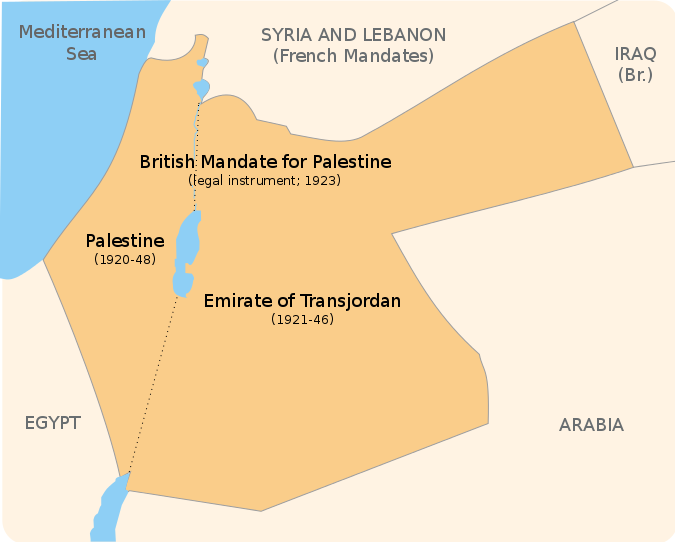
The first major wave, known as the First Aliyah (1882–1903), saw thousands of Jews—mainly from Eastern Europe and Yemen—settle in Palestine, which was then part of the Ottoman Empire. These early settlers established agricultural communities such as Petah Tikva and Rishon LeZion. After World War I, Britain took control of Palestine under the League of Nations Mandate, and the Balfour Declaration (1917)—in which Britain expressed support for a Jewish national home—further encouraged Jewish immigration in the following decades.
Balfour Declaration (1917)
In November 1917, during World War I, the British government issued the Balfour Declaration, a statement of support for the creation of a “national home for the Jewish people” in Palestine. The declaration was delivered in a letter from Foreign Secretary Arthur Balfour to Lord Rothschild, a leader of the British Jewish community. It became a cornerstone of British policy in the Middle East.
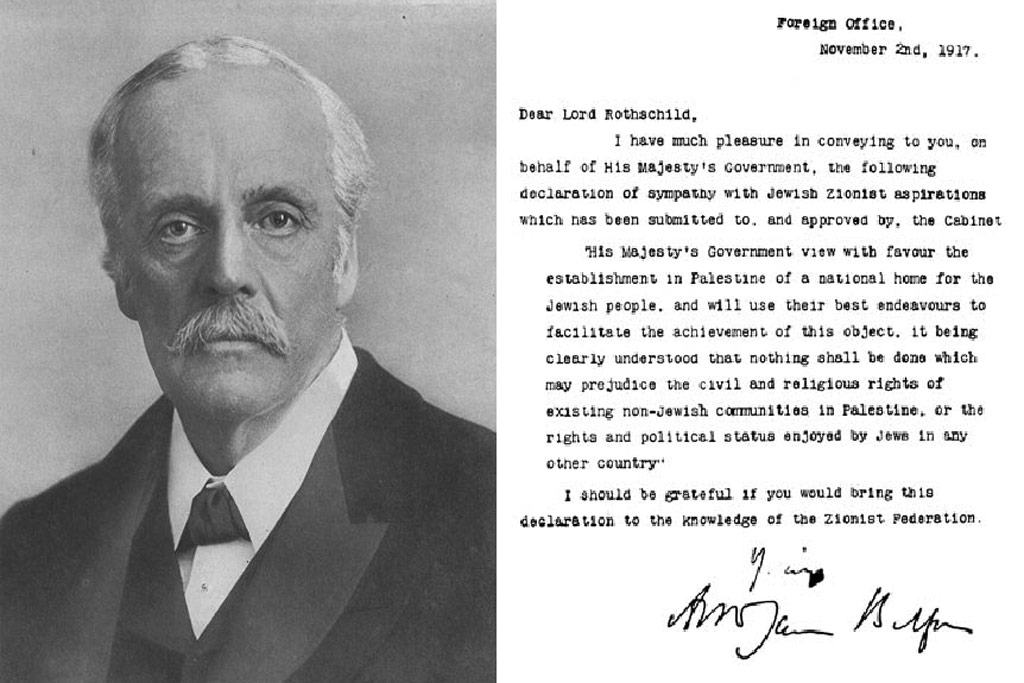
However, the declaration was controversial. At the time, Palestine’s population was approximately 90% Arab Muslims and Christians, who were neither consulted nor informed about the policy. The Arabs viewed the declaration as a betrayal, especially since Britain had earlier promised independence to Arab leaders in exchange for their support against the Ottoman Empire during the war (e.g., McMahon-Hussein Correspondence).
This declaration sowed the seeds of the Arab-Jewish conflict and was later incorporated into the League of Nations Mandate for Palestine in 1922, legitimizing Jewish immigration under British rule.
British Mandate and Jewish Settlements (1920–1947)
Under the League of Nations Mandate for Palestine, formalized in 1922, Britain assumed responsibility for implementing the Balfour Declaration. Article 6 of the mandate explicitly required the Mandatory authorities to facilitate Jewish immigration and land settlement, while safeguarding the rights of other communities
The World Zionist Organization (WZO) served as the international political and organizational engine: it founded institutions like Keren Hayesod, the Jewish Colonial Trust, and the Jewish National Fund (JNF) to channel funds, purchase land, and establish infrastructure in Palestine. In 1929, the WZO’s local branch was formally recognized as the Jewish Agency, coordinating settlement, education, and welfare under British supervision.
The JNF played a central role: by the late 1930s it had acquired around 155,000 hectares, and by 1948, JNF-owned land constituted over half of land held by Jews in Palestine (about 936,000 dunams). These lands were typically leased to Jewish settlers, and remained under strict Jewish control.
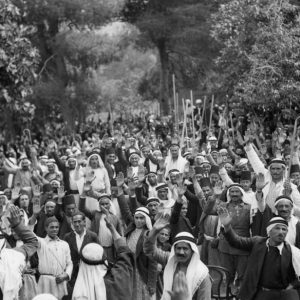
British administrative policies often supported Zionist objectives, granting concessions for Jewish economic ventures—such as electricity, mining, and education—despite increasing Arab resistance, including riots and revolts in the 1920s and 1930s, most notably the Arab Revolt of 1936–39 and the 1920 and 1929 intercommunal violence
Arab Revolts and Tensions (1936–1939)
From 1936 to 1939, Palestinian Arabs launched what became known as the Great Arab Revolt—a three-year uprising against British colonial rule, mass Jewish immigration, and land acquisitions. It began with a general strike and economic boycott in April 1936, organized by the Arab Higher Committee under Jerusalem’s Grand Mufti Haj Amin al‑Husseini, demanding an end to land sales to Jews and Jewish immigration.
The revolt expanded into guerrilla warfare by rural Arab factions, marked by ambushes, bombings, and attacks on both British forces and Jewish communities. In response, Britain imposed martial law, deployed 20,000 troops, and supported Zionist militias like Haganah and special units led by Orde Wingate to suppress the rebellion.

Approximately 5,000 Palestinian Arabs were killed, 15,000 wounded, and 5,600 detained or exiled; Jewish fatalities numbered around 415. In 1939, Britain issued the White Paper, severely restricting Jewish immigration and land sales in policy shift designed to placate Arab demands—even as it alarmed Zionist leadership
Chapter 2: 1948 – Birth of Israel and the First Arab-Israeli War
UN Partition Plan (1947)
On 29 November 1947, the United Nations General Assembly adopted Resolution 181 (II), proposing the partition of British Mandate Palestine into separate Jewish and Arab states, with Jerusalem designated as an international corpus separatum under UN administration. The UN Special Committee on Palestine (UNSCOP) drafted the proposal, which allotted 56.5% of the land to a Jewish state, 42.9% to an Arab state, and 0.6% (Jerusalem and surroundings) under UN trusteeship.
Jewish leaders accepted the plan—though some viewed it as a tactical step toward future expansion—while the Arab leadership rejected it outright, objecting to the demographic and territorial allocation despite being the majority population at the time The resolution planned for British withdrawal by August 1948, marking the end of the Mandate and triggering civil conflict between the communities during the interim.
Creation of Israel – May 14, 1948
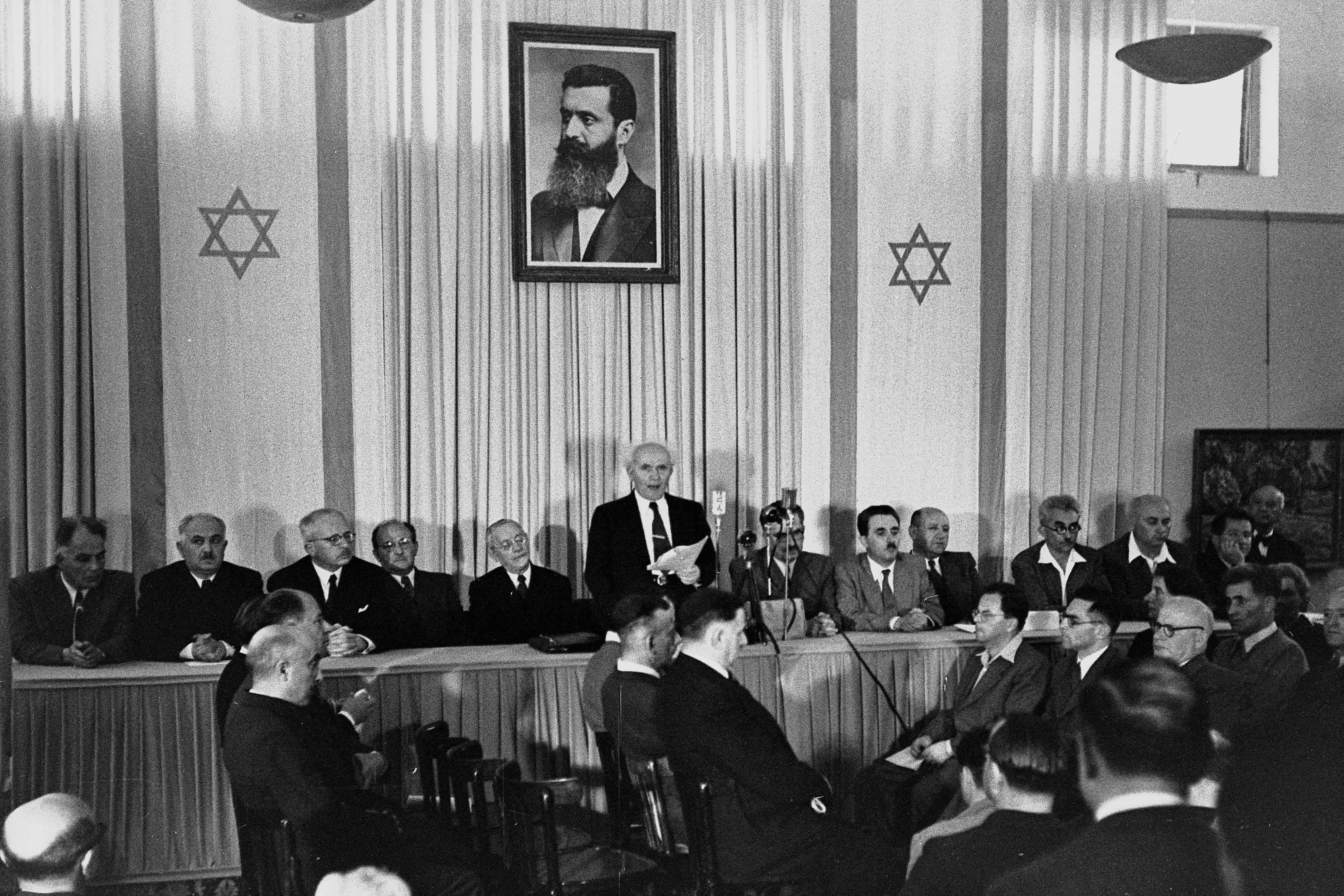
On 14 May 1948, David Ben‑Gurion, head of the Jewish Agency, formally declared the establishment of the State of Israel in Tel Aviv, at the conclusion of the British Mandate. His proclamation, read in the Tel Aviv Museum Hall beneath a portrait of Theodor Herzl, marked the official birth of Israel. Within hours, the United States and the Soviet Union extended formal recognition, granting diplomatic legitimacy to the new state.
Almost immediately, five neighboring Arab states – Egypt, Jordan, Syria, Lebanon, and Iraq – invaded, rejecting the UN Partition Plan and launching coordinated attacks from multiple fronts to prevent the creation of Israel. The ensuing conflict, known as the 1948 Arab–Israeli War or War of Independence, would continue into 1949, resulting in armistice agreements and substantial demographic and territorial changes.
Nakba (The Catastrophe)
During and after the 1948 War, over 700,000 Palestinians—about 80% of the Arab population in Mandatory Palestine—were displaced or expelled from their homes, many permanently becoming refugees in surrounding countries. Around 531 Palestinian villages and towns were destroyed, while a total of 774 were seized, fundamentally altering the demographic landscape. This mass displacement gave rise to one of the world’s longest-running refugee crises; today millions of Palestinians descend from those displaced in 1948.
Chapter 3: 1967 Six-Day War and Occupation
In June 1967, tensions between Israel and neighboring Arab countries escalated into a full-scale war, known as the Six-Day War. In just six days, Israel launched a preemptive strike and decisively defeated the combined forces of Egypt, Jordan, and Syria. As a result, Israel captured vast territories:
-
West Bank and East Jerusalem from Jordan
-
Gaza Strip and Sinai Peninsula from Egypt
-
Golan Heights from Syria
This territorial expansion more than tripled Israel’s size and placed over one million Palestinians under Israeli military occupation, particularly in the West Bank and Gaza.
The war had significant geopolitical implications. The capture of East Jerusalem gave Israel control over the entire city, which it later annexed, although the international community has not recognized this move. The occupation of the West Bank and Gaza became the focal point of the Israeli-Palestinian conflict, leading to decades of military control, settlement construction, and unrest.
In response to the conflict, the United Nations Security Council passed Resolution 242, which called for the “withdrawal of Israeli armed forces from territories occupied in the recent conflict” and the recognition of every state’s right to live in peace within secure and recognized boundaries. However, disputes over the interpretation and implementation of this resolution have persisted, and it remains a cornerstone of peace negotiations to this day.

The Six-Day War not only redrew the map of the Middle East but also solidified Israel’s role as a dominant military power in the region, while deepening the Palestinian struggle for statehood and self-determination.
Chapter 4: 1987–1993 – The First Intifada
The First Intifada—from December 9, 1987, to September 1993—was a grassroots uprising by Palestinians in the West Bank, Gaza Strip, and East Jerusalem against Israeli military occupation. Sparked by a fatal traffic collision in the Jabalia refugee camp, Palestinians launched waves of civil disobedience, including stone-throwing, street protests, tax strikes, business boycotts, and graffiti laden with political slogans. This marked a shift from armed resistance to mass civilian mobilization, led by local committees (UNLU) rather than remote PLO leadership.
Israeli authorities responded with curfews, mass arrests, house demolitions, and a controversial policy reportedly aimed at “breaking the bones” of protesters. Fatalities exceeded 1,100 Palestinians—including around 250 children—and about 200 Israelis died in related violence. Over 120,000 Palestinians were arrested, 2,500 homes destroyed, and tens of thousands suffered injuries from beatings, shootings, tear gas, and torture allegations. Human rights organizations documented extensive abuses, drawing global condemnation.
Despite suppression, the movement created international awareness of the Palestinian plight and significantly shifted regional politics. In 1988, the PLO proclaimed the State of Palestine, recognized UN resolutions 242 and 338, and formally accepted Israel’s right to exist. This marked a historic political transition enabling later negotiations.
This pressure culminated in the 1991 Madrid Peace Conference, paving the way for secret Oslo negotiations in 1993, led by Israeli and Palestinian officials under Norwegian mediation. On 13 September 1993, the Declaration of Principles (Oslo I) was signed in Washington, D.C., establishing mutual recognition between Israel and the PLO and creating the Palestinian Authority, tasked with interim self-governance in parts of the West Bank and Gaza.
Though envisioned as a transitional framework lasting up to five years, the Oslo process failed to deliver a permanent peace. Key issues—Jerusalem, refugees, settlements, borders—remained unresolved. The assassination of Israeli Prime Minister Yitzhak Rabin in 1995 further derailed progress. Distrust, ongoing settlement expansion, and sporadic violence continued to undermine the hopes sparked by Oslo.
Chapter 5: 1993–2000 – Oslo Peace Process
The Oslo Accords—beginning with the Declaration of Principles (Oslo I) signed in September 1993—marked an historic breakthrough. For the first time, Israel recognized the PLO as the legitimate representative of the Palestinian people, and the PLO acknowledged Israel’s right to exist and renounced terrorism. These agreements paved the way for the creation of the Palestinian Authority (PA), granting limited self-rule in parts of the West Bank and Gaza Strip under phased redeployments.
Under Oslo II (1995), the West Bank was divided into Areas A (full PA control), B (civil only), and C (Israeli control). Israel retained control over nearly 60% of the territory—including settlements and strategic roads—leaving less than 20% under PA jurisdiction, where the majority of Palestinians live.
Settlement expansion accelerated despite Oslo’s spirit, growing from about 116,000 settlers in 1993 to over 372,000 by 2000. This expansion undermined trust and Palestinian hopes for a viable contiguous state.
Critical issues—final borders, Jerusalem’s status, refugees, security arrangements, and settlements—were deferred to final status talks, meant to conclude by 1999. Those negotiations never produced an agreement. The assassination of Prime Minister Yitzhak Rabin in 1995 further derailed progress, propelling Benjamin Netanyahu into power—who opposed key Oslo components and continued settlement growth.
By 2000, mutual distrust had deepened. Israel’s firm control over Area C and military checkpoints, combined with continued violence and Palestinian disenchantment, led to the collapse of negotiations at Camp David and triggered the Second Intifada, signaling the formal end of the Oslo process.
Though the PA and some cooperative institutions remain, Oslo failed to deliver a sovereign Palestinian state or a lasting peace, and became instead a framework of unresolved interim realities.
Chapter 6: 2000–2005 – The Second Intifada
The Second Intifada, or Al‑Aqsa Intifada, began on 28 September 2000, following Ariel Sharon’s controversial visit to the Al‑Aqsa Mosque compound accompanied by Israeli security forces. The visit triggered widespread protests and clashes across East Jerusalem, West Bank, and Gaza.
Violence quickly escalated. Palestinian militants carried out approximately 138 suicide bombings and other attacks targeting Israeli civilians. Notable incidents included the Passover Massacre (Netanya, 2002), which killed 30. Israel responded with Operation Defensive Shield (March–May 2002), reoccupying key West Bank areas, re‑instituting checkpoints and conducting targeted assassinations.
By the end of the uprising in 2005, around 4,300 Palestinians and approximately 1,000 Israelis had been killed. Of the Israeli fatalities, some 78% were civilians. Palestinian casualties included both combatants and civilians, with B’Tselem estimating around 3,000 noncombatants, including minors. Israeli forces fired over 1 million rounds in the early stages alone.
One of the Intifada’s most visible consequences was the construction of the Israeli separation barrier beginning in 2002. Roughly 85% of it lies within the West Bank, restricting movement for Palestinians, though Israeli and Palestinian experts agree the barrier drastically reduced suicide attacks.
In Gaza, militant groups—Hamas’s Al‑Aqsa Martyrs’ Brigades, Islamic Jihad, and Fatah factional forces—increased rocket fire and coordinated attacks, intensifying Israeli military interventions.
The uprising significantly weakened the Palestinian Authority, exposed internal Fatah-Hamas divisions, and hardened Israeli public opinion in favor of stringent security policies. Oslo’s peace framework collapsed. While the Sharm el-Sheikh Summit in February 2005 formally ended hostilities, trust remained shattered and the political stalemate persisted.
Chapter 7: Gaza Wars and Humanitarian Crises (2008–2021)
Between 2008 and 2021, Gaza was repeatedly engulfed in major conflicts—Operation Cast Lead (2008–09), Operation Pillar of Defense (2012), Operation Protective Edge (2014), and the May 2021 Gaza war sparked by tensions in Sheikh Jarrah, Al‑Aqsa, and escalations by Hamas rocket fire.

Operation Cast Lead (December 2008–January 2009) killed about 1,385 to 1,419 Palestinians—most civilians, including over 300 children—and 13 Israelis (including civilians). Over 3,540 housing units were destroyed, and another 2,870 severely damaged, leaving more than 20,000 Gazans homeless. Critical infrastructure—factories, workshops, water pipes, reservoirs, UNRWA facilities, and schools—was extensively damaged, resulting in monumental economic loss and disrupted services.
Operation Pillar of Defense (2012) was shorter—around eight days—but intensified international criticism. Rocket-fire from Gaza triggered Israeli airstrikes, and civilian casualties and distrust soared.
Operation Protective Edge (2014) extended over weeks and had a high toll: UN reported heavy bombardment, acute civilian suffering, and destruction of homes, schools, hospitals, and mosques. At least 479 Palestinians, including many children, were killed in the early days. Israel struck over 860 targets in three days alone, raising global humanitarian concern.
In the May 2021 Gaza war, triggered by confrontations in Sheikh Jarrah and Al‑Aqsa, clashes escalated into rocket barrages by Hamas and retaliatory Israeli airstrikes. Thousands of Palestinians were killed or injured; Gaza’s infrastructure suffered widespread devastation.
Chapter 8: 2023–2025 – Recent Escalations & Failed Peace Efforts
On 7 October 2023, Hamas carried out a devastating cross‑border assault known as Operation Al‑Aqsa Flood, launching over 3,000 rockets into southern Israel. Roughly 1,200 people were killed, including at least 735 Israeli civilians, 379 security officials, and 79 foreign nationals, making it the deadliest attack in Israel’s history. Over 3,000 militants infiltrated via vehicles, motorcycles, paragliders, and breaches at Gaza’s fence. Attackers targeted kibbutzim, a music festival near Re’im, and civilian settlements, resulting in mass casualties, hostage-taking, and widespread terror. Hamas abducted about 251 hostages, including children; over 140 have since been released or rescued, 57 confirmed killed, and around 49 remain captive—some shown injured or starved in propaganda videos.
In response, Israel declared war on Hamas and launched an escalation in Gaza, implementing a complete siege, ground invasion, and aerial bombardment. By mid‑2025, Palestinian death toll estimates ranged from 60,000 to over 60,000, with over 1 million displaced, and extensive civilian suffering from hunger, blocked aid, and destruction of infrastructure. Gaza’s ministry reported 60,034 killed; independent reports placed fatalities between 37,000–60,000+, many women and children among them. Intense urban combat and Israeli tactics spurred allegations of violations. Former Israeli military leaders criticized the campaign as disproportionate. The International Criminal Court issued arrest warrants for Hamas and local Israeli leaders for war crimes including civilian targeting and starvation policies.
Global reactions were sharply divided. Massive protests erupted worldwide calling for a ceasefire and humanitarian access. The Arab League and OIC nations condemned Israeli strikes and blockade of Gaza, while Western powers—notably the US, UK, EU—recognized Israel’s right to self-defence but urged restraint. Some Arab leaders for the first time condemned Hamas and called for its disarmament and release of hostages. A France–Saudi–EU initiative emerged, proposing a demilitarized Gaza governed by the PA under international supervision.
The UN General Assembly passed a non-binding resolution in October 2023 calling for an immediate ceasefire; 121 countries voted in favour. Major heads of state—from Pakistan, Venezuela, China, Egypt, Saudi Arabia, Jordan, and others—publicly called for urgent humanitarian pauses and a political solution.
Peace efforts faltered. Ceasefire negotiations, prisoner‑swap talks, and mediated pauses collapsed under mutual mistrust and political pressure. Israel’s leadership debated full reoccupation of Gaza, though military advisors cautioned against it. Conditions in Gaza deteriorated: 180 deaths from starvation since mid‑2025, aid delivery bottlenecks, deadly attacks near distribution centres, and insufficient healthcare and sanitation led to mounting deaths from hunger and disease.
By 2025, Gaza’s infrastructure lay in ruins—nearly all housing, schools, hospitals, roads, utilities destroyed—and reconstruction remained stalled due to political stalemate. Despite global scrutiny, no sustainable peace agreement emerged. The conflict entrenched division, deepened mistrust, and made a negotiated two-state solution increasingly elusive.
Ceasefire Deals and Collapses
In the wake of the 2023 Hamas-Israel war, several temporary ceasefire agreements were brokered to de-escalate violence, facilitate humanitarian aid, and secure hostage exchanges. Notably, a brief truce in late 2023 allowed for the release of dozens of Israeli hostages in exchange for Palestinian prisoners, and enabled limited humanitarian aid to enter the besieged Gaza Strip, where food, medicine, and fuel were in short supply. However, these ceasefires were short-lived, often violated within days due to renewed airstrikes, rocket attacks, or failed commitments from both sides.
Mediation efforts led by Egypt (Cairo talks) and Qatar (Doha talks) attempted to secure a more durable truce, but deep-rooted mistrust, continued military operations, and conflicting demands—such as the lifting of Israel’s blockade or Hamas’s disarmament—led to the collapse of negotiations. The repeated breakdown of ceasefire talks reflects the broader challenge of achieving a sustainable political resolution to the Israel-Palestine conflict.
Two‑State Solution: Still a Possibility?
The concept of a two‑state solution—Israel and Palestine living side by side in secure, recognized borders—is still formally endorsed by most international organizations, including the United Nations, European Union, Arab League, OIC, and dozens of nations. In September 2024, around 90 states launched the Global Alliance for the Implementation of the Two‑State Solution under the patronage of the EU, Norway, Saudi Arabia, and others. At a 2025 UN General Assembly conference, nearly every nation endorsed the “New York Declaration,” reaffirming the two‑state framework based on the pre‑1967 Green Line. UN Secretary‑General Guterres insisted the two‑state vision remains the only viable path to justice and lasting peace in the region.
However, the idea faces mounting obstacles:
1. Settlements in the West Bank
Today, about 700,000 Israeli settlers live in the West Bank and East Jerusalem, alongside roughly three million Palestinians. Settlements, especially contiguous clusters, fragment Palestinian territory and undermine contiguity. Analysts estimate Israeli-controlled areas—including settlements, roads, and closed military zones—now cover around 60% of the West Bank, leaving little room for a viable Palestinian state.
2. Status of Jerusalem
Jerusalem remains one of the most contentious issues. While Palestinians claim East Jerusalem—occupied in 1967—as their capital, Israel insists on recognizing unified Jerusalem as its undivided capital. The UN maintains Jerusalem should remain a corpus separatum under international administration, as outlined in multiple UN resolutions (including 181, 194, and 478)—a status Israel rejects Wikipedia. This disagreement over sovereignty erodes trust and complicates negotiations.
3. Security Concerns
Israel cites security imperatives, demanding demilitarization of any future Palestinian state and retaining the ability to respond to threats. Hamas’s ongoing presence in Gaza and the West Bank division fuels Israeli fears. Meanwhile, Palestinians demand security guarantees and freedom from occupation. These mutually conflicting requirements stall compromise.
4. Palestinian Political Divisions
Since 2007, Palestinians remain fragmented between Fatah (in the West Bank) and Hamas (in Gaza). Although the Beijing Declaration of 2024 proclaimed reconciliation between nearly a dozen factions—including Fatah and Hamas—implementation remains weak. The political division undermines the Palestinian negotiating position and international perception of a viable, unified state partner.
5. Stalled Recognition and Diplomatic Dynamics
As of early 2025, 147 UN member states formally recognized Palestine—but the United States continues to block full UN membership, vetoing resolutions in the Security Council. At the same time, countries like France, Canada, and the UK have pledged conditional recognition of Palestinian statehood by September 2025 if certain conditions are met.
Despite internal skepticism—especially within Israel, where current political leadership largely opposes the framework—the international consensus remains firm. In May 2025, UN envoy Sigrid Kaag warned that the two‑state solution is “on life support,” calling for urgent collective action to revive it through political will, diplomatic pressure, and concrete implementation strategies.
Meanwhile, conferences such as the July 2025 UN‑hosted gathering in New York laid groundwork for a phased 15‑month plan toward a Palestinian state, with conditional recognition timelines from France, Saudi Arabia, Malta, Canada, and the UK.
United Nations & Arab League: Divided But Active
United Nations
The United Nations, especially through the General Assembly and Security Council, has consistently issued resolutions calling for Israel’s withdrawal from territories occupied since 1967, including the West Bank, East Jerusalem, Gaza, and the Golan Heights. For instance, UNGA Resolution 58/292 (2004) reaffirmed that these areas remain under military occupation and affirmed the right of Palestinians to self-determination and sovereignty within pre‑1967 borders.
Similarly, UNSC Resolution 446 (1979) declared Israeli settlements in occupied Arab territories to have “no legal validity” and to be a serious obstacle to peace. These positions were reinforced by SC Res. 452 (1979) and SC Res. 2334 (2016), which explicitly condemned settlement expansion and reiterated that any changes to pre‑1967 lines are invalid unless mutually agreed upon.
In September 2024, the UN General Assembly passed a non-binding resolution demanding Israel end its occupation within a year, receiving overwhelming support—124 countries voted in favor, despite opposition from key Western nations. Furthermore, assemblies have repeatedly called for an advisory opinion from the International Court of Justice on the legality of the occupation and settlement activities.
While supportive in rhetoric, UN resolutions lack enforceability, limiting the body’s ability to compel compliance. Nonetheless, these resolutions shape international norms and provide a legal framework supporting the two-state solution and Palestinian rights.
Arab League
The Arab League has consistently condemned Israeli occupation and settlement activity, particularly through endorsements of the Arab Peace Initiative (2002, reaffirmed 2007), which proposed full Israeli withdrawal to 1967 lines in exchange for normalized relations with all Arab states.
However, despite repeated statements, the League has rarely moved beyond diplomatic declarations. Internal divisions—over national interests, normalization ties, and divergent views on Hamas—have weakened its political impact. For example, during an emergency Gaza reconstruction summit in 2025, major actors like Saudi Arabia and the UAE abstained, reflecting deep disagreement and the League’s limited cohesion.
In a notable shift after October 2023, all 22 Arab League members condemned Hamas’s October 7 attack, and collectively issued a declaration, along with other international partners, calling for Hamas to disarm and the Palestinian Authority to resume governance of Gaza—a historic moment of unity among Arab states.
Yet overall, the League remains reactive rather than proactive—issuing strong condemnations but lacking coordinated sanctions, peace enforcement mechanisms, or unified political action to resolve the conflict.
Current State (2025): A Fragile Ceasefire
By mid‑2025, Gaza remains under a crippling total blockade imposed since October 2023. As of March, Israel halted all entry of food, fuel, medicine, electricity, and humanitarian aid—triggering famine: over 60,000 Palestinians have died, including 122 confirmed starvation deaths, many of them children. Severe malnutrition affects more than 66,000 children under five. Though limited aid deliveries resumed in May through an alternative U.S.- and Israeli-led scheme, the UN continues to reject it as unlawful under humanitarian principles.
In the West Bank, Israeli demolitions, settler violence, and military raids have surged. As of early 2025, more than 1,080 structures have been demolished, displacing over 1,100 Palestinians. House seizures and settler attacks—often backed by Israeli forces—have displaced 40,000 Palestinians in recent months, particularly from refugee camps like Jenin, Tulkarem, and Nur Shams.
Israeli authorities continue expanding settlements and outposts: over 224 unauthorized outposts exist—including 66 established during the Gaza war—and more than 20,000 new housing units are approved. Notably, the controversial E1 settlement plan (3,000+ units east of Jerusalem) has been revived. France, the UK, Canada, and EU condemned these as illegal and lebensraum—undermining any prospect of a West Bank contiguous state.
Jerusalem remains a flashpoint. East Jerusalem’s Palestinian neighborhoods are increasingly isolated by “conflict roads” and encircled by settlement infrastructure. They lack basic services—roads, sewage, garbage collection, parks—exposing stark inequalities even in middle-class areas.
Politically, the ceasefire is fragile. Israel briefly paused hostilities in January, allowing for hostage exchanges and limited aid entry, but resumed full-scale offensive on 18 March 2025. The resumed assault killed over 4,200 Palestinians, displaced more than 632,000, and sealed Gaza under renewed blockade.
Israeli Prime Minister Netanyahu is weighing a full reoccupation of Gaza, reversing the 2005 disengagement. But top security officials—including outgoing IDF Chief Eyal Zamir—resist the move, warning of military entanglement and further international isolation.
Internationally, sympathy and outrage are growing. Parliamentarian recognition of Palestine comes from France, UK, and Canada, increasing pressure on Israel—but diplomatic actions remain symbolic without tangible policy change.
Human rights groups, the UN, and observers warn that unless the siege ends and rebuilding begins, Gaza faces mass atrocity risks. Amnesty International has demanded a permanent ceasefire, lifting of the blockade, and strict accountability for war crimes.
Despite the lull in formal war efforts, no political solution seems near. Settlement expansion continues, Palestinian displacement accelerates, and ceasefire negotiations stall amid mutual mistrust. Without meaningful international enforcement, the ceasefire remains a veneer over escalating occupation, humanitarian crisis, and deepening division.
Humanitarian Crisis in Gaza (2025)
As of 2025, the humanitarian crisis in Gaza has reached catastrophic levels. Following the October 7, 2023, Hamas-led attacks on Israel and the massive Israeli military response, Gaza has been devastated by continuous bombardment, displacement, and total blockade. With over 35,000 Palestinians killed—including thousands of children and women—and more than 75,000 injured, the scale of human suffering is unimaginable.
Israel’s military campaign, aimed at dismantling Hamas infrastructure, has left critical civilian infrastructure in ruins. Hospitals, schools, water plants, and power stations have been either destroyed or severely damaged. The healthcare system has collapsed, with no fuel for generators, a shortage of medicines, and insufficient medical personnel to treat the injured.
More than 1.7 million people—over 70% of Gaza’s population—have been displaced from their homes. Many are living in overcrowded, makeshift shelters or open areas with no access to clean water, electricity, or sanitation. Malnutrition and infectious diseases are spreading rapidly, particularly among children.
The Israeli blockade, tightened since 2023, restricts the entry of food, fuel, and humanitarian aid. Despite temporary ceasefires and international pressure, aid deliveries remain limited and unsafe. UN agencies like UNRWA and the World Food Programme report that Gaza is on the brink of famine.
Global protests and UN resolutions have condemned the disproportionate impact on civilians, but no lasting ceasefire or political breakthrough has occurred. Meanwhile, reconstruction is impossible under blockade conditions.
The psychological toll is also alarming—generations of children face trauma with no access to mental health support or education. Gaza today is not just a war zone; it is a humanitarian catastrophe, with no resolution in sight unless international powers enforce accountability and a long-term political solution.
Conclusion: Is Peace Still Possible by 2030?
The Israel–Palestine conflict, from British-facilitated settlements before 1948 to today’s war-torn Gaza in 2025, shows how colonial decisions, nationalism, religion, and geopolitical interests created a crisis with no easy end. A peaceful future requires more than ceasefires — it needs justice, mutual recognition, and global will.
Read More:Martindox